
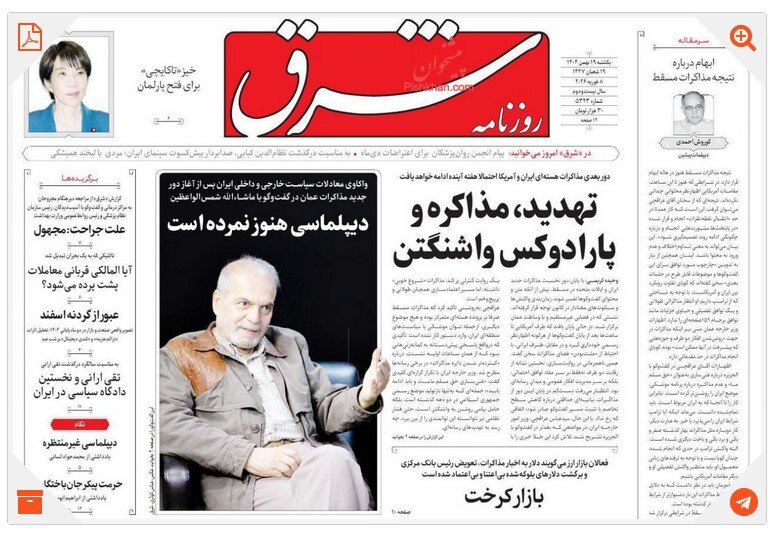
Shargh, in an interview with Seyyed Jalal Sadatiyan, a foreign policy analyst, examined the new round of Tehran–Washington talks held in Muscat on Friday, January 6. According to him, officials of the Islamic Republic of Iran now have enough experience to avoid shocking surprises like the June 12-day war. Even so, the fragile positive atmosphere should not be misread. While preparing for negotiations, the risk of a real war always exists, and there is no guarantee that the process will end through diplomacy.
Sadatiyan argues that to increase the chances of success, the presence of Steve Witkoff (the chief U.S. negotiator) in the next rounds is essential, and Iran should also follow up on the negotiations through Washington. This would help create a balanced and transparent framework between the two sides and prevent misunderstandings or obstruction. Despite the fragility of the current environment, the Oman talks have created an important diplomatic opportunity that could lead to an agreement. From this expert’s perspective, the key to success lies in combining goodwill, readiness for direct action, and tapping diplomatic capacities so that this fragile opportunity can turn into a tangible and lasting outcome.
Etemad: A different kind of diplomacy
Etemad spoke with Mohammad-Javad Haghshenas, a reformist political and cultural figure, about how the new round of Iran–U.S. negotiations differs from previous ones. He says the first session of the new round of the Iran–U.S. talks took place, and based on Araghchi’s statements, if the process continues, it could be used to prepare a framework for an agreement. However, the start of the Muscat negotiations between Iran and the United States—regardless of their final outcome—carries a meaningful message in the regional foreign policy landscape. Choosing Oman as the host once again highlights its traditional role in sensitive and quiet mediation efforts. The Muscat talks began at a time when the Iran–U.S. relations are in one of their most complex and tense phases. There is neither mutual trust nor a clear short-term prospect for a comprehensive agreement. Even so, the very act of dialogue should be seen as a sign of minimal rationality prevailing over maximal confrontation—rationality driven more by necessity than optimism. If the Muscat negotiations are to become more than a symbolic gesture, they require a set of complementary decisions both inside and outside the country.
Khorasan: An understanding to continue the negotiations
Khorasan wrote that the indirect Iran–U.S. talks in Muscat ended neither in an agreement nor in a deadlock. But they did produce one definite outcome: ‘an understanding to continue dialogue to reach a political framework.’ This key point, drawn from the Iranian foreign minister’s official remarks and Omani accounts, shows that neither side is seeking an immediate agreement, nor are they willing to abandon the negotiating table. What happened in Muscat was essentially the consolidation of a dialogue track that had been reactivated after a period of intense military threats from Washington. America’s return to negotiations — after weeks of military rhetoric, deployment of equipment to the region, warnings to its citizens to leave Iran, and the prominent presence of the CENTCOM commander in the talks — carries a contradiction. While Washington continues to speak of military options, it has effectively accepted that without dialogue, it has no way to manage the Iran file. At this point, the language of threat becomes less a tool for action and more a tool for psychological and media pressure. Based on official statements and field indicators, the Muscat talks are a step toward stabilizing the negotiation path.
Javan: Trump’s turn toward diplomacy!
The Javan newspaper wrote about what it describes as Trump’s shift toward diplomacy. According to the paper, after several weeks of threatening language against Iran, and following the indirect Tehran–Washington talks, the U.S. president has spoken of accepting an agreement with Iran limited solely to the nuclear issue. However, in his first reaction, Trump immediately pointed the finger at Iran for the failure to reach a nuclear agreement, claiming that if Iran had previously offered a similar proposal, the White House would have accepted it. The troubled history of U.S. behavior — especially during Donald Trump’s presidency — alongside the initiation of a tariff war against Iran’s trading partners and the anti-Iran statements of the U.S. Treasury Secretary, suggests that Trump has leaned more heavily on economic pressure than on military-security pressure. Iranian officials and the public view Trump’s statement — that he is willing to enter negotiations limited to the nuclear issue and has no demand beyond preventing Iran from acquiring a nuclear weapon — with deep skepticism. The 12-day war stands as the closest and clearest reminder that the words of American officials, especially Trump, cannot be taken at face value.
Disclaimer : This story is auto aggregated by a computer programme and has not been created or edited by DOWNTHENEWS. Publisher: tehrantimes.com



