
MADRID – The concept of a colonial toolbox remains a potent but often under-examined framework for understanding contemporary international discourse. It does not refer to a physical object, but to the enduring repertoire of practices, epistemologies, and governmental rationalities developed by imperial centers to categorize, manage, and ultimately subordinate colonized populations.
Its relevance today complicates any simplistic notion of a post-colonial world order. For much of the non-West, the colonial is not yet past; its logic persists, adapts, and is recycled within the language of modern geopolitics, media, and diplomacy.
This adaptive quality is crucial. The toolbox does not merely repeat; it iterates. A canonical example, articulated by scholar Gayatri Chakravorty Spivak as “white men saving brown women from brown men,” was visible during the 2001 invasion of Afghanistan, framing military intervention as liberation from Islamic oppression. This narrative did not originate in Washington, but echoed moral justifications from earlier imperial projects, such as the British East India Company’s interventions in South Asia. The mechanism is one of recalibration, where old tropes are actualized to serve contemporary strategic ends, creating a continuity between imperial past and hegemonic present.
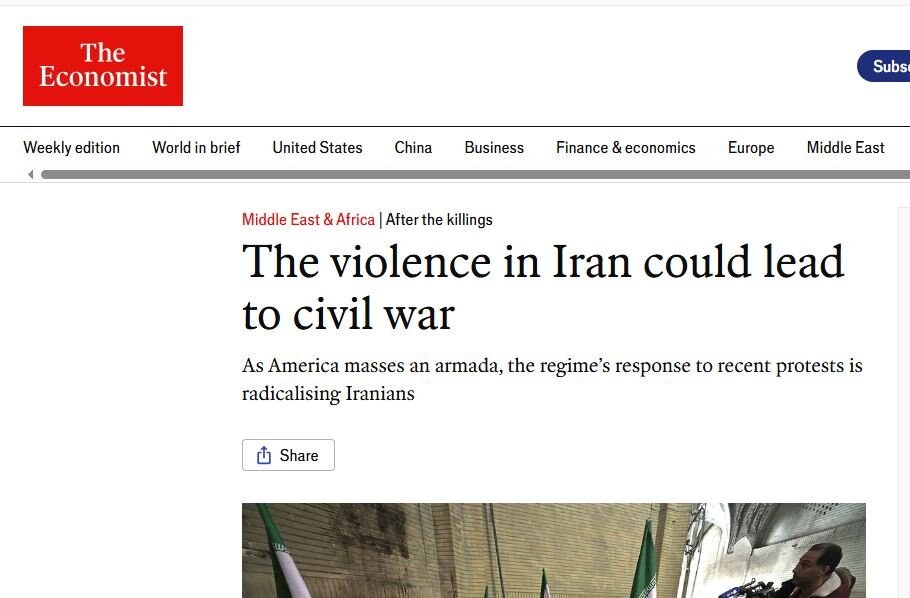
A more recent manifestation can be observed in Western media representations of Iran, such as The Economist’s article titled “The violence in Iran that could lead to a civil war.” The piece constructs Iran as a tragic topography, inherently prone to irrational, cyclical violence. In this framing, violence is rendered ahistorical and apolitical, a raw spectacle of bloodshed. The Iranian populace, both inside the country and abroad, is depicted as trapped in an eternal, chaotic feud, incapable of nuanced political action or self-governance.
This portrayal is a profound delusion. The colonial toolbox does not seek fidelity to truth, but the construction of narrative as truth. While it is wise to remain skeptical of grand narratives, the material consequences of dominant representations are very real. Non-Western societies disproportionately bear these consequences, facing sanctions, isolation, and, in extreme cases, military intervention.
Underlying such analyses is a familiar thesis: left to themselves, the natives will descend into a Hobbesian state of nature, a perpetual war of all against all. By implication, the civilizing presence of the West is necessary, a modern reincarnation of the white man’s burden. It reinstates a binary of modern versus primitive, rational versus irrational, guardian versus ward. This discursive move places Iran in what cultural critic Anne McClintock called “anachronistic time,” a backward realm of atavistic conflict, contrasted against the forward-moving panoptic time of the modern West.
Yet to view this primarily as a story about Iran misses the point. Such narratives reveal more about the West’s unresolved anxieties and its nostalgic attachment to a logic of guardianship. The white man cannot rest, for his imagined charge is eternal. Looking away would, in this imaginary, invite disorder. The narrative functions disciplinarily, justifying not necessarily immediate invasion, though it primes the ground for one, but a regime of constant monitoring, political isolation, and economic pressure. It legitimizes perpetual interventionism as a reluctant duty rather than a strategic choice.
A sober analysis must reject this impoverished narrative. Iran is not a site of political nullity, but of deep political complexity. It is a nation with a sophisticated political culture; a history of robust intellectual and theological debate; and a populace continuously engaged in nuanced negotiation with the state.
Reducing this tapestry to a spectacle of eternal conflict constitutes epistemic violence. It dismisses the agency of millions of Iranians navigating and shaping their reality. It obscures Iran’s strategic calculus as a regional actor with historical traumas and security concerns. It also renders invisible the ongoing, consequential internal dialogue about Iran’s future, a discourse that deserves careful analysis as a political project, not as chaotic spectacle.
The persistence of the colonial toolbox in analyses of Iran underscores a failure of Western political imagination. It represents a retreat to familiar archetypes rather than engagement with a nation on its own terms. A constructive approach would abandon the narrative of inherent chaos. It would seek to understand Iran’s internal discourse, recognize the agency of its people and institutions, and engage with the country as a historical subject rather than an object of management. The path forward lies not in resurrecting a colonial logic, but in fostering a knowledge that respects sovereignty, and interacts with the multifaceted political life of a nation that defies caricature.
The unfinished project is not the remaking of Iran into a polity modelled on the West. Iran pursues its own path, guided by its own dialectic and frameworks. The real challenge lies with the West, which must move decisively beyond the colonial gaze. Confronting the present requires abandoning convenient tropes, engaging with reality on its own terms, and recognizing that the objects, practices, and epistemologies of the past continue to shape how nations perceive and act in the world. Only by doing so can dialogue, negotiation, and mutual understanding unfold on a plane that is genuinely equal and historically grounded.
Disclaimer : This story is auto aggregated by a computer programme and has not been created or edited by DOWNTHENEWS. Publisher: tehrantimes.com



