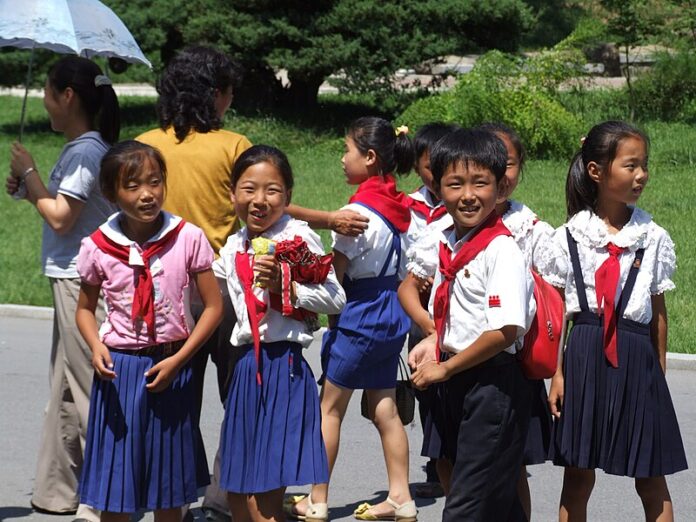
Parents at some elementary schools in North Hamgyong province are unhappy about the selection of the first batch of students to join the Korean Children’s Union in a ceremony on the birthday of Kim Jong Il on Feb. 16.
Homeroom teachers informed students about whether they had been recommended for union admission in mid-January. That set off a debate about fairness that eventually led to arguments between parents and homeroom teachers.
A source in the province told Daily NK recently that parents and homeroom teachers had quarreled about recommendations for the first batch of union admission at an elementary school in the Chongam district of Chongjin at the end of January.
One parent showed up at school in person to complain to the homeroom teacher that their child was not on the recommended list despite being a good student with perfect attendance. But the homeroom teacher retorted that recommendations were based on the school’s guidelines and the homeroom teacher’s judgment.
The enraged parent marched straight to the principal and demanded that their child be reassigned to a different class, creating quite a disturbance at the school.
Red neckties create classroom hierarchy
All North Korean children are required to join the Korean Children’s Union when they enter second grade (at age seven). But rather than all being admitted at once, students are divided into three batches, with admission ceremonies falling on three major holidays: Kim Jong Il’s birthday (Feb. 16), Kim Il Sung’s birthday (April 15), and the anniversary of the union’s establishment (June 6).
These ceremonies are typically held as part of a union rally, with newly admitted students saying their vows and then being given the union’s distinctive red neckties and badges.
Unfortunately for some students, the timing of union admission has become a de facto form of classroom ranking. Officially, admission recommendations are based on students’ grades and exemplary behavior at school. But in reality, the source said, parents often influence the recommendation process.
“Students admitted in the first ceremony (on Feb. 16) think of themselves as the best because they’re the first to wear the red neckties. But the students admitted in the third and last ceremony reportedly feel embarrassed and struggle to hold their heads up around their classmates,” the source said.
“An invisible hierarchy forms in the classroom based on the timing of union admission. Those with neckties are regarded as top students, while those without are seen as being behind,” the source added.
As a result, the source said, every year parents pay visits to their homeroom teachers and school administrators to arrange for their children to be included in the first batch of admissions, with bribes often changing hands in the process.
Before being admitted to the union, students are reportedly expected to memorize the children’s union membership oath, members’ rights and obligations, and poetry and songs composed by North Korea’s supreme leaders.
Students who have been recommended at the class level can still be dropped from the list if they are not approved by the school’s union committee.
“Parents are pushing their kids to learn everything by heart to ensure they aren’t disqualified during the committee’s review. Homeroom teachers made their recommendations between Feb. 1 and 3, and the admission list will be finalized following the union committee’s review on Feb. 6 or 7,” the source said.
A Note to Readers
Daily NK operates networks of sources inside North Korea who document events in real-time and transmit information through secure channels. Unlike reporting based on state media, satellite imagery, or defector accounts from years past, our journalism comes directly from people currently living under the regime.
We verify reports through multiple independent sources and cross-reference details before publication. Our sources remain anonymous because contact with foreign media is treated as a capital offense in North Korea—discovery means imprisonment or execution.
This network-based approach allows Daily NK to report on developments other outlets cannot access: market trends, policy implementation, public sentiment, and daily realities that never appear in official narratives. Maintaining these secure communication channels and protecting source identities requires specialized protocols and constant vigilance.
Daily NK serves as a bridge between North Koreans and the outside world, documenting what’s happening inside one of the world’s most closed societies.
Disclaimer : This story is auto aggregated by a computer programme and has not been created or edited by DOWNTHENEWS. Publisher: dailynk.com