
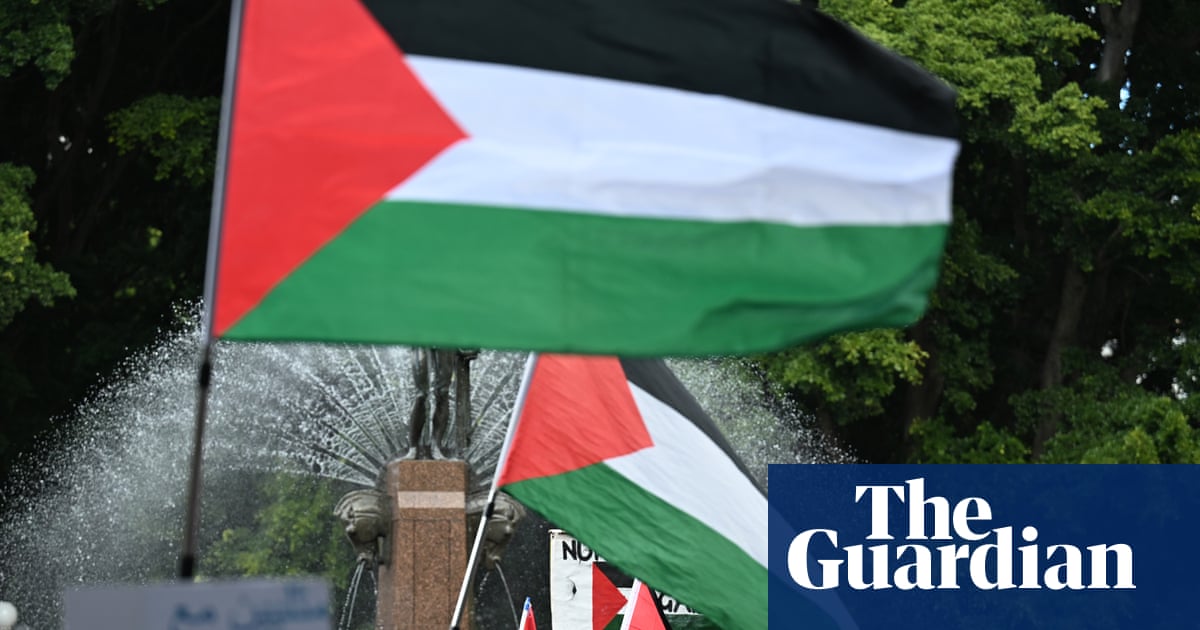
The New South Wales government handed police sweeping powers for the duration of Israeli president Isaac Herzog’s visit for the improper purpose of suppressing protests, Palestine Action Group Lawyers have argued in court.
Monday’s urgent hearing in the supreme court came ahead of a planned protest later in the evening where people opposed to Herzog’s visit plan to march from Town Hall to state parliament.
Palestine Action Group faced the state in court before justice Robertson Wright after they launched a challenge to the Minns government’s use of powers generally used to facilitate major sporting events.
The government in court rejected the suggestion that the powers were improperly invoked, arguing they were needed to secure the safety of the Israeli president and the community.
The “major event” declaration grants police additional powers until Thursday in sections of the CBD and eastern suburbs to move people on, close specific locations and issue orders to prevent disruption or risks to public safety.
Police may search anyone inside the area or as a condition of entry, and anyone who fails to comply with directions may face penalties, including fines of up to $5,500.
Felicity Graham, acting on behalf of the Palestine Action Group alongside Peter Lange SC, argued the government had improperly used the Act to curtail protests. She pointed to comments the government made on Saturday when announcing the declaration that “we cannot allow a situation where mourners, visitors and protesters are brought into close proximity in a way that risks conflict, violence or public disorder”.
She noted the sports minister, Steve Kamper, said confrontation between protesters and officials could make world news and impact the reputation of the state and Australia.
“One might say the quiet part has been said out loud,” Graham said.
“This is about stopping legitimate political expression in the public square against a controversial visiting head of state, from a country that is before the international court of justice on a charge of genocide.”
Wright questioned this. The judge suggested the motivation of the government was to keep opposing groups separated in the context of security risks following the Bondi terror attack, when 15 people were murdered during a Hanukah celebration.
Graham countered: “In terms of where the president expects to be, it’s difficult to match that up then with the breadth of the major event declaration.”
“Just as the Act prohibits the declaration of a protest as a major event, we say the major event can’t be declared in such broad terms, lacking in such specificity, as to only describe a four-day period and a very large geographical area as a backdoor way of stopping protests during that time in the general location.”
Lange argued that the extent of the powers was unreasonable in this instance. He said the declaration gave police the power to ask any person living in the eastern suburbs over the next four days to open their bag, container, or “any other thing” in their possession.
Brendan Lim SC, on behalf of the government, argued that what constituted an “event” in the legislation was not defined – and therefore should be given a “broad meaning”.
“It is the maintenance of security and safety of the president, dignitaries and the community generally, in light of the national terrorism threat and heightened community tensions, and the need to safely manage potential large crowds,” Lim told the court.
“That is not a purpose of suppressing protest, it is a purpose of securing safety.”
The government’s barrister said that police carving out Hyde Park from the declaration showed that suppressing protests was not the point – despite earlier arguments from Graham that this was a distraction.
Wright was expected to make a decision on whether the government appropriately used its power’s under the state’s major events legislation at about 4pm. The protest against the Israeli president was due to start at Town Hall at about 5.30pm.
The group planned to march in a breach of another protest restriction: a public assembly restriction declaration, which was extended by police on Tuesday.
The extension prevents the authorisation of protests under the form 1 system, effectively banning marches in designated areas without the risk of arrest. The current designated area includes the Town Hall and takes in the northern part of the CBD and the eastern suburbs but excludes Hyde Park.
Disclaimer : This story is auto aggregated by a computer programme and has not been created or edited by DOWNTHENEWS. Publisher: theguardian.com



