
Developers delivering Sydney’s housing construction boom are cutting costs by killing native animals as a first resort or relying on volunteer organisations to work free, a NSW parliamentary inquiry heard.
Wildlife Information, Rescue and Education Service (WIRES), which operates across much of the state, and Sydney Wildlife Rescue, which has an urban focus, told the NSW inquiry into licences to harm native animals on Monday that the system was not fit for purpose.
The Upper House inquiry chaired by Animal Justice Party MP Emma Hurst is focused on non-commercial licences given to private landholders under a regime introduced by the former government in 2018. This includes farmers and urban property owners.
Jessica Crause, chair of the central branch for Sydney Wildlife Rescue, testified that she often witnessed the licences leading to “cruelty [that] is significant and visible” and this occurred in all areas of high development in Sydney, but some more than others.
“It’s sometimes postcode dependent – I end up in the same suburbs over and over and over because the licences are being reissued over and over and over,” Crause said.
“The locations are places like Bankstown, Auburn, Chullora, Yagoona – all around that realm – where lethal management seems to be the first step and there is no room, in my experience, for educating the member of the public for non-lethal control.
“You then get a lot around Sutherland Shire, where it is carte blanche – we’re poisoning this [animal], but now we’ve got 65 to 70 sulphur-crested cockatoos and corellas who are the secondary poisoned animal as a result of lethal poisoning of another species.”
In some cases, pest removalists set up traps and then fail to return, Crause said, so possums are trapped for weeks or non-target species such as brush turkeys left to “boil to death in the sun”.
Trees with active nests are often felled or lopped, with outcomes for the birds including “being thrown into a chipper by arborists, witnessed by children … left on the verge, dying after trees have been removed, getting hit by cars, and chainsawed in half”, she told the inquiry.
At one point, she said, her wildlife group had 50 chicks and eggs from hollow-dwelling birds dropped off in a four-week period, including threatened species such as gang-gang cockatoos, raptors and parrots.
When wildlife rescue groups are engaged, outcomes are better, Crause said. Volunteers often had detailed local knowledge about the length of the nesting season or could advise on non-lethal measures.
She described a case in the Sydney CBD in which a building owner was issued a licence to shoot peregrine falcons on a building where they had nested for decades because they were swooping workers rappelling down the side of the skyscraper. Peregrine falcons in cities help control populations of rats and pigeons.
Crause spent “more than 100 hours, 16 site visits and significant financial resources” helping the building owner find non-lethal solutions such as training the peregrine falcons not to swoop people in high-visibility clothing. Since then, no falcons had died and six to 10 chicks had fledged, she said.
Crause said it was unreasonable for the government to rely solely on volunteer organisations to deal the impact of licences held by commercial enterprises.
Dr Colin Salter, policy lead at WIRES, said reform was needed, but it should not further burden the volunteer wildlife rescue sector.
“We have projects going through environmental impact assessment as part of their requirements saying they’ll have volunteer wildlife carers on site so their multi-million or hundreds-of-million-dollar projects can go ahead on the expectation that the volunteers will provide this service at no cost,” Salter said. “This is an endemic issue.”
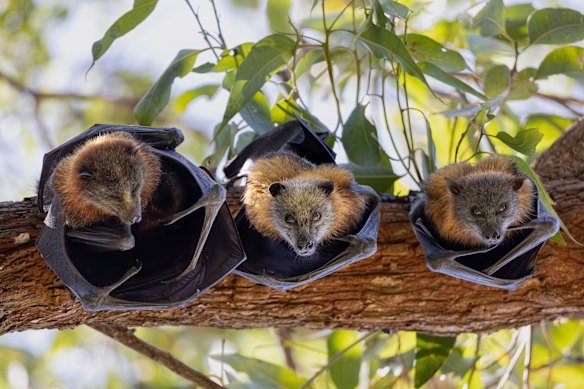
Liberal MP Scott Barrow asked whether it was acceptable for people to be unable to use their backyards or local parks because of the “stink and risk of disease” caused by colonies of bats.
Salter said flying foxes were an important part of the ecological community and it was important to find ways to co-exist.
“We need to shift our efforts to think about managing conflict [with wildlife], as opposed to managing wildlife in itself,” Salter said.
The WIRES submission says “inexcusable harm is implicit and explicit in the licensing program” and calls for greater transparency.
Sydney Wildlife Rescue also recommends making it mandatory for applicants to demonstrate they have tried non-lethal mitigation before getting a licence, and for enhanced reporting to include the impact on joeys, fledglings and eggs left orphaned by licensed killing.
Humane World for Animals wildlife program manager Dr Renae Charalambous said a dramatic increase in licences meant “an average of one animal being shot, poisoned or otherwise destroyed every minute” in 2025.
Get to the heart of what’s happening with climate change and the environment. Sign up for our fortnightly Environment newsletter.
 Caitlin Fitzsimmons is the environment and climate reporter for The Sydney Morning Herald. She was previously the social affairs reporter and the Money editor.Connect via email.
From our partners
Disclaimer : This story is auto aggregated by a computer programme and has not been created or edited by DOWNTHENEWS. Publisher: www.smh.com.au