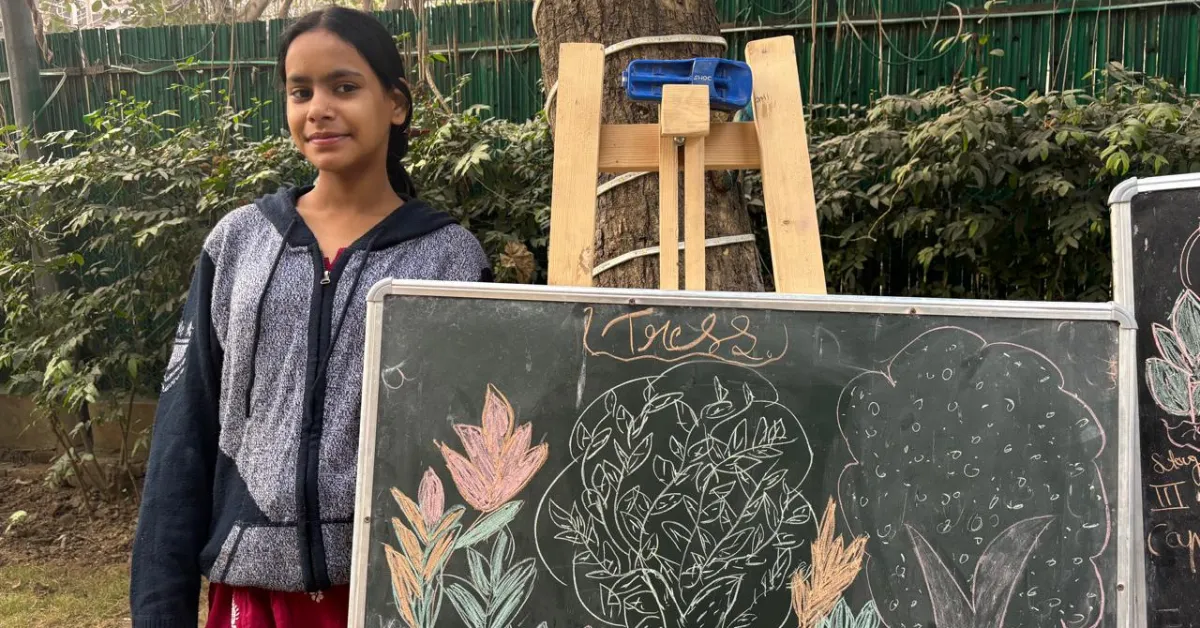
On a quiet weekend afternoon in Delhi’s Kidwai Nagar, a small group of children stand in a semi-circle around a tree. IRS officer Rohit Mehra bends down, gently running his fingers over the bark, telling them how this isn’t just a tree but where life begins.
The children listen intently, asking questions that rarely make it to textbooks. Why are leaves thick in Delhi but thin in the mountains? How does a tree breathe? Why is photosynthesis so important?
For Rohit, an Indian Revenue Service officer, these moments are not extracurricular. They are the reason he wakes up each day.
“This is one of my goals, my passions, and my reason to live,” he tells The Better India.
What began as a personal quest for sustainable living has now blossomed into something extraordinary: the ‘School of Trees,’ an innovative, community-led space where nature is both the classroom and the teacher.
How a family’s love for nature planted the seed
The idea for the School of Trees didn’t spring from detailed plans or corporate funding. It grew organically, like the trees Rohit and his wife Geetanjali cherish so deeply.
“For the last 10–12 years, we’ve lived simply,” Rohit shares. “Holidays and free time became moments for sustainability.”
Even before the School of Trees existed, Rohit and Geetanjali’s home championed green living. The couple created vertical gardens from discarded plastic bottles and made environmental care a daily practice.
In 2021, they founded India’s first tree hospital in Amritsar to treat diseased trees. These weren’t isolated efforts — they were tiny steps that nurtured their philosophy: sustainability as a way of life, not just an activity.
Dressed for work, Rohit would take his children outside early to make seed balls or plant saplings. These actions were small but impactful, silently planting the idea of environmental stewardship in their young minds.
But a turning point arose when Rohit noticed a troubling gap in the lives of modern urban children: a deepening disconnect from nature.
“Kids today know car brands, movies, and trends,” he laments. “If they can grasp those ideas, why can’t we foster the same curiosity for trees and the environment?”
He realised the issue wasn’t just a lack of awareness; it was the absence of emotional connection. “When I was a child, I looked up to actors because they seemed ‘cool.’ I want today’s kids to think that planting trees and caring for nature is cool,” he says passionately.
And with that conviction, the School of Trees was born in 2025, starting humbly inside his Kidwai Nagar colony. No classrooms. No formal registrations. No borrowed syllabi. Just trees, soil, curiosity, and time.
Every tree has a lesson
At the heart of the School of Trees lies a simple yet profound belief: trees are not just plants but silent teachers of life.
“We are extensions of the planet,” Rohit explains. “Everything we eat, everything we touch — it starts here, with the soil, the sun, the trees.”
Standing among the kids, Rohit often weaves science and culture into his lessons. “In Indian traditions, trees are revered as ancestors. It’s not just symbolic; it’s scientific. Through photosynthesis, trees sustain all life on Earth.”
He breaks down the process in simple terms for his audience, explaining how trees convert sunlight into life-sustaining oxygen while absorbing carbon dioxide.
/filters:format(webp)/english-betterindia/media/media_files/2026/02/06/school-of-trees-2026-02-06-11-28-04.png)
“If photosynthesis stops, life as we know it ends,” he states plainly. He uses tree canopies as a metaphor for cooperation and teamwork: “Leaves grow together, overlapping for survival. We too must learn from their quiet teamwork.”
To make this knowledge engaging, Rohit created a “living” alphabet chart.
“I am not teaching ABCD,” he says. “I am building phonetics for life. A is for afforestation, B for bamboo, E for Earth. When children learn language through nature, the alphabet itself begins to mean something.”
Turning learning into play
At the School of Trees, learning doesn’t feel like a chore — it feels like a game.
Every weekend, around 45 children between the ages of seven and 17 gather for these “tree parties.” There are no desks or rules to sit still; the children lounge around fuzzy patches of grass and towering trunks, playing games designed to make them think deeply without even realising it.
What makes it even more special is that the School of Trees is open to all — with no fees, no registrations, and no barriers to entry, ensuring that curiosity, not privilege, leads the way.
One popular activity is a tree observation game. One child holds a stopwatch, while others have one minute to name all the trees they’ve seen in the neighbourhood. The winner gets chocolates, but with one twist: they can take only a small handful.
“Imagine the level of consciousness this builds,” Rohit says. “While travelling, they start observing the trees around them and learning about the environment they are a part of.
/filters:format(webp)/english-betterindia/media/media_files/2026/02/06/school-of-trees-2026-02-06-11-38-01.png)
The competition motivates them to observe more closely, but the limit on chocolates teaches them restraint and balance.”
In another activity, kids are given pots and seeds with simple instructions: plant, water, and observe. Weeks later, they proudly return with tales of their seedlings’ growth, newfound questions, and an increased sense of responsibility.
For Sakshi(16), these sessions are more engaging than anything she’s experienced in her formal education. “In school, plants are just theory — definitions we memorise for exams. Here, we actually do things. When we make seed balls or plant saplings, it feels real,” she says with a smile.
But for her, the biggest surprise was learning who stood behind it all. “I didn’t know officers like him cared about trees. I thought they only worked in offices or solved big cases. But seeing him love trees? That’s inspiring.”
The change that ripples
The lessons of the School of Trees don’t stop when the sessions end. They ripple outward, into the homes and daily lives of the children and their families.
“Earlier in a session, we showed the kids how to use old plastic bottles as planters. Now it’s become instinct for them,” Rohit says.
Children who once hesitated to touch soil now proudly cycle home with pots balanced carefully on their bikes. They water their plants, track progress, and even inspire their parents. “If there’s plastic waste at home, I think, ‘How can we use this?’” says 12-year-old Meenakshi, who dreams of planting a mango tree one day.
/filters:format(webp)/english-betterindia/media/media_files/2026/02/06/rohit-mehra-school-of-trees-2026-02-06-11-39-23.png)
The lessons often tie back to larger, ancient philosophies like the Panch Tattva — the five elements of Indian thought. Rohit explains how the water inside the body reflects the Earth’s water, how fire translates to metabolism, and how balance within mirrors balance in nature. “Pollution out there and being unhealthy inside — it’s all the same imbalance,” he adds.
According to Geetanjali, the biggest reward is seeing these lessons stick. “This isn’t just about knowledge. It’s about giving children a direction. When they learn to question, reuse, and connect with nature, that’s when transformation happens.”
Through the initiative, nearly 200 people have collectively planted around 250 saplings, turning awareness into visible action. While the programme has also nudged several families to adopt small but meaningful habits like composting and reusing bottles, its larger impact lies in sparking conversations around sustainability at home and in classrooms.
Rohit has received multiple partnership enquiries from schools and colleges across Delhi, but he has consciously chosen to keep the initiative non-monetised.
“This is a passion project,” he says, adding that he wants the work to remain rooted in intent and impact rather than commercial collaborations.
Growing roots of change
At the heart of the School of Trees is a partnership rooted as deeply as the trees themselves. Rohit and his wife, Geetanjali, run the initiative together — not as a project, but as an extension of how they choose to live.
Together, they have planted close to 200 saplings, nurturing both young minds and green spaces with the same quiet commitment.
/filters:format(webp)/english-betterindia/media/media_files/2026/02/06/rohit-mehra-school-of-trees-2026-02-06-11-42-27.png)
“This is not about reading books or sharing knowledge from them,” Geetanjali says. “It is about giving children direction through hands-on experience.”
For her, the value of the School of Trees lies in what children carry forward. She sees them drawing plant diagrams on blackboards, understanding how saplings grow from seeds, and grasping concepts they once memorised only for exams.
Beyond knowledge, she believes the initiative opens up new possibilities for the future.
“There is a vast scope in greenery and agriculture,” Geetanjali explains. “If even one child finds a direction from here — whether as a green entrepreneur or someone who cares deeply for the environment, we have achieved our purpose.”
Rohit’s dreams remain simple yet far-reaching. “I want every school to have a tree school,” he says. “And when we leave this planet, we should give back at least two trees.”
As the children head home with soil-smudged hands and beaming faces, they carry more than just plants — they carry purpose. In Kidwai Nagar, where a small community gathers each weekend to share stories under the shade of trees, something bigger is quietly growing.
Through the School of Trees, Rohit and Geetanjali are proving that when care for nature becomes part of who we are, it can transform not just one child, but an entire generation.
All images courtesy Rohit Mehra
Disclaimer : This story is auto aggregated by a computer programme and has not been created or edited by DOWNTHENEWS. Publisher: thebetterindia.com