BEIRUT—In principle, no direct causal relationship exists between the Epstein scandals and any American decision to wage war against Iran. Initially, the release of the documents followed a legal and institutional process distinct from the military posture adopted by Washington amid rising regional tensions.
Attempts to merge these two trajectories into a single explanatory framework rely more on coincidence and speculation than on demonstrable evidence.
The narrative linking the files to war gained momentum after the documents were made public, with claims portraying them as a mechanism of pressure on President Donald Trump.
According to this framing, the release functioned as leverage designed to coerce compliance with Israeli and neoconservative demands for confrontation with Iran.
This interpretation drew credibility from controversy surrounding Epstein’s alleged intelligence connections and Trump’s documented social proximity to him during the 1990s. Yet credibility alone does not establish causality.
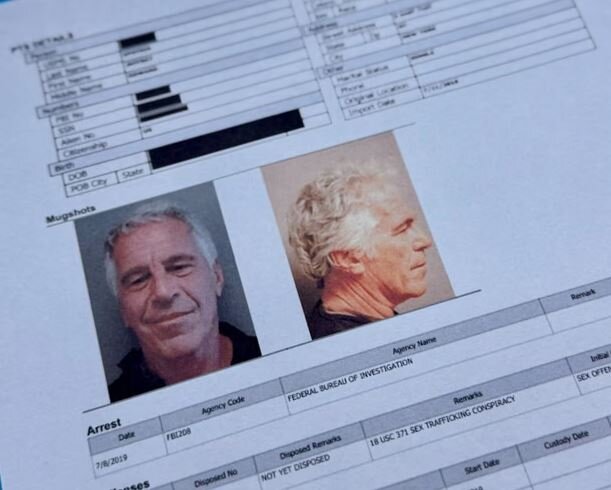
A review of the legal process undermines the coercion thesis. The U.S. Department of Justice released the documents under congressional mandate, following the passage of a transparency law in November 2025.
The legislation compelled disclosure within a defined legal framework that allowed redactions to protect victims and ongoing investigations.
Trump opposed the law for months but ultimately signed it under political pressure from within his own party. The January 2026 release, therefore, reflected statutory obligation rather than intelligence timing or strategic blackmail.
The law itself emerged from sustained public pressure, particularly among Republican voters.
The Epstein case had evolved into a symbol of elite immunity and moral rot within American power structures. Republican lawmakers calculated that continued secrecy would erode their political capital, while disclosure could be reframed as exposing corruption rooted in earlier administrations and entrenched institutions.
The decision not to veto the law reflected damage control rather than submission to external pressure.
More importantly, the notion that war offers an escape from the Epstein scandal lacks strategic logic. Military escalation against Iran would inevitably expand media scrutiny, congressional oversight, and investigative journalism.
War intensifies institutional exposure rather than containing it. For a political figure carrying unresolved ethical vulnerabilities, escalation represents a multiplier of risk, not a shield.
This dynamic renders the argument that Epstein pressures accelerate war less convincing than the inverse. If any functional relationship exists, it lies in restraint rather than propulsion.
The scandal constrains decision-making by increasing the political cost of actions that trigger systemic scrutiny. In this sense, the Epstein files operate as a limiting factor within an already volatile strategic environment.
The confrontation with Iran itself must be situated in a longer historical and ideological context whatsoever!
Since the victory of the Islamic Revolution in 1979, the United States has waged a continuous aggression against Iran in political, economic, and military forms.
These hostilities predate Iran’s nuclear program, missile capabilities, and regional alliances. Its central target has been the revolutionary philosophy articulated by Imam Khomeini, a philosophy that rejected American hegemony, challenged Western domination, and placed Palestine at the core of Islamic and human justice.
For Imam Khomeini, resistance was not a peripheral issue but a pillar of revolutionary legitimacy.
Opposition to the Israeli enemy functioned as a moral, political, and civilizational boundary separating submission from resistance. This stance transformed
Iran into a systemic adversary of the Western order, not because of weapons programs, but because it offered an alternative model grounded in sovereignty, popular legitimacy, and alignment with the oppressed.
From this perspective, the war on Iran is not a reaction to episodic crises or scandals, but a sustained effort to neutralize a revolutionary idea.
Hence, the Epstein files belong to an internal American reckoning with elite power. The conflict with Iran belongs to a deeper struggle over ideology, legitimacy, and Resistance. Confusing the two obscures both.
Disclaimer : This story is auto aggregated by a computer programme and has not been created or edited by DOWNTHENEWS. Publisher: tehrantimes.com