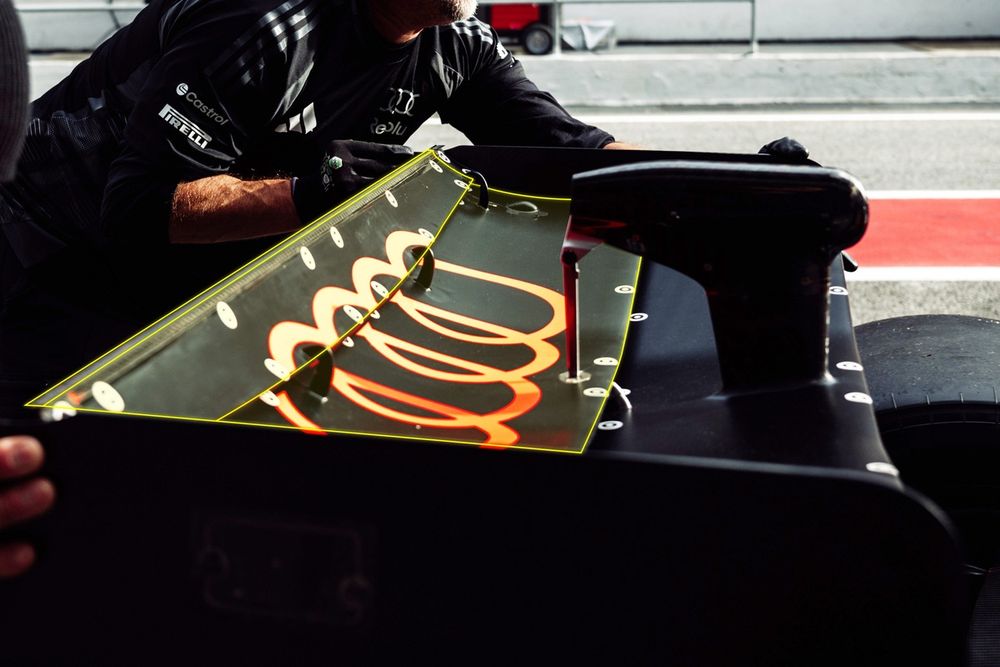
In Barcelona, a host of different approaches to Formula 1’s new active aerodynamics were on display, with Audi and Alpine standing out for their distinctive rear-end solutions. On the wing of the four-ring team, the rotation pivot is positioned at the centre rather than on the leading or trailing edge of the flaps, which causes the two flaps to rotate in a different way compared with the team’s rivals.
One of the most significant regulation changes in F1 this year concerns active aerodynamics, which have expanded beyond the DRS of old and changed its purpose. Now, moveable elements will be found on the front and rear wings, and these can be exploited on every straight, regardless of position.
The 2026 regulations, while still within the limits imposed by the FIA, are freeing engineers’ creativity – leading to very different design philosophies across the F1 grid. This creativity can also be seen in the field’s active aerodynamics, where different designs have emerged from team to team.
Across the grid, the geometry of the movable flaps changes, the number of wing elements that can move varies, and it is possible that some solutions will be alternated from race to race, depending on the characteristics of the circuit. There is also variety across the ways in which teams open the rear wings.
Until last year, the room for manoeuvre was limited, and teams simply made maximum use of the 85-millimetre opening allowed by the regulations, lifting the leading edge via an actuator while the trailing edge remained fixed.
Audi rear wing with the two mobile flaps closed
Photo by: Audi
Essentially, the pivot around which the rotation occurred was located at the rear part of the movable flap, while the section that moved was the more forward one, which was lifted upward. With the 2026 rules, however, different interpretations have emerged: Alpine and Audi, in particular, have taken paths that clearly diverge from those of the competition.
While all the other teams have maintained the traditional opening, with the trailing edge remaining fixed and the leading edge being lifted – often rising higher than the lateral endplate on the outer side to maximise the opening and reduce drag on the straights – in the case of Audi and Alpine, the anchoring point of the pivot around which the rotation occurs has been moved.
In Alpine’s case, as reported last week, the wing works in reverse: it is the trailing edge that collapses while the leading edge remains fixed, creating a sort of “extension” of the mainplane. Audi’s approach is even more curious, because the engineers in Hinwil have chosen an intermediate solution between the two philosophies, positioning the pivot around which the two rear flaps rotate (highlighted in yellow in the image) exactly at the centre of its lateral supports (in red), which remain fixed as required by the regulations.
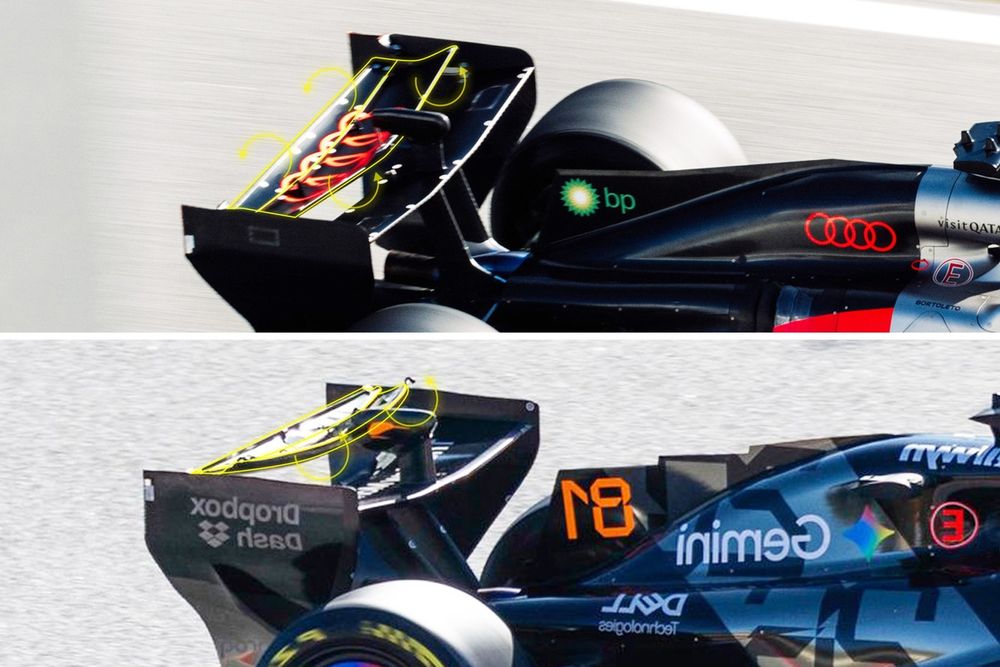
Comparison of the Audi rear wing (with the pivot point in the center) and McLaren (with the pivot point on the trailing edge)
Photo by: Audi
As a result, the flaps on the R26 no longer remain in an almost horizontal position, or at most inclined by just a few degrees; instead, in the open configuration they take on an oblique inclination, with a smaller “gap” compared to rivals when the different solutions are compared.
This is a decidedly curious solution, because having the flaps open in an oblique manner also means changing the direction in which the airflow moves in that area of the car. The visual and aerodynamic effect is that the air appears to be almost “pushed” downward, precisely because of the steep inclination taken on by the flaps during the opening phase.
While many teams use two actuator attachment points – one for each movable flap – in order to lift both elements simultaneously, Audi’s system is different: there is a single linkage connected to the first flap, while the second is “passive” and is dragged along in the movement via the small supports that connect the two profiles, rather than by the actuator itself as happens on the other cars.
We want your opinion!
What would you like to see on Motorsport.com?
– The Motorsport.com Team
Disclaimer : This story is auto aggregated by a computer programme and has not been created or edited by DOWNTHENEWS. Publisher: motorsport.com