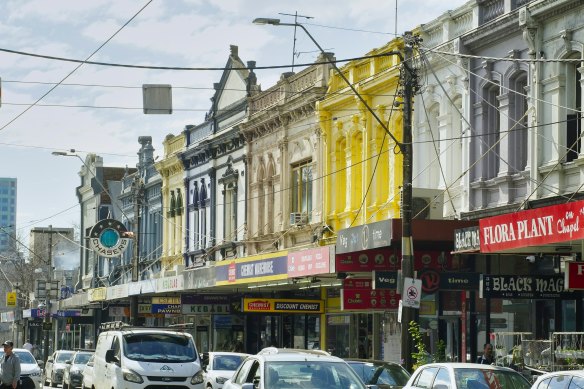

Towers up to 20 storeys and large areas friendly to townhouses have been slated for Melbourne’s south-east as the Allan government releases the missing piece in its pledge to encourage higher-density housing around train and tram corridors.
Draft maps are to be released on Wednesday for the government’s remaining 23 train and tram activity centres, where it intends to allow denser housing close to public transport and is seeking public feedback.
This masthead has been provided with 10 of the maps ahead of their full release. They show that land around Caulfield train station will have the tallest height limits, some areas being zoned up to 20 storeys.
Malvern, Prahran, South Yarra and Springvale will have pockets that permit buildings up to 16 storeys.
The tallest height limits are proposed for sites beside railway stations and, at Toorak Village, which is on a tram line.
Height limits have not been detailed for two areas on the western side of Caulfield Racecourse that have been earmarked as “strategic sites” for urban renewal. Limits for these will be determined later.
There are 60 activity centres proposed in total, 58 based around public transport hubs and two separate projects that will identify key sites for housing in the City of Melbourne and the City of Yarra. Draft maps have been published for 35 of the areas so far. Wednesday’s release details the remaining 23 train and tram zones in Melbourne’s south-east and east.
The final two activity centres, in the City of Melbourne and the City of Yarra, differ from the train and tram hubs. For those two, the state government will work with the local councils to identify land that could be developed.
Outside the areas with the taller height limits, the government proposes areas of lower density to allow townhouses and low-rise apartments to be built within walking distance of stations. The lower-density areas comprise a much greater share of the suburbs involved than the areas planned for high-rise towers.
Streets that are five minutes’ walk from a station would have height limits up to four storeys, or six storeys if the block is bigger than 1000 square metres. Areas 10 minutes’ walk from a station would have limits of three storeys, or four storeys for bigger blocks.
These catchments cross over and merge in suburbs where train stations are close together, with South Yarra, Hawksburn, Prahran and Windsor effectively connected into a larger activity centre.
“Whether it’s making it easier to build homes close to public transport, townhouses in our inner suburbs, or family homes with a backyard – our planning reforms are all about giving more Victorians real housing choice,” Planning Minister Sonya Kilkenny said.
The government’s activity centres have provoked a backlash in some suburbs, including in Brighton, where locals have held rallies opposing the state’s plans led by local Liberal MP James Newbury.
Many of the centres to be mapped out on Wednesday include heartland seats for the Liberals, including deputy party leader David Southwick’s seat of Caulfield.
Another four centres will be detailed for the electorate of Malvern, alongside six already published. MP for Malvern and former opposition leader Michael O’Brien has argued his electorate has been unfairly asked to shoulder the biggest share of the new hubs.
O’Brien is retiring at the November state election, and former Kooyong federal election candidate Amelia Hamer will run for the Liberal Party as his replacement.
A further four centres are in Prahran, which the Liberals won in a byelection last year but is in danger of returning to the Greens at the state election.
Further out, Labor seats such as Springvale, Bentleigh, Noble Park and Dandenong have been included in the latest release of maps.
The new activity centres on the Cranbourne and Pakenham train lines have had an extra 1200 railway services a week since February 1, with trains running directly through the new Metro Tunnel. Another eight centres are on the Frankston line, where trains returned to the City Loop on February 1, and four are on the Sandringham line, where a new timetable is planned later this year.
In Melbourne’s east, Blackburn, Nunawading, Mitcham and Ashburton stations will have activity centres, while Riversdale and Willison stations will be combined into one centre because they are close together.
Toorak Village does not feature rail but has been selected because it is a built-up area along the No. 58 tram route.
The draft maps are open to further consultation this month and next month. Some 3000 submissions were sent to the Department of Transport and Planning before details of height limits were released.
Opposition Leader Jess Wilson has previously criticised the activity centre program as providing “no voice and no choice”, arguing property taxes were stalling the construction of affordable new homes.
Height limits and boundaries can change following community feedback. The first 10 pilot activity centres announced by the government were altered after consultation.
Plans for all 60 centres are expected to be finalised by the middle of this year. The Allan government expects they will help provide more than 300,000 new homes by 2051.
Start the day with a summary of the day’s most important and interesting stories, analysis and insights. Sign up for our Morning Edition newsletter.
From our partners
Disclaimer : This story is auto aggregated by a computer programme and has not been created or edited by DOWNTHENEWS. Publisher: www.smh.com.au