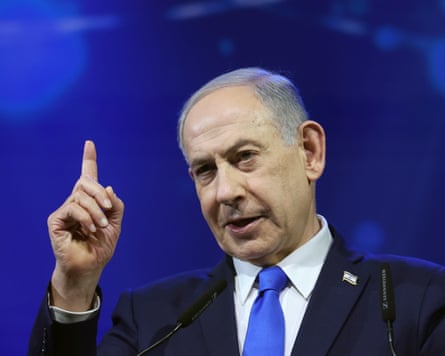
Tehran has told the US not to allow Israel to destroy the chance of reaching an agreement over Iran’s nuclear programme amid speculation that Benjamin Netanyahu intends to use a hastily arranged White House meeting with Donald Trump on Wednesday to divert negotiations.
Iran’s intervention came as the Israeli prime minister flew to Washington to plead with Trump not to negotiate a deal with Tehran if it excludes limiting the country’s ballistic missile programme, dropping its support for proxy forces in the region and curtailing human rights abuses at home.
Netanyahu is deeply concerned that Trump’s son in law Jared Kushner and his special envoy, Steve Witkoff, are prepared to strike a deal confined to limiting the scope of Iran’s nuclear programme, which in Israel’s view would do nothing to rein in the long-term threat Tehran poses to the region.
Speaking before leaving for Washington, Netanyahu said he would “present to the president our approach around our principles on the negotiations”. He is expected to provide Trump with fresh intelligence about Iran’s military capabilities, including new long-range ballistic missiles.
Netanyahu faces a delicate task in setting out his stall because he risks being seen as challenging two of Trump’s most respected aides by mapping out a set of demands that could force the US into prolonged conflict with Iran.
He also risks angering Trump by opening up divisions in the Republican party, especially if he reminds the US president that he made repeated unfulfilled promises to come to the help of Iranian protesters.
Netanyahu’s turbulent relationship with Trump was already entering another rough patch as he continues to stall on his Gaza peace plan by barring a Palestinian technocratic body from entering the strip and seeking in effect to annex the West Bank.
In a sign that he knows he is treading on thin ice, Netanyahu agreed to take the US ambassador to Israel, Mike Huckabee, with him. Before heading to Washington, Huckabee said there was “an extraordinary alignment between US and Israel on Iran”, and that as far as he knew the two sides shared the same red lines.
Iran expressed its anger at Israel’s intervention. Ali Larijani, the the head of the Supreme National Security Council, the body overseeing Tehran’s negotiating strategy, said: “The Americans should think wisely and not allow him, with his posturing, to create the impression before his flight that he is going to the United States to set the framework of nuclear negotiations. They must remain vigilant regarding Israel’s destructive role.”
Larijani met the mediators between Washington and Tehran in Muscat to to discuss the agenda for further talks.
Iran’s foreign ministry spokesperson, Esmail Baghaei, said in his weekly press briefing: “Our negotiating party is America. It is up to America to decide to act independently of the pressures and destructive influences that are detrimental to the region.”
Israel’s alarm about a potential deal that undercuts its ambitions for regime change in Tehran has grown ever since the US agreed to reopen indirect talks with Iran, which started in Oman on Friday.
The Iranian government also still faces political challenges at home, with more reformist groups and academics issuing statements protesting against the suppression of dissent and in particular the arrest of leaders of the Reformist Front.
The front issued a further statement expressing its shock, and warning that the regime’s exclusionary approach and baseless accusations would worsen the political deadlock and “strengthen the violent and war-mongering factions supporting Israel”. It called on Iran’s president, Masoud Pezeshkian to intervene urgently to secure the release of its leadership.
Even if the planned second round of talks are confined to Iran’s nuclear programme, as Tehran wants, there is no guarantee of success because it insists on maintaining its right to enrich uranium as fuel for nuclear power plants, something the US permitted under the 2015 deal but Trump has appeared to rule out.
Trump has sent the aircraft carrier Abraham Lincoln and three accompanying warships to the region which are capable of hitting a huge range of Iranian military and economic sties. The US has also buttressed the air defences of US bases across the region.
The head of Iran’s atomic energy authority has said Tehran might be prepared to dilute its stock of highly enriched uranium to 60% purity, a limited concession given the 2015 deal limited it to enriching to 3.75% purity.
Disclaimer : This story is auto aggregated by a computer programme and has not been created or edited by DOWNTHENEWS. Publisher: theguardian.com