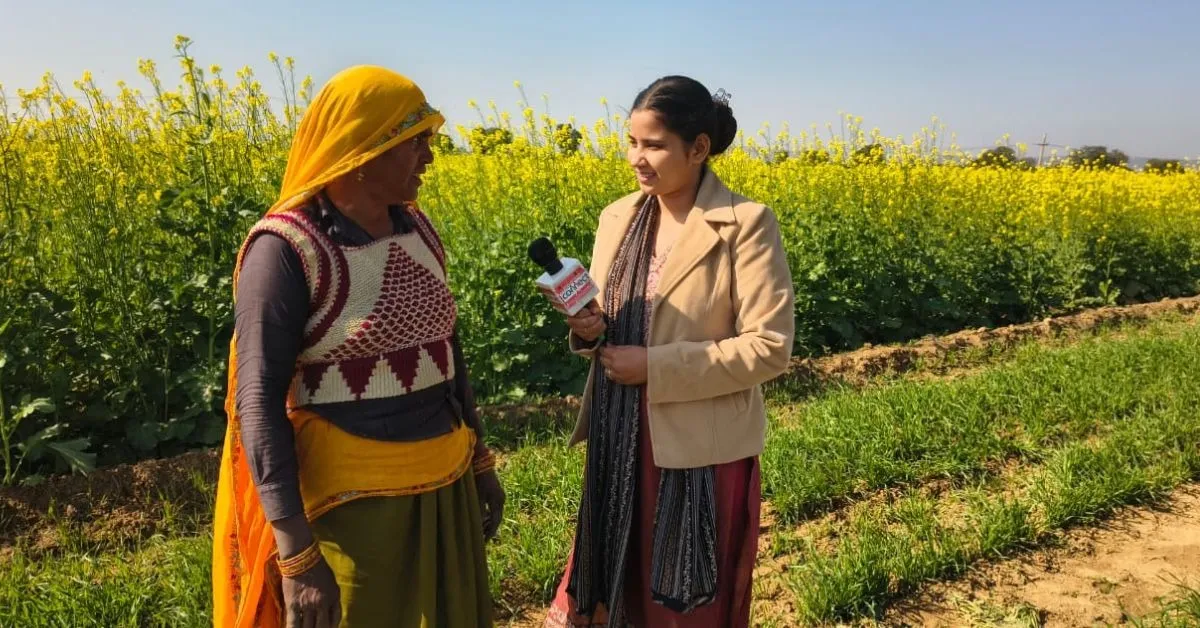
Namaskar, aap sun rahe hai aapka apna samudayik Radio Connect FM 107.8, janta se jude direct samudayik Radio Connect (Greetings, you are listening to your very own Community Radio Connect FM 107.8. Community Radio Connect – directly connects with the people.)
It’s been a decade since Mamta (31) was a broadcaster at the Alfaz-e-Mewat radio station in Haryana’s Nuh district (formerly known as Mewat). But she narrates her opening lines perfectly, intonation and pitch exactly as if she’s back in her host seat.
Mamta recalls the bundle of nerves she was on her first day as a broadcaster. “I’d never worked before that,” she shares, adding that she applied for the role whilst completing her B.A degree. “I was anxious about the job. I was nervous about whether I would be comfortable among people who were so experienced,” she explains.
But after a two-year stint when she quit — Mamta moved to Rajasthan after marriage — she was remembered as one of the most competent broadcasters the radio station had ever seen. Remembered for her razor-sharp observation skills and her ambitious tone, she was adept at anchoring programmes that resonated deeply with her listeners.
For many of the families, especially the women who would tune in to Mamta’s segments, it was a breath of fresh air. As Pooja Oberoi Murada, Principal Lead at S M Sehgal Foundation — whose grassroots programmes and development interventions are impacting people across 13 states in India, and whose brainchild is Alfaz-e-Mewat (now rebranded as Community Radio Connect FM 107.8) — shares, “Thirteen years ago, when we started the radio station in Nuh, the district was a media dark area. The literacy levels were low. While there were so many government schemes available to the people, we wondered how they would ever be able to access this information.”
Thus, Alfaz-e-Mewat was established to ensure information reached the last mile. In May 2010, the foundation received a Letter of Intent (LOI) from the Ministry of Information and Broadcasting, which allocated Alfaz-e-Mewat a broadcast frequency of 107.8 MHz.
Pooja recalls how, despite their call for aspiring broadcasters drawing interest from teachers, farmers, students, and unemployed youth, only one woman went on to complete the training. Today, however, that reality stands challenged, as the radio station in Nuh and in Rajasthan’s Alwar sees women take on visible roles, both as broadcasters and as an audience.
Getting women to articulate their thoughts on a public forum wasn’t easy, Pooja reasons. “Initially, our women broadcasters would tell their own daughters to dial in and ask their questions on-air. We hoped that hearing a woman voice her question would encourage other women to also dial in with theirs. We had to continuously do things so that women would feel more confident, relaxed, and like their voices were getting heard,” she explains.
A spectrum of topics, a ripple of impact
Mitti ki Khushbu — a series on the importance of soil health management for sustainable agriculture and food security; Saaf, Safai, aur Sehat — a programme focusing on health and hygiene, building awareness about cleanliness and the importance of safe drinking water; Hamare Buzurg Hamara Samman — a series raising awareness among senior citizens about government schemes and benefits available under the Atal Vayo Abhyuday Yojana (AVYAY), Sapno ki Udaan — a series spotlighting women who have overcome social and personal barriers and how they did it.
The programmes recalibrate what is worthy of attention.
As I speak to the women who see Community Radio Connect FM 107.8 as an information lifeline, one thing becomes clear: one of the most popular programmes across regions is Jal Jangal Zameen (Water, Soil, Forests). Rekha Devi (46) from Ramgarh, Rajasthan, who religiously tunes into the segment at 8 am, says it has been a boon for her farmland.
She explains, “Earlier, I had to construct furrows between the crop rows for the water to seep into the land. But one day, while listening to the radio, they spoke about drip irrigation. I told my husband about it, and we started implementing it on our farm. This allows me much more time on my hands, because I do not have to dig furrows.”
/filters:format(webp)/english-betterindia/media/media_files/2026/02/10/community-radio-1-2026-02-10-18-13-15.jpg)
Rekha is thrilled with the hands-on, practical knowledge disseminated through the radio channel. Sharing another case where a radio segment led to ripples of impact, Sonia Chopra, Program Lead at S M Sehgal Foundation, shares, “Back when we started our programmes in Nuh, very few households had a toilet in the home. Our focus group discussions with the women revealed that many women would wait until dark to relieve themselves. One of our programmes Shochalay Mere Angana, a series focusing on women and sanitation, inspired one of the women so much that she spoke to her family and they had a toilet constructed inside the home.”
In fact, her story was featured by The New York Times. When Bhagwan Devi was interviewed, she told the publication, “Radio made us realise that we could bring real change. That we also have equal rights as men.”
Keshmina’s story offers another example of radio’s tangible impact. A native of Jhirka, Haryana, Keshmina (39) is regular on the radio circuit. Her personal favourite segment is Sapno Ki Udaan (Flight of Dreams).
One day, whilst listening in, Keshmina overheard the presenter deep diving into the idea of women-led small businesses and how this could create sustainable sources of income.
“I called in that day and asked how I could start a business. Later, after the show, the presenter got in touch with me and guided me on how to open my cosmetics shop in my home,” she shares.
/filters:format(webp)/english-betterindia/media/media_files/2026/02/10/community-radio-2-2026-02-10-18-16-27.jpg)
Keshmina, who is a farmer, is thrilled with the dual income. The side hustle also means an opportunity to make friends with the women who head to her shop to purchase bangles, earrings, and makeup products.
From silence to airwaves: how women’s voices are now getting heard
Haryana has never had a woman chief minister. According to a report, in the last 13 assembly elections since 1967, women have comprised only 7.62 per cent of all elected MLAs (Member of the Legislative Assembly). In a state where politics continues to be limited, shaped by long-standing social biases and weak gender-equality indicators, and women, even when in a position to voice their opinions, echo their family’s, it was a breakthrough to hear Mamta’s voice on the radio every morning. It confronted stereotypes.
Interestingly, Mamta shares that her time at the channel has shaped her present circumstances. “During the segments, I got to know a lot about SHGs (self-help groups). Once I moved to Rajasthan after marriage, I interviewed for a post under the National Rural Livelihood Mission (NRLM) — a poverty alleviation project implemented by the Ministry of Rural Development. My knowledge of SHGs got me selected for the post,” she shares.
It is this lasting impact that they are proud of, says Anjali Makhija, Chief Executive Officer and Trustee, S M Sehgal Foundation. As she shares, “Women’s empowerment is a cross-cutting theme in all our programmes. Our intention has always been to play a catalytic role in what the government is doing. Where the government is not able to reach, we try to pitch in. So also in case of the radio, the purpose is to disseminate information and give a voice to women who never had a chance to share their opinion.”
And the impact is telling, says Anjali, adding that the shift in women’s mindsets has culminated in professional growth of the village children, adolescent girls deciding to delay their marriages and enroll in schools.
/filters:format(webp)/english-betterindia/media/media_files/2026/02/10/community-radio-5-2026-02-10-18-25-47.jpg)
The foundation empowers women by training them as krishi sakhis (friends of farmers). The women farmers provide expert agricultural advice, promote sustainable practices, and act as community leaders, bridging the gap between scientific knowledge and last-mile adoption while gaining economic independence and recognition.
As far as the radio segments go, she says, women’s participation is shaping the narrative. “They are dialling in with specific questions related to their lives and development. So it’s an integrated impact that we are trying to create,” Anjali points out.
Through its various initiatives, the foundation hopes this growing participation will steadily challenge the idea that a woman’s role, choices, or identity must be confined within narrow social expectations.
Taking change to the last mile
Rekha Devi is never alone. All the time while she’s cooking, cleaning, washing up, Rekha has the company of her best friend. And it’s a very knowledgeable one. But the purpose of Community Radio Connect FM 107.8 isn’t solely entertainment. Rekha’s kitchen garden is a shining example of how the radio can cultivate productive passions.
“One of the segments spoke about an interesting idea: growing a kitchen garden by reusing water from washing vegetables,” she shares. Today, spinach, fenugreek, and coriander flourish outside her home.
When I ask Rekha about when she started listening to the radio, she gives me a puzzled stare. “I never stopped,” she replies.
Growing up, the radio was an important member of the family. “My father had one. Listening to the radio was just a habit,” she shares, adding that today, it continues, albeit through more modern technology — Rekha connects to Community Radio Connect FM 107.8 through the Radio Garden app.
/filters:format(webp)/english-betterindia/media/media_files/2026/02/10/community-radio-4-2026-02-10-18-23-24.jpg)
For Rekha, the radio programmes offer a glimmer of truth and hope. And sometimes, it is a community’s only access to the world outside. For instance, during the COVID-19 pandemic, the station launched a programme 21 din 21 baatein (21 Days 21 Topics) with expert-led messages on frequent handwashing, access to healthcare services, and social distancing, along with verified information from the district collector, chief medical officer, and other government authorities.
It braided the truth with quiet courage. Meanwhile, women like Keshmina see the radio channel as one that is allowing them an agency to subvert the patriarchy rampant in their own states. “Previously, no one ever asked my opinion at home. Not my husband, while making decisions, nor my children, when it came to their education and careers,” she explains. “But ever since I started listening to the radio, I have become more informed on different topics, and I started sharing my opinions in family discussions. In fact, I encouraged my son to do his B.Sc degree because of everything I had heard on the radio, and he is so happy that he pursued it.”
This is the power of radio, Anjali underscores.
One of her favourite anecdotes to share is how, during their sit-downs with the community, the women would share, “I had never stepped outside my house. Even if I did, I would have to answer so many questions about where I was going and why. But now, I feel independent.”
This, says Anjali, is the freedom radio allows women. “That independence in terms of mobility is so important to women. It gives them a platform to interact. It’s like showing them the path, and then the door to independence opens for a lifetime.”
All pictures courtesy S M Sehgal Foundation
Sources
‘How a Radio Station Is Empowering Women in a Rural Heartland’: by Karan Deep Singh, Published on 10 October 2023.
‘To Be A Woman In Haryana Politics’: by Saumya Kalia, Published on 3 October 2024.
‘How Rural Community Radio Stations are Helping India’: by Sehgal Foundation, Published on 15 April 2020.
‘Alfaz-e-Mewat FM 107.8’: by Community Voices.
‘Still a man’s world: Only 87 women elected to Haryana Assembly since 1966 formation, no woman CM yet’: Gunjan Sharma.
Disclaimer : This story is auto aggregated by a computer programme and has not been created or edited by DOWNTHENEWS. Publisher: thebetterindia.com