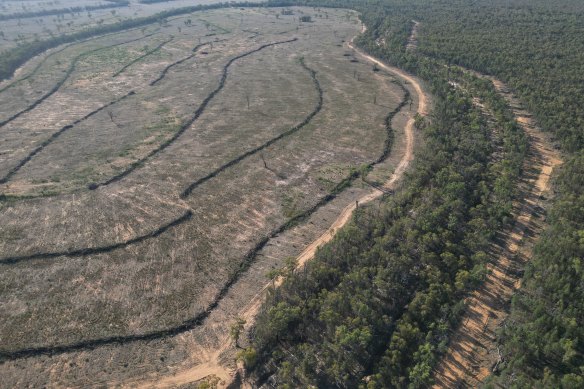

Private land clearing in NSW is directly contributing to the state’s extinction crisis, with new figures showing an area of high-biodiversity land equivalent to four Sydney Harbours was cleared between 2016 and 2023.
The Minns government made an election commitment to stop excess land clearing and is working on an overhaul of the state’s biodiversity laws, in line with a review by former Treasury secretary Ken Henry. Modest changes are also proposed for the Local Land Services Act, the main legislation governing farmers for day-to-day land management under which the bulk of clearing occurs.
The study by the Wentworth Group of Concerned Scientists overlaid the annual NSW Statewide Landcover and Tree Study (SLATS) figures with other government data on high-biodiversity land, the distribution of threatened species, and riverbank corridors important for the health of water catchments.
Professor Richard Kingsford, a conservation biologist at the University of NSW and a Wentworth Group scientist, said NSW was “on an extinction path” for native species, and overlapping laws in the Biodiversity Conservation Act and Local Land Services Act were “failing to protect biodiversity”.
“You can’t achieve biodiversity conservation without tackling the threats, and obviously land clearing is one of the biggest threats to biodiversity, [along with] climate change, invasive species, and development of rivers,” Kingsford said.
“We have these two pieces of legislation which are really integrated in terms of how they manage native biodiversity and native vegetation, and we also know that most of the biodiversity in NSW is on private land.”
The SLATS data has an 18-month lag. The 2023 data, which showed a 40 per cent jump in land clearing, mainly for agriculture, is the most recent available. Environmentalists said the data suggested NSW was a “deforestation hotspot on par with Indonesia”. Last year’s State of the Environment report made it clear that biodiversity was “going from bad to worse”.
From 2010 to 2023, a total of 677,500 hectares of combined woody and non-woody land was cleared and re-cleared, representing an average of 48,393 hectares a year, the Wentworth Group study said.
In 2016, the former Coalition government loosened land clearing laws and released the NSW Biodiversity Values Map. In the following eight years, 13,880 hectares of land marked on the map as high-biodiversity were cleared.
The Wentworth Group also found that threatened species were likely impacted, based on their modelled distributions across the landscape. Between 2010 and 2023, 12 threatened species had 5 to 15 per cent of their habitat cleared, and 26 threatened ecological communities had 1 to 15 per cent of their likely occurrence cleared.
The land clearing also undermined decades of investment in river restoration and catchment management, with 33,682 hectares, or 0.6 per cent, of riverbank corridors cleared between 2010 and 2023, the Wentworth Group said.
Henry, who is also chair of the Australian Climate and Biodiversity Foundation, said the Wentworth Group research should be used by the NSW government in its overhaul of laws governing land clearing.
He pointed out that while almost 700,000 hectares were cleared from 2010 to 2023 – three times the size of the ACT – the trend was accelerating, with almost 500,000 of it in the five years to 2023. He was particularly concerned that so much of it was “unallocated”, meaning the government does not know why the clearing occurred.
“We knew when we were undertaking the review that the practice of allowing landholders effectively to self-assess their own clearing with zero oversight … was full of risk, and we were aware that when you’ve got somewhere between 60 and 80 per cent of clearing in NSW recorded as unallocated, that means you’ve got a big black hole in system accountability,” Henry said.
Henry said there should be real-time reporting on land clearing.
“You look at the scale of what’s happened, and you just find it impossible to understand, but it’s really only been able to happen because of a lack of transparency,” he said. “The public has just been kept in the dark.”
When the SLATS data was released last July, the NSW government said most of it was clearing of “invasive native species”, which it defined as native woody plants that either regenerate thickly following disturbance or encroach on vegetation communities where they previously did not occur.
Henry said reforms to federal environmental laws passed last year by Environment Minister Murray Watt mandate that any clearing of native woody vegetation older than 15 years had to be assessed, regardless of whether it was invasive native species or not. He said the NSW government should update the Local Land Services Act to reflect the tighter rules.
Nathaniel Pelle, the Australian Conservation Foundation’s nature and business lead, said while many farmers protected ecosystems, most habitat destruction was happening on grazing land to supply beef to the supermarkets and big burger chains.
“Every year the number of native animals listed as threatened in NSW goes up, and it’s no coincidence that happens at the same time the healthy habitat available to them goes down,” Pelle said.
“Half of the animals on the threatened species list are expected to be extinct within a century, and there’s just no way to prevent that without halting the bulldozing of healthy ecosystems and restoring large areas of degraded habitat.”
A spokesperson for the NSW Department of Climate Change, Energy, the Environment and Water said the government had started broad and detailed consultation to support development of its strategy to “put nature on a path to recovery” including reforms to the Biodiversity Conservation Act.
A spokesperson from Agriculture Minister Tara Moriarty’s office said the government had completed consultation on the land clearing code and would strengthen environmental protections.
Get to the heart of what’s happening with climate change and the environment. Sign up for our fortnightly Environment newsletter.
 Caitlin Fitzsimmons is the environment and climate reporter for The Sydney Morning Herald. She was previously the social affairs reporter and the Money editor.Connect via email.
From our partners
Disclaimer : This story is auto aggregated by a computer programme and has not been created or edited by DOWNTHENEWS. Publisher: www.smh.com.au