

S&P 500 futures were up marginally this morning after the index closed down 0.33% yesterday. The index is up 1.41% year to date, which isn’t bad given that we’re only 42 days into the new year … unless you compare that to foreign stocks.
Global stocks are up nearly 9% year to date, as tracked by the MSCI ACWI ex U.S. ETF, an exchange-traded fund that tracks mid- and large-cap stocks in all countries except the U.S.
South Korea’s KOSPI, for instance, is up 24% year-to-date. You can see why that might be tempting. Why wait for a market that is growing at about 1% per month when there’s one growing at nearly 1% per day? (The index rose exactly 1% today, by amazing coincidence.)
Analyst Ed Yardeni of Yardeni Research yesterday sent his clients a brutal chart showing the performance of U.S. stocks compared to foreign stock markets globally. You can see the U.S. right at the bottom there, besting only India.
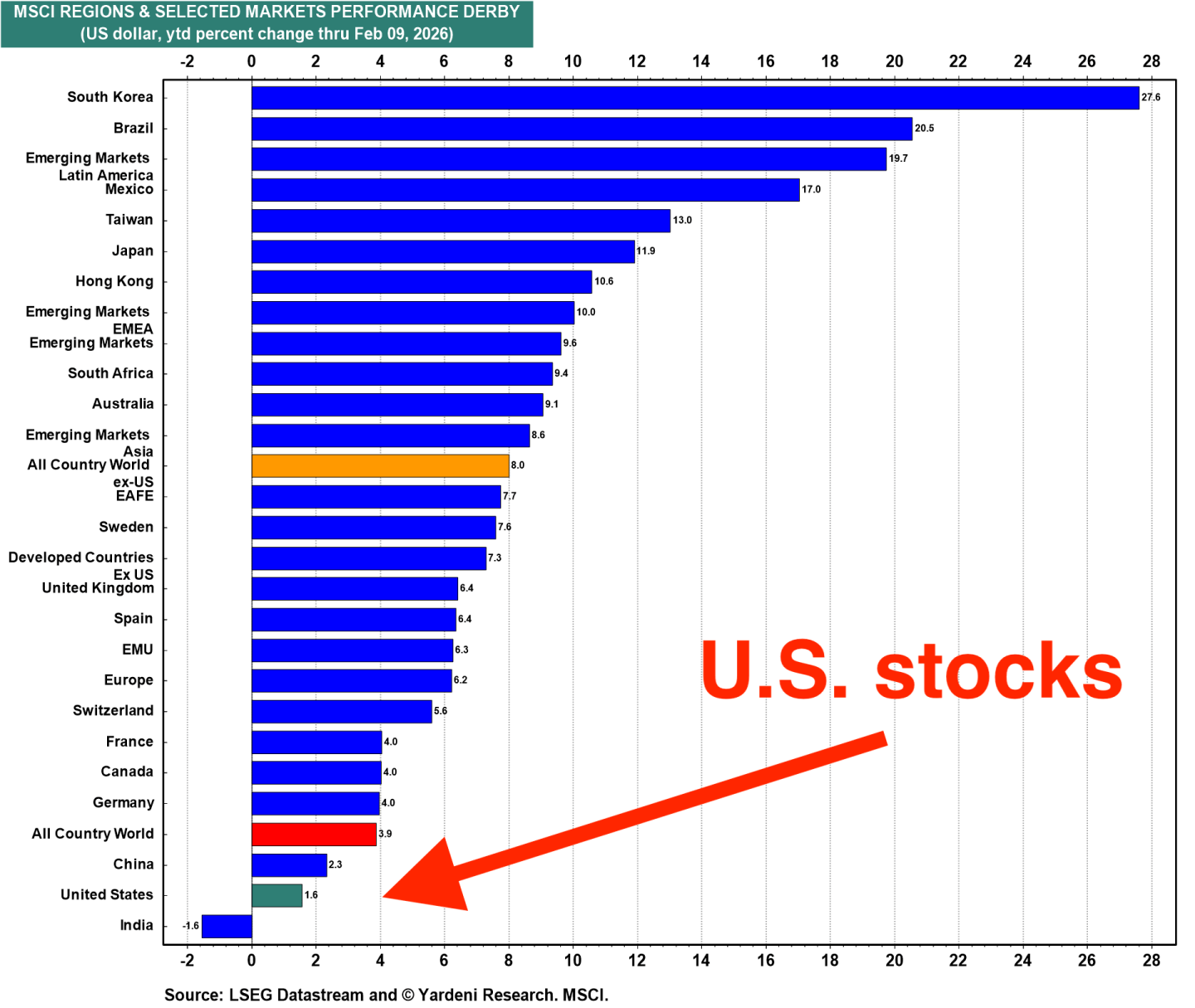
“Does this mean that American exceptionalism, which was touted as recently as 2024, is kaput? Is this another sign of de-dollarization?” Yardeni asked, rhetorically. “We don’t think so. America remains exceptional, and foreigners continue to invest in the U.S. However, there are plenty of exceptional companies overseas that have also attracted global investors.”
One might argue that this is the “Sell America” trade in action. But that is not quite what is happening.
Last year, foreigners invested $1.6 trillion into the U.S., a record sum, according to Ruchir Sharma, the chair of Rockefeller International. The problem for those investors is that the U.S. dollar is down 10.6% over the last 12 months compared to a basket of foreign currencies. That means any gains foreign investors made on money invested in U.S. equities a year ago will receive a 10% haircut if they want to realize those gains today.
Unsurprisingly, investors are looking elsewhere. They want to hedge their currency losses in the U.S. with the high-risk, high return gains to be found in Europe and Asia. There’s a global bull market going on, so it’s easy to do—almost any major stock index outside the U.S. is performing better than the S&P.
Right on cue, Goldman Sachs this morning raised its 2026 forecast for the MSCI Emerging Markets index (mostly Asia and Brazil), implying 12-14% in U.S. dollar returns, according to a note from Sunil Koul and colleagues.
That’s not “Sell America.” It’s more like “Use Marginal Future Dollars to Not Buy America.”
Here’s a snapshot of the markets ahead of the opening bell in New York this morning:
- S&P 500 futures were up 0.11% this morning. The last session closed up 0.33%.
- STOXX Europe 600 was down 0.23% in early trading.
- The U.K.’s FTSE 100 was up 0.47% in early trading.
- Japan’s Nikkei 225 was up 2.28%.
- China’s CSI 300 was down 0.22%.
- The South Korea KOSPI was up 1%.
- India’s NIFTY 50 was flat.
- Bitcoin was down at $66.7K.
Disclaimer : This story is auto aggregated by a computer programme and has not been created or edited by DOWNTHENEWS. Publisher: fortune.com



