
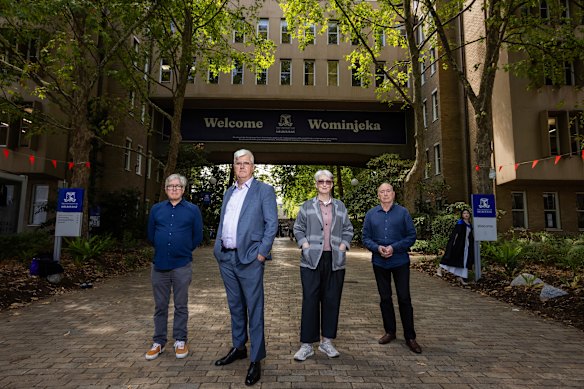

Leading scholars at the University of Melbourne are warning the university to rethink its plan to tear down a landmark building designed by one of Australia’s greatest modernist architects, arguing it risks erasing its own heritage.
The plea comes after staff based inside Sir Roy Grounds’ John Medley Building were told they must vacate ahead of the building’s “retirement”, as the university presses ahead with a dramatic reshaping of the Parkville campus in which close to a dozen late 20th-century buildings will be demolished.
For the first time, pre-eminent academics within the university’s Faculty of Arts are speaking out against the planned demolition of the John Medley Building, which was built in the late 1960s and refurbished at a cost of $4.5 million less than 10 years ago.
The building’s archway serves as the southern gateway to campus and is a popular photo spot for new and graduating students.
Professor Philip Goad, chair of architecture at the university’s Faculty of Architecture, Building and Planning, and also chair of the Heritage Council of Victoria, urged the university to reconsider its plan to demolish the John Medley Building.
“Its heritage significance needs to be really understood properly before there’s a decision made to remove it,” Goad said.
Christopher Marshall, professor of art history and curatorship at the university, said the building was a major public work by one of Australia’s most important architects and labelled its planned demolition “an act of cultural vandalism”.
The John Medley Building has not been listed on the Victorian heritage register, but Goad said it is one of several modern buildings on campus that contribute to the university’s character.
Though the building is not recognised alongside other Grounds buildings such as Hamer Hall and the National Gallery of Victoria, it is sympathetic to the university’s history and helps to make the campus a more human-scaled place, Goad said.
“Roy Grounds was thinking about the history of the campus as an urban precinct, rather than doing a one-off, sort of ‘look at me’ building. He’s doing something which tries to understand the historic nature of the campus and complement it,” he said.
“What John Medley [building] does … is allow the university to create a series of quite intimately scaled outdoor rooms, not some giant outdoor mall. It’s what a lot of students and staff love about the university, moving through these courtyards between buildings which are relatively well scaled.”
The plea comes after the university’s dean of arts, Professor Jennifer Balint, told staff in December that they will be relocated in mid-2026.
Balint acknowledged many staff would struggle to come to terms with the building’s fate.
“I want to acknowledge the great fondness among staff for the John Medley Building as a long-standing and architecturally distinctive gateway to the Parkville campus,” she wrote in an email seen by The Age.
“However, it’s also important to note that the building has significant limitations, including major accessibility issues, that make it unfit for purpose into the future.”
Balint emailed staff with an update on Tuesday, hours after The Age submitted questions to the university, informing them the relocation had been deferred until 2027.
The John Medley Building was renovated around 2018.
Alison Young, professor of criminology in the School of Social and Political Sciences, was involved in consultation on the significant refurbishment at the time.
“That process of design and renovation that I was part of took an entire semester … It was a huge amount of labour,” Young said.
The $4.5 million project involved extending the elevator shafts from the fifth to sixth floor, improving toilet accessibility and refurbishing three floors of the building. A master plan for a full refurbishment was never completed.
During consultation, architects working on the project spoke of the heritage value of Grounds’ work, and emphasised that “any intervention in the building should be sympathetic to his philosophy”.
“It’s an incredibly well-thought-out building, and it’s kind of painful that it’s being reframed as this eyesore and problem,” Young said.
When The Age visited the building this week, several international students and their families were gathered near the building’s archway, taking family photographs.
Marshall says the archway is the “welcome mat of the university”.
“They’re ripping out the welcome mat,” he said.
The building is part of the university’s cultural heritage, and belongs to everyone, he argued.
“If we just unthinkingly perform this cultural vandalism, just tear down this building, we can’t put it back,” Marshall said.
“Yes, it’s an old building. It needs care … There is just a sense that the University of Melbourne’s cultural heritage doesn’t matter, and it doesn’t belong to everybody. But it does.”
The university released its estate master plan in 2023, trumpeting the “greening of Grattan Street” by creating 22,000 square metres of parkland. The plan also envisages the demolition of several late 20th century buildings, including the towering Medical Building on the south-west corner.
The uncosted plan has a forecast completion date of 2040.
Melbourne University professor in urban planning David Nichols said that at a time when the university preaches sustainability, it would be more environmentally friendly, and less costly, to update the building “than to pull the whole thing down and start again”.
“There’s rhetoric about usability issues with the Medley Building. Whatever the issues are, I’m confident that it would cost a lot less to fix those problems within an existing building,” he said.
“There’s some poor decisions being made here about major changes, particularly when one side of the university is saying we don’t have the money.”
In a statement, a university spokesperson said the demolition of the John Medley Building “will enable the university to deliver a contemporary, purpose-built teaching space that will become a focal point for student activity on campus”.
“This is part of a broader, long-term plan to ensure our precincts and campuses meet the university’s long-term education and research needs,” the spokesperson said.
Start the day with a summary of the day’s most important and interesting stories, analysis and insights. Sign up for our Morning Edition newsletter.
 Adam Carey is senior city reporter (suburban). He has held previous roles including education editor, state political correspondent and transport reporter. He joined The Age in 2007.Connect via X or email.
From our partners
Disclaimer : This story is auto aggregated by a computer programme and has not been created or edited by DOWNTHENEWS. Publisher: www.smh.com.au


