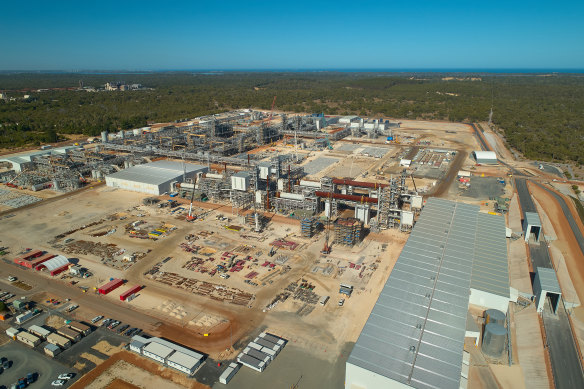

US lithium giant Albemarle has shut down its Kemerton lithium hydroxide processing plant in Western Australia, in a move expected to impact about 250 workers at the site.
The company announced overnight it would idle its last operating train at the plant and place it into care and maintenance immediately.
The Kemerton processing plant, located near Bunbury, produced lithium hydroxide using spodumene from the nearby Greenbushes mine.
A statement from Albemarle said the company would aim to meet customer demand for lithium hydroxide through other production channels.
Albemarle chairman and chief executive Kent Masters said idling operations at Kemerton was a difficult decision.
“It follows significant actions we have taken over the past two and a half years to reduce operating costs during an extended period of price volatility in the market,” he said.
“Unfortunately, recent lithium price improvements alone are not enough to offset the challenges facing Western hard-rock lithium conversion operations.
“This decision improves our financial flexibility and preserves optionality.”
The market for lithium hydroxide has rallied in recent months, due to a stronger demand for energy storage and a shortening of supply.
However, in releasing Albemarle’s December quarter results, Masters said the company was focused on driving down costs.
“The steps we have taken to optimise our asset portfolio, reduce costs and strengthen our financial flexibility have improved our competitive position,” he said.
“Even as market conditions improve, we continue to drive cost reduction and productivity actions to enable long-term growth, powered by our world-class resources.”
The latest announcement follows a move by the company in July 2024 to idle production on Train 2 and place it into care and maintenance.
At the same time, Albemarle announced plans to stop construction activities on Train 3 to focus its manufacturing efforts on the continued qualification on the remaining Train 1 in a decision that cost around 300 jobs at the site.
In January 2024, Albemarle shelved plans to build a fourth train at the plant in a bid to complete commissioning activities on the first two trains.
Each Kemerton train had the capacity to produce about 25,000 tonnes of lithium hydroxide per year.
Chamber of Minerals and Energy WA chief executive Aaron Morey said the company’s decision was a reflection of the current lithium market.
“Albermarle has made a significant contribution to Western Australia’s ambitions to capture value and create jobs through downstream processing of our world-class lithium reserves,” he said.
“Resources are traded on global markets and today’s decision illustrates how competitive those markets are.
“The outcome is a timely reminder of the hard realities of competing internationally to build and sustain downstream industries in Australia.”
Albemarle holds a 49 per cent share in the Talison joint venture, which operates the Greenbushes mine in WA’s South West that is considered the world’s largest and highest-grade hard-rock lithium mine.
The remaining 51 per cent is held by a joint venture between Tianqi Lithium Corporation and IGO Limited.
In a statement, Albemarle added that its mining interests in Australia, including its holdings in Greenbushes and Wodgina and its exploration interests in Western Australia, were not impacted by the Kemerton decision as they remain core components of the company’s strategy.
WA opposition energy spokesman Dr Steve Thomas said it came as no surprise that operations at the Kemerton refinery were stopping.
“The lithium industry has been suffering from low prices, which have dropped dramatically since 2022 thanks to oversupply in the market and a slower-than-expected take-up of electric vehicles,” he said.
“This has made the viability of all lithium projects problematic.”
Thomas said Albemarle faced difficult issues with the cost and reliable supply of energy, which made the situation more unstable.
“This combination of factors has delivered the sad result we see today,” he said.
“I hope that a correction to the lithium market and stable energy prices will one day see lithium hydroxide being produced in Kemerton in the future.
“In the meantime, I wish the best to the workers in this time of trial and uncertainty.”
Get the day’s breaking news, entertainment ideas and a long read to enjoy. Sign up to receive our Evening Edition newsletter.
From our partners
Disclaimer : This story is auto aggregated by a computer programme and has not been created or edited by DOWNTHENEWS. Publisher: www.smh.com.au