
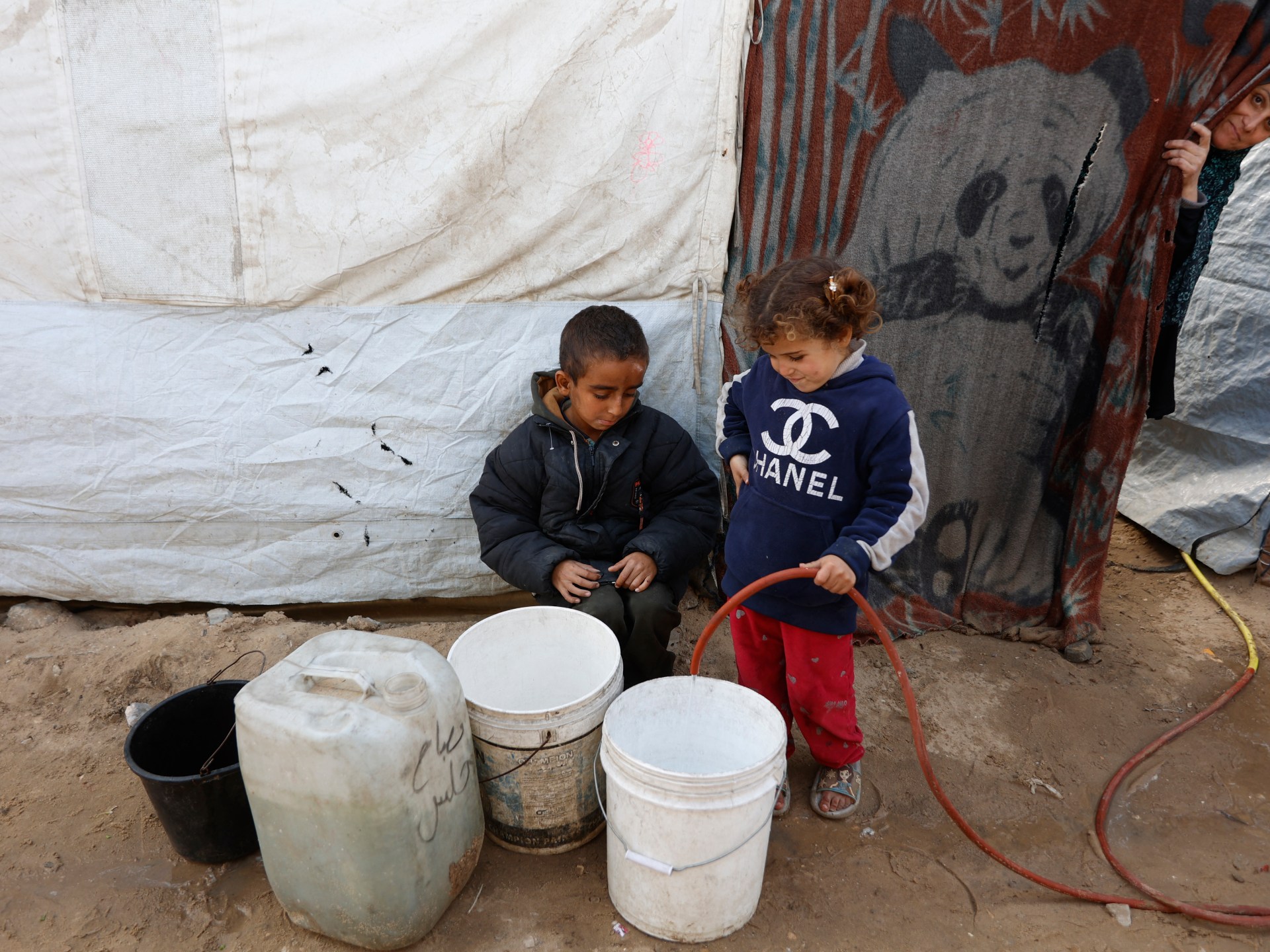
Khan Younis, Gaza Strip – It is 5:30 in the morning. The sun hasn’t fully risen, but 15-year-old Mahmoud rubs the sleep from his eyes.
He woke up this morning not in a warm bed, but on a thin mattress in a crowded tent – displaced, like hundreds of thousands of others in Gaza.
Recommended Stories
list of 3 itemsend of list
And Mahmoud did not reach for a schoolbag to get ready for school. Instead, he picked up a rough, frayed burlap sack.
“The sack is empty now, but I feel its weight even before I fill it,” Mahmoud said, as he looked at his palms, calloused and scarred from carrying the sack around Khan Younis’s streets, planning to begin his day. “My back hurts before I even start walking.”
But Mahmoud insisted that he has to fill his sack – even if that comes at the expense of his childhood and his education.
The young Palestinian is forced by the economic situation in Gaza, brought on by Israel’s genocidal war, to spend his days filling his sack with items that can be used as fuel for his family.
Nylon, cardboard and scraps of wood find their way into his sack.
“Sometimes I walk for six hours just to find a few pieces of wood,” Mahmoud said, describing his daily routine. “The dust from the rubble gets into my lungs. I cough all night. But I can’t stop, there is no fire to bake bread.”
Mahmoud feels a deep sense of responsibility for his family. He explained that his father was killed in an Israeli air strike early last year, one of more than 70,000 Palestinians in Gaza to be killed by Israel since the war started in October 2023.
Advertisement
As his mother’s eldest, and with Gaza mired in deep poverty with little help coming, Mahmoud knows that it is his job now to provide. Despite his age, he doesn’t consider himself a child any more.
“My mother is waiting for me to come back with something to make a fire,” he said. “If I collect any extra, I sell it at the market to buy bread.”
Economic strife
Mahmoud knows that life could be different. He talks about his school days with nostalgia in his voice.
“I used to go to school before the war, when my father was alive,” he said. “Sometimes, while I am dragging the sack through the market, I see my old math teacher, and I hide behind the wall. I don’t want him to see me like this – dirty, working like a donkey instead of studying. I was one of the top students.”
Mahmoud’s story is typical of Gaza’s current conditions and is tied to two issues that are a direct result of Israel’s genocidal war: the destruction of school buildings and the dire economic situation in the Gaza Strip.
Israeli attacks – including air strikes, shelling and deliberate demolitions – have left much of Gaza decimated. According to the United Nations, more than 97 percent of schools in Gaza have either been damaged or destroyed, and most of the 658,000 children of school age in the enclave have had “limited access” to in-person learning for more than two academic years.
Even now, with a shaky ceasefire in place since October, many of the schools that remain standing are used as shelters for Gaza’s legion of displaced people, preventing them from being used for education.
While there are no accurate statistics on the number of children forced to work in Gaza, Palestinians on the ground say that they have seen an increase as a result of the enclave’s economic circumstances.
In November, the UN reported that Gaza’s economy had “collapsed”, with gross domestic product (GDP) – an important economic indicator – down 83 percent compared with the pre-war period.
The weak economy, coupled with a lack of electrical power and the thousands of families whose breadwinners have been killed in the war, led to situations like Mahmoud’s.
Child trauma
“What we are witnessing in Gaza is not merely child labour,” said Yaqeen Jamal, an educational psychologist who has provided psychological support to children during the war. “It is the systematic destruction of an entire generation’s future.”
“These children lose their sense of security and their childhood, and they bear responsibilities that exceed their cognitive and physical capabilities,” she added.
Advertisement
Jamal said that would inevitably lead to dangers in the future. “The long-term effects will be catastrophic. We are facing a generation suffering from illiteracy and deteriorating mental health, which will create a societal gap that will be difficult to bridge.”
“Rebuilding schools and resuming the educational process must be the top priority, because education is the last line of defence for [these] people’s identity and future,” she said.
Reconstruction in Gaza is likely to take years, with Israel continuing to hinder the process, and uncertainty over whether Israel will attack Gaza again.
That means that children like 11-year-old Layla continue to be forced to work to help their families.
Her father suffers from a physical disability that limits his mobility, leaving him unable to work. The burden has instead fallen on Layla, who goes out every day to the streets of Khan Younis to sell tea.
She walks back and forth on al-Bahr Street – the main street in Khan Younis – calling out “hot tea, hot tea for one shekel”.
Layla carried a tray containing eight cardboard cups, two-thirds full of tea, and covered each cup with aluminium foil to keep it hot.
Asked about her favourite colour, she replied that it was pink, and remembered her pink room, full of her toys. Then she remembered her favourite toy, a pink doll.
Her doll currently lies under the rubble of the pink room, destroyed in Israel’s war.
“I wish that the colour pink would return to my life, that my room would return, that my family’s happy life before the war would return, she said. Then she hurried away down the street, focused on selling more tea.
Disclaimer : This story is auto aggregated by a computer programme and has not been created or edited by DOWNTHENEWS. Publisher: aljazeera.com









