
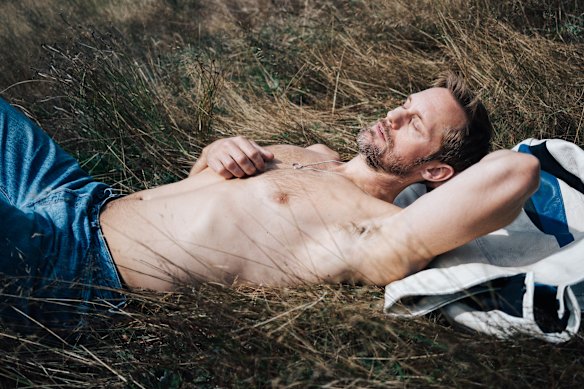
Set in the world of biker kink, Pillion brings a hidden culture into the open (literally).
What would Jane Austen say? In Harry Lighton’s vibrant Pillion, the serene Surrey hiking destination Box Hill, immortalised as a picnic spot by the Divine Jane in Emma, throbs anew as the location for a celebratory picnic for a gay bikers’ club with a focus on leathery sub-dom sex in the open air. It’s a far cry from Jane’s cold collations and caustic conversation, but Lighton approaches his subjects without judgment and helps us to do the same. You may not fancy it, but this is real life in all its infinite variety.
Pillion is Lighton’s first feature. It is based on Adam Mars-Jones’ 2020 novel Box Hill, about a naive young gay man who finds his greatest pleasure in an older man’s power.
“I’d made a couple of short films about sexual transgression, so it was a subject I was interested in prior to getting the book, but I absolutely loved its tonal complexity,” Lighton says. “It did seem like a bold choice, but in a way that excited me. I felt, ‘OK, I can do something here which might offer an original take on a culture that people don’t often see’.”
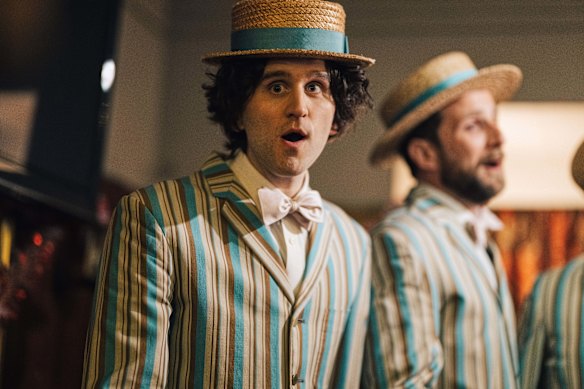
Lighton’s free adaptation of the novel centres on Colin (Harry Melling), a suburban gay lad in his 30s, who works as a parking officer and still lives with his parents. Colin is singing in a barbershop group with his dad (Douglas Hodge), wearing a natty straw boater, when he first sees Ray, a tantalisingly taciturn biker (Alexander Skarsgård at his most broodingly beautiful). Colin sings well, “but it’s barbershop, so it’s kind of lame,” says Lighton. “I wanted to show two contrasting male subcultures, the bikers and barbershop, and let that juxtaposition sit with the audience.”
Ray, having given Colin permission to pay for his chips, leaves him a note on the bar naming a rendezvous time: Christmas Day. Colin’s parents may be disappointed when he leaves the dinner table, but they encourage him. Dates don’t happen often. Peggy, his mother (Lesley Sharp) has terminal cancer: she wants to see her boy settled with someone nice. In this one respect, says Lighton, she is like his own mother.
“It can be hilarious, the ways in which she encourages my romantic life. Sometimes she’ll cut out a magazine article if she thinks there’s someone who looks attractive and nice, who I should be dating.”
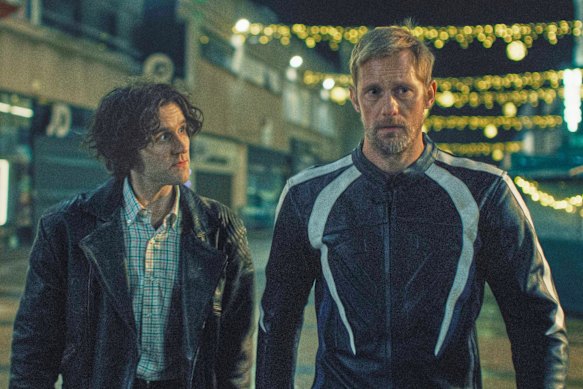
Ray is not nice. He leads Colin to an alleyway and demands to be serviced. A slight nudge with one foot indicates that he wants his boots licked. Colin is thrilled. He is less thrilled the following week, when Ray tells him he can sleep on the floor at the foot of his bed, but he does as he’s told.
By day, Ray lounges on his couch in a sparsely furnished flat, reading Karl Ove Knausgaard’s My Struggle. Colin stands by, ready to serve. He may be rewarded with a wrestle, dressed in fetish wear Ray provides; he may not. They don’t go out, except to meet the bike gang. Colin rides pillion, revelling in his subservience.
Given the film lands at a time when the streaming world has been fixated by the barely filtered gay sex scenes in Heated Rivalry, the comparisons have been predictable. A Reddit discussion thread titled Heated Rivalry vs Pillion suggests that viewers “watch Pillion first, Heated Rivalry will be your aftercare”.
Lighton did his research into the community he was depicting in Pillion. The Gay Bikers Motorcycle Club – the UK’s largest LGBTQ+ bike club – invited him to join them for a weekend, ride pillion himself and ask questions. Lighton cast some of them in his film. “Once I’d done that weekend with them, it just didn’t make any sense to me to try and search for the equivalent in actors and then put them in loads of make-up, when I had all these guys who were the real deal,” he says.
The club isn’t focused on sex, he says, but there is a crossover with the leather scene. “Once we cast them, we were also casting people from the kink community … These guys became the resource of information for both me and the actors.”
For a community that thrives in the shadows, their frankness seems surprising. “There’s a real sort of loud and proud aspect to the kink scene,” says Lighton. “Part of domination and submission is performing a role, so in that sense kinksters have an adeptness with performance, but I was amazed, actually, at how comfortable they all were in front of the camera.”
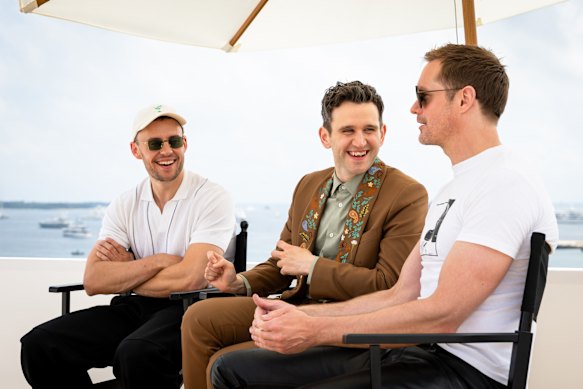
A posse of those who had stayed with the film through its production cycle came along when it screened at the Cannes Film Festival, providing the local press with quite the photo opportunity. Clearly, they felt ownership over a rare film that showed their lifestyle sympathetically, albeit with all its warts.
There are fewer warts here than in Mars-Jones’ book, admittedly. In Box Hill, Colin is described as “tubby”. He hates himself from the start, after which his vestigial self-esteem is sanded back over years of humiliation. Lighton didn’t want to play it that way.
“I think that if someone is choosing to jump into a new way of life out of self-hatred, then it feels like there’s a real desperation there,” he told Letterboxd. “Whereas, if you are full of self-doubt — and I definitely know what it is to be crippled by self-doubt, or fear of the unknown — it’s not from hating myself, it’s just being scared of taking the leap.”
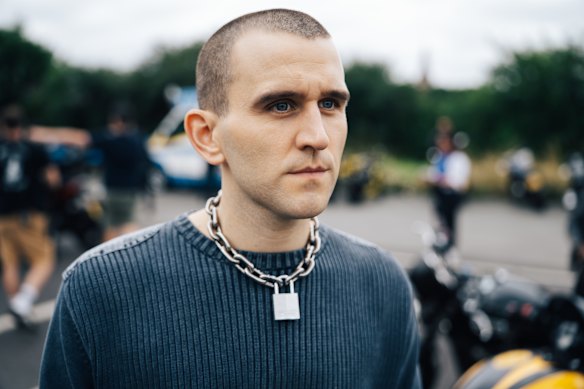
Harry Melling says it was that sense of a beginning that drew him to the role. “We meet Colin about to jump,” he says. “He wants something from the world and from his life and that felt like a very exciting starting point. And then he’s in this situation that feels right, but he doesn’t know why yet.” Lighton says he and Melling fixed on something they called “stubborn optimism” – given aural expression by the relentless cheer of the barbershop songs – that would carry Colin forward, letting him feel hope in situations that would leave most of us feeling crushed.
Ray, on the other hand, remained a mystery. Colin never knows what he does for a living; neither do we. “I spent five years writing him, so over the course of those five years I’d often think about his backstory and occasionally pursue those avenues,” says Lighton. “But what I found was that whenever I did, Ray became less exciting to me. Whenever I gave answers, it narrowed him in a way that impoverished him as a character. So I just decided right, I’m not going to think about backstory.” Skarsgård took the same approach. Later, he joked that Pillion was a great gig because it required no preparation at all. He came in cold and just got colder.
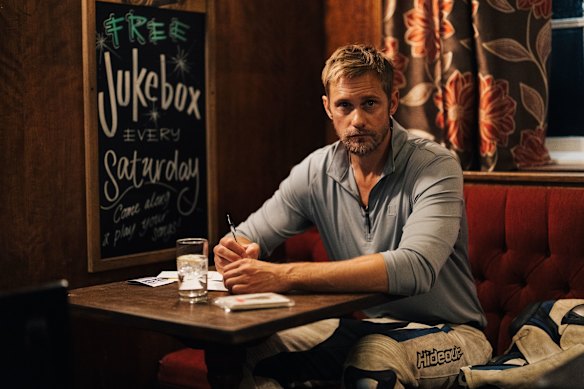
Did Lighton judge Ray, even privately? “I wanted his toxicity to sit in a grey area,” he says. “The question for me that I was always trying to ask was, you know, does Colin liberate himself through Ray from heteronormative life? Or does he exchange one incarceration for another? And I’m happy with that being a question.” Peggy accuses Ray of being a creep; audiences may agree.
Lighton sees a lighter side, expressed in his character’s music choices: pop singer Tiffany as background music for the wrestling scene, the sheet music for Satie’s Gymnopedie No. 1 on his piano. “I judge Ray for some of his behaviour,” he concedes. “But I also find there’s courage in someone like Ray, who has chosen to build a life which exists outside respectability. To me, that’s kind of courageous.”
Pillion is in cinemas from February 19.
Must-see movies, interviews and all the latest from the world of film delivered to your inbox. Sign up for our Screening Room newsletter.
Disclaimer : This story is auto aggregated by a computer programme and has not been created or edited by DOWNTHENEWS. Publisher: www.smh.com.au








