A car glides along Mumbai’s Coastal Road, officially known as the Dharmaveer Chhatrapati Sambhaji Maharaj Marg, the sea flashing briefly in the corner of the windscreen.
As the driver settles into a steady speed, the tyres begin to hum: first a low vibration, then a recognisable rhythm. Within seconds, the Oscar-winning song Jai Hofills the cabin, not from the stereo but from the road itself.
On 11 February 2026, India got its first musical road, a 500-metre stretch on the northbound road between Nariman Point and Worli, just after vehicles exit the coastal tunnel. The musical section plays its tune when vehicles travel at roughly 60–80 km/h.
Signboards placed inside the tunnel at 500 metres, 100 metres, and 60 metres before the stretch guide motorists to maintain the right speed while alerting them to the upcoming musical feature.
What is India’s first musical road?
The Mumbai installation uses specially engineered rumble strips. These are grooves cut into the asphalt at calculated depths and distances to create sound through tyre friction.
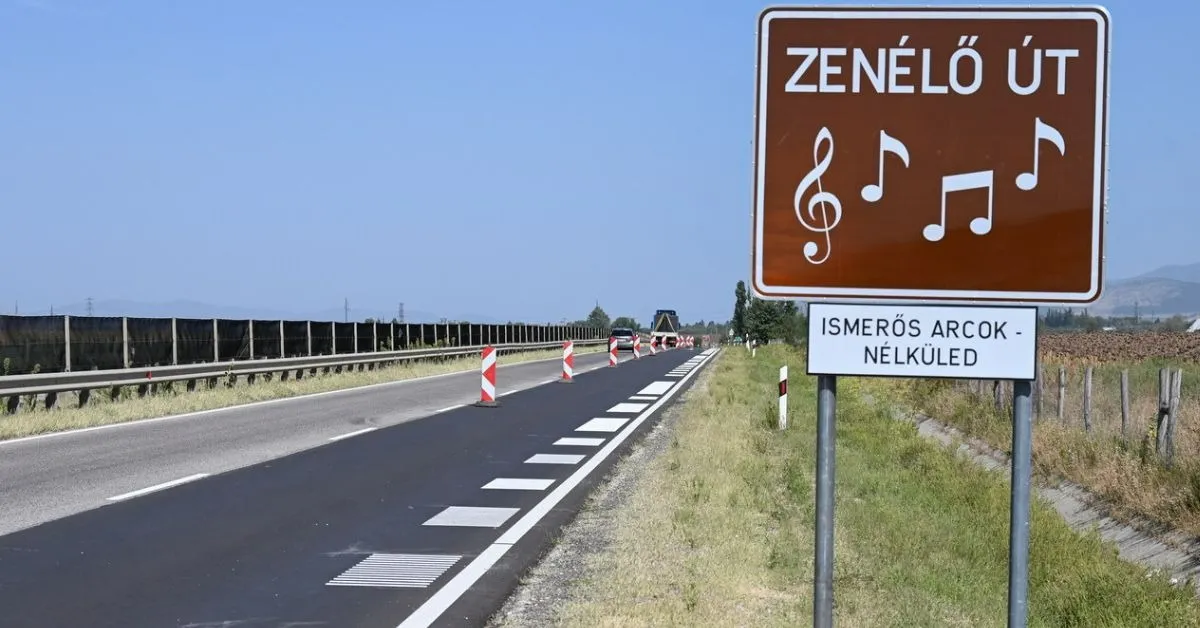
Officials say the project was executed using Hungarian technology and technical expertise. Hungary has long experimented with melody roads that combine traffic management with creative design.
The chosen tune, Jai Hofrom Slumdog Millionaire, is audible even with windows closed when drivers maintain the intended speed range.
The science behind how the roads make music
At first glance, the musical road appears as a series of shallow ridges carved into the asphalt. But each groove is carefully placed using acoustic calculations.
When tyres roll over these ridges, they vibrate rapidly, like running a stick along the gaps of a metal fence.
The spacing between grooves determines how often the tyre is jolted. Faster impacts create higher-frequency vibrations, while wider spacing produces lower tones.
Engineers design these intervals so that when a car moves at a specific speed, the vibrations combine into recognisable musical notes.
Inside the vehicle, the car’s body acts as a resonating chamber, amplifying these patterns into sound waves that drivers perceive as a melody.
If a driver goes too slowly, the notes stretch and sound off-beat; too fast, and the tune becomes rushed and distorted.
The concept builds on traditional rumble strips used worldwide to alert drivers who drift from lanes, but here, the same safety principle is turned into an acoustic instrument.
Musical roads around the world
While Mumbai’s installation is India’s first, the idea has decades-old roots. The earliest known musical road, called the ‘Asphaltophone’, appeared in Denmark in 1995, created by artists Steen Krarup Jensen and Jakob Freud-Magnus using raised road markers to produce tones.
The modern concept gained popularity in Japan in 2007, when engineer Shizuo Shinoda discovered that grooves cut into asphalt could generate musical sounds when vehicles passed over them at specific speeds.
From there, melody roads spread globally, appearing in countries like Hungary, South Korea, and the United Arab Emirates.
In Japan, several well-known ‘Melody Roads’ run through scenic areas such as Gunma and Hokkaido, where drivers hear local folk tunes while travelling at steady speeds.
Hungary’s Route 67 near Mernye famously plays rock hit number A 67-es útby the band Republic, turning a highway stretch into a musical tribute.
South Korea’s Anyang ‘singing road’ plays nursery tunes to keep motorists alert, while the UAE’s Sheikh Khalifa Street in Fujairah features a 750-metre musical stretch that plays Beethoven’sOde to Joy.
Across Europe and beyond, installations range from small experimental roads to tourist attractions designed to encourage safe driving.
Each country adapts the technology differently; some use it to maintain speed discipline on long highways, while others create interactive public art experiences that transform routine commutes into something unexpectedly playful.
/filters:format(webp)/english-betterindia/media/media_files/2026/02/12/musical-road-japan-2026-02-12-13-15-57.jpg)
A new note in urban infrastructure
Beyond novelty, musical roads are sometimes used as behavioural nudges, encouraging drivers to maintain consistent speeds and lane discipline.
Mumbai’s pilot aims to explore whether sound-based design can make commuting both engaging and safer, while showcasing how infrastructure can merge art, engineering, and public experience.
Sources
‘Mumbai Coastal Road gets India’s first ‘Melody Road’, here’s all about the 500-metre musical stretch’: by Mid-Day, Published on 11 February 2026.
‘Mumbai Debuts India’s First Melody Road, ‘Jai Ho’ Now Part of Commute’: by Radhika Ramaswamy for NDTV, Published on 11 February 2026.
‘Japan’s melody roads play music as you drive’: by Bobbie Johnson for The Guardian, Published on 13 November 2007.
‘This Road Plays Song When Drivers Travel At Right Speed, Old Video Goes Viral’: by NDTV Offbeat Desk for NDTV, Published on 19 July 2023.
‘Beethoven at 100km/h? Fujairah’s ‘Musical Road’ plays ‘Ode to Joy’ as you drive’: by Malay Mail for Malay Mail, Published on 19 July 2025.
‘Roads That Make Music — What Are Musical Roads?’: by Stephanie Pyrzynski for Tinley Park Mom, Published on 14 August 2022.
Disclaimer : This story is auto aggregated by a computer programme and has not been created or edited by DOWNTHENEWS. Publisher: thebetterindia.com