
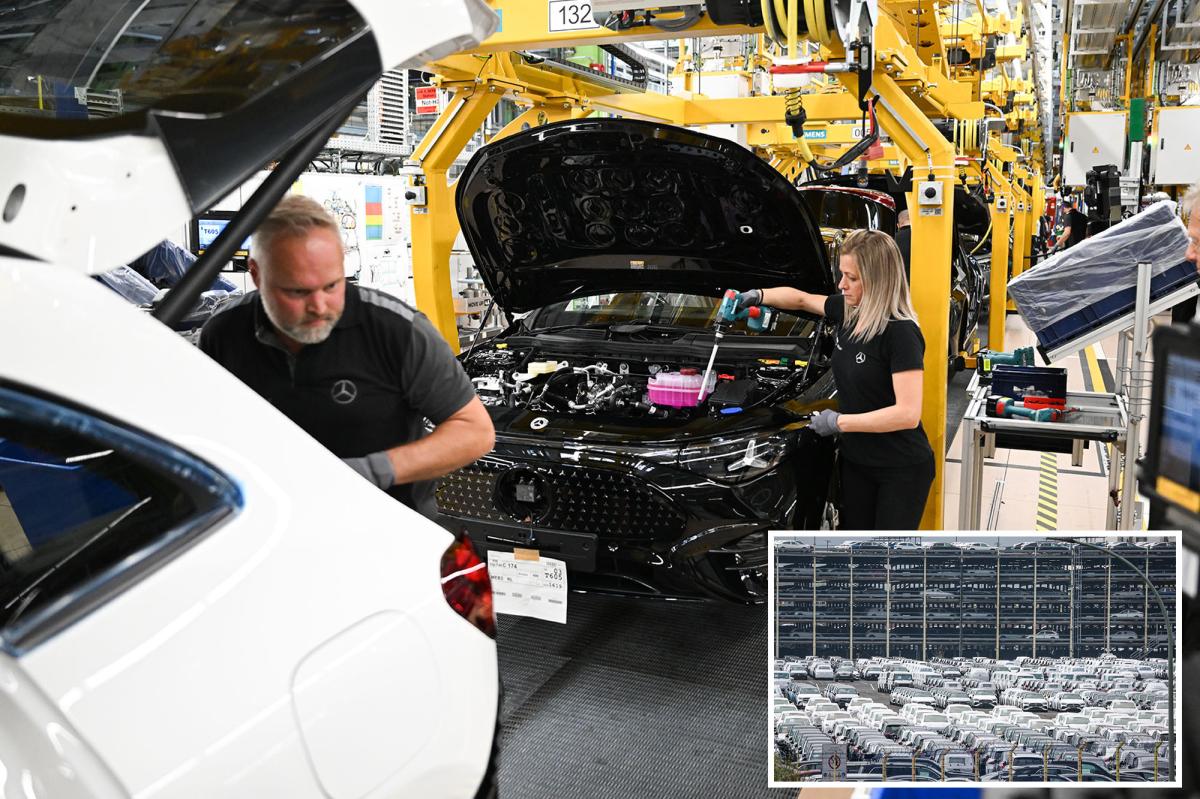
Mercedes-Benz on Thursday said its 2025 earnings were more than halved on a massive $1.2 billion hit related to President Trump’s tariffs – and warned that more challenges are on the way.
The luxury German automaker’s full-year operating profit was 5.8 billion euros, or roughly $6.9 billion – a roughly 57% drop from 2024. It largely missed Wall Street expectations of $7.8 billion.
Mercedes blamed the dismal results on steep costs from Trump’s auto tariffs and intense competition from foreign rivals, especially Chinese automakers.
The premium automaker said it’s planning more cost-cutting measures in 2026, and aims to launch several new vehicles in its goal to release 40 new models in a three-year period.
“Amid a dynamic market environment, our financial results remained within our guidance, thanks to our sharp focus on efficiency, speed, and flexibility. Now we are all set for 2026,” Ola Kaellenius, chief executive of Mercedes-Benz Group AG, said in a statement Thursday.
Mercedes is just one of many European car giants facing a complex web of issues, including supply chain snags, rising production costs, tariff pressures and costly retreats on electric vehicle ambitions.
The company is aiming for a 3% to 5% return on vehicle sales in 2026 – down from the 5% growth it recorded last year.
It expects revenues to stay roughly flat from $157 billion in 2025, while it anticipates group earnings before interest and taxes will be “significantly above” the previous year.
Many foreign automakers reported a hit to earnings in 2025 from steep tariff charges after the Trump administration slapped levies as high as 25% on imported vehicles and auto parts.
Ford’s tariff bill last year was about $2 billion, and it has said it’s expecting to incur similar charges this year.
General Motors – which reported a $3.1 billion tariff charge in 2025 – is anticipating another $3 billion to $4 billion hit in 2026, even as it works to ramp up US vehicle production.
Nissan has also increased its domestic production plans, yet it still expects a roughly $2 billion hit to earnings in 2026.
Many of these automakers have reduced their output of electric vehicles, both to prioritize US production and to account for waning demand after Trump axed a $7,500 federal EV tax credit.
Mercedez-Benz USA has abruptly brought its electric vehicles back to the US after pulling most of the line off the market last summer, according to a January report in Autoblog.
Auto giants like Stellantis, Ford and General Motors have revealed billions of dollars in charges related to swift retreats on electric vehicle plans at $26.5 billion, $19.5 billion and $7.6 billion, respectively.
Disclaimer : This story is auto aggregated by a computer programme and has not been created or edited by DOWNTHENEWS. Publisher: nypost.com



