Every Event. Every Medal in 4K.
Watch live & on demand.
Livigno: Athletes across most sports at the Winter Olympics who are last to go are faced with an agonising choice.
Since their performance is decisive, and there is a leaderboard with a number to beat on it, they have the option of knowing exactly what score they require – and therefore, exactly what they need to do – to claim victory, or deciding whether ignorance is bliss.
The ‘reverse order’ final is built because of the suspense that’s generated. To go last is to have the ultimate advantage. But do they really want to know?
Some prefer that information, to help them decide exactly where to position the dial between risk and safety, to narrow their focus. Some prefer to stay in the dark, to avoid performance paralysis, and find themselves feeling freer that way.
Jakara Anthony, for example, prefers to focus on herself. Or at least she did when she fluffed her lines on the last run of the women’s moguls final this week, saying afterwards she was unaware of any specifics.
“I hadn’t seen what anyone else had done or knew their scores,” she said. “I knew I’d have to lay down a great run because it is the Olympic final.”
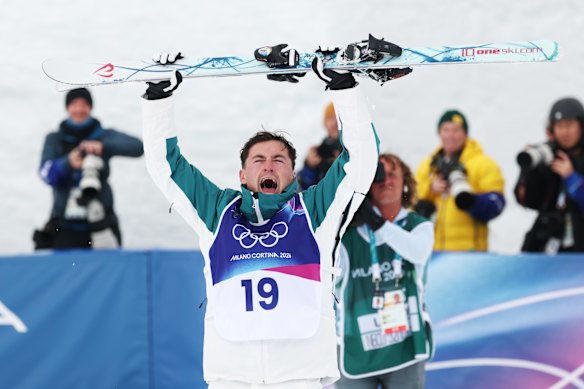
“Let’s go!“: Cooper Woods celebrates after winning gold at the men’s moguls final.Credit: Getty Images
Ordinarily, Cooper Woods would fit into that category, too. But there was something different in the air for him on Thursday in Livigno.
“Today, for the first time, I actually listened to scores, and I watched a couple of runs up the top,” he said. “Usually in the past, it’s been a bit too much for me.”
Qualifying: fire in the belly
In Olympic moguls, there is a field of 30 athletes, and two initial stages of qualifying. In the first, the top 10 go through to the finals, held the next day. The rest have to go again, and in that second run, the bottom 10 of the remaining 20 are eliminated.
Woods came 15th on his first attempt with a score of 73.67. His family’s reaction was disappointment; not in him, but how the judges assessed his performance, though he later revealed he not only shared their view, but that it motivated him.
So the next day, after a check-in with his sports psychiatrist, he came out breathing fire, putting down a vastly-improved 80.46 – the best score by any competitor in the second round of qualifiers, and the second-best from the entire field to that point.
“I was a bit pissed off at the judges from the day before,” Woods said. “I was pretty fired up. I was going out there with vengeance. I was like, ‘I’m leaving nothing on the table. You guys can’t score me low.’
“I was in the gate with my coach, and there were probably a couple of explicit words just before we dropped in to get [me] really fired up.”
Suddenly, confidence was flowing.
Final one: pressure makes diamonds
But Woods knew he had to up the ante to mix it with the medal contenders.
There are two jumps in moguls, each positioned between all the bumpy snow; in his qualifiers, he performed a back full and an off-axis 720 grab, but he felt that wasn’t going to be enough for the finals.
Not only did he plan to go faster, but he wanted to add an extra degree of difficulty to his top jump.
“Originally heading into the first final, we were going to go back to the qualification two run, because we scored so well. Then we had a couple of opportunities in finals training, and I just wasn’t missing,” he said.
“I was like, ‘Let’s go all in. We’re at the Olympics. Let’s do it.’”
That meant adding an extra 360-degree spin to the back full, turning it into what’s called a back double full.
In the first final, only eight of the 20 skiers progress for a shot at the podium.
From being middle of the road on Wednesday, Woods scored a stunning 83.60 – the best of the round, meaning he would be last to jump in the decisive run.
“I didn’t actually realise that I was the top qualifier of that round. It was only until I started putting my skis on that my coach told me,” he said. “Then I kind of freaked out a little bit.”
Final two: all on the line
With his Olympic dreams on the line, Woods was locked in. The plan was simple: rinse and repeat.
“I kept reminding myself that it is a pleasure to drop last,” he said.
“I’ve never dropped last in my career, and I was dropping last behind some serious heavy hitters. I just need to relax up there, got a good coach, he kept me dialled in. I was pretty bloody nervous … [but] I knew what I had to do.”
While he was waiting for his turn, for the first time – and only because he was feeling so good about himself – Woods allowed his coach to let him in on what the seven other competitors were doing, and how they were scoring. He even saw some of it for himself.
“There’s a game plan,” he said.
“We have so many awesome staff that are videoing and analysing other people … They were pretty straight up on what I needed to do and I needed to trust them and believe in that. I heard there was another 83 that got scored when I was up top and I was like, ‘Oh my goodness.’ It’s a big mountain to get a score like that … the coach that I had up top, he was like, ‘Stay disciplined. Do the same thing.’
“It worked out.”
The score to beat for gold was 83.71, from Canadian veteran Mikael Kingsbury, widely considered one of the greatest moguls skiers of all time, who went just before him, the seventh of the eight still in contention. This was his final Olympics, and after winning gold in 2018 and silver in 2022 in this event, he was aiming to finish as champion again.
And it looked like he might have done enough … until Woods dropped in.
He produced the same score, 83.71. In those situations, the tiebreaker is the turns score, or how the panel of judges assesses how they handled skiing on the moguls, and how smoothly and straight they moved.
That was the difference. Woods’ turn score was 48.4, while Kingsbury’s was 47.7 – so he won gold, upsetting one of the sport’s true GOATs in the most high-pressure way imaginable, with the last run of an Olympic final.
“He kind of ticked all the boxes,” said teammate Jackson Harvey. “He jumped really well, execution on the jumps was close to perfect and his skiing was very composed.”
What got him over the line was his precision and attention to detail.
“Just the overall cleanliness of it,” said teammate Matt Graham, who lifted Woods in the air when the final scores were revealed.
“He connected the dots, it was seamless. Landed the top air really well and just skied out, didn’t make a mistake … whereas Mick made a little mistake in the middle, and then I think they were both pretty similar in time.”
The Winter Olympic Games is broadcast on the 9Network, 9Now and Stan Sport.
Most Viewed in Sport
Disclaimer : This story is auto aggregated by a computer programme and has not been created or edited by DOWNTHENEWS. Publisher: www.smh.com.au