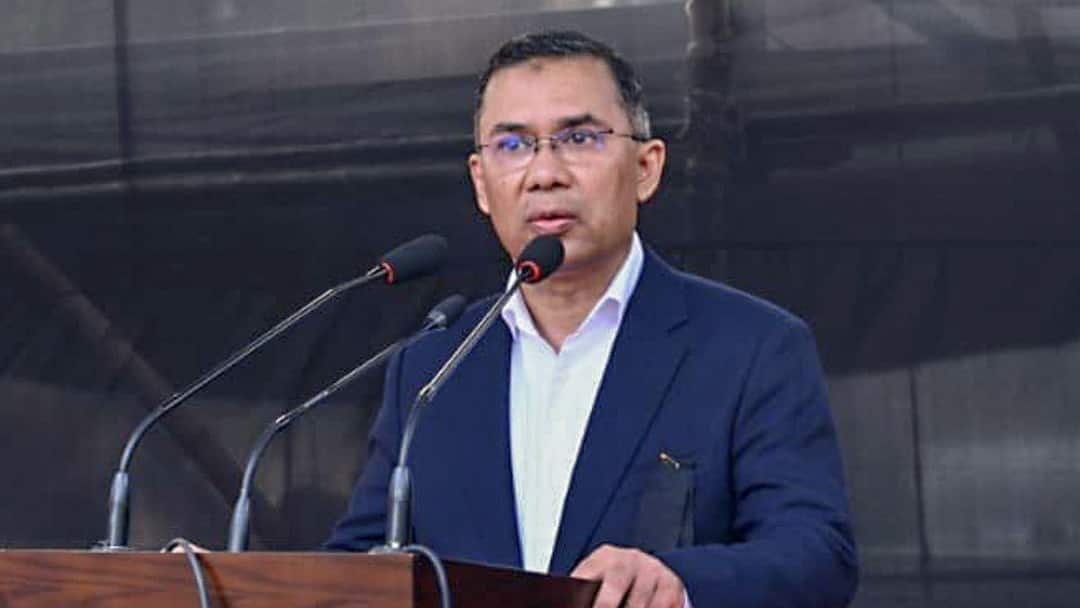
As Bangladesh heads into a pivotal general election, the Bangladesh Nationalist Party (BNP), led by Tarique Rahman, appears to be walking a careful line on relations with neighbouring India.
Two strands in the party’s election manifesto, released just days before polling, highlight this delicate balancing act. On one hand, the BNP pledged to improve ties with neighbouring countries to ensure shared growth. On the other hand, it accused India of border killings and “push-ins”, vowing to take strong measures to prevent what it described as unfair activities.
“Since any attack on the people of Bangladesh is naturally unacceptable, strong measures will be taken to prevent all unfair activities, including border killing and push-ins,” the manifesto stated.
The language has prompted geopolitical observers to ask: Is the BNP extending a hand of friendship or signalling a tougher posture?
A ‘Bangladesh First’ Pitch
The 2026 election is widely seen as more than a routine political exercise. If the BNP secures victory, the most striking development would be the political resurgence of Tarique Rahman. After nearly two decades in London, Rahman returned to Bangladesh following the departure of former prime minister Sheikh Hasina to India, ending a 17-year absence from domestic politics.
Rahman has framed his campaign around a “Bangladesh First” approach. He has promised to shift away from what he calls a “one-power” focus in foreign policy and to tackle corruption in government, a pointed critique of Hasina’s tenure, which he has repeatedly described as corrupt and brutal.
His rhetoric against Hasina, combined with her relocation to India, has added another layer of complexity to Dhaka–New Delhi ties.
A Potential Reset in India-Bangladesh Relations
For years, India has regarded the BNP with caution, particularly because of its alliance with Jamaat-e-Islami between 2001 and 2006. That period shaped perceptions in New Delhi of the BNP as an adversarial force.
Now, Rahman is signalling a recalibration. He has spoken of building a relationship based on “mutual respect” rather than suspicion, suggesting that future ties should rest on equality and shared interests.
If the BNP forms the next government, key issues are expected to move quickly to the forefront. Among them are the revival of the SAARC summit and the extradition of Sheikh Hasina.
Hasina, currently staying in New Delhi, has been sentenced to death in absentia by a special tribunal in Bangladesh for alleged crimes against humanity. Whether a BNP-led government formally seeks her extradition, and how India responds, could become a defining diplomatic test.
In an interview with The Indian Express, Mahdi Amin, a close adviser to Rahman, pointed to what he called “great opportunities” for cooperation with India under a BNP administration.
“Of course, there are issues, but every issue can be an opportunity as well to forge better ties between people-to-people contacts,” Amin said. “We would appreciate bilateral relations based on mutual trust, mutual interest, a reciprocal relation where we can serve both nations with equality, fairness and justice.”
Related Video
Lamborghini Case Update: Court Hearing Concludes, Decision on Police Remand Awaited
Disclaimer : This story is auto aggregated by a computer programme and has not been created or edited by DOWNTHENEWS. Publisher: abplive.com