Hans van Leeuwen
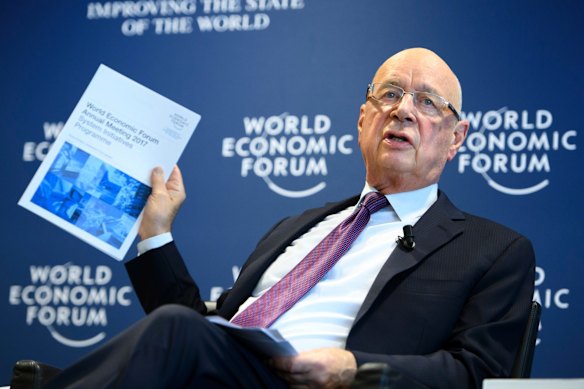
Until last year, there was probably just one man who had attended every single gathering of the global elite in the Swiss ski town of Davos: the founder and ringmaster of the whole circus, Klaus Schwab.
But last month, as 3000 politicians and business chiefs gathered for the annual World Economic Forum (WEF) summit, Schwab was conspicuous only for his absence. He was on holiday in the mountains of Oman.
After being dramatically squeezed out of the agenda-setting Swiss institute he created in 1971 last April, the 87-year-old could only watch from afar as the show went on without him.
And what he saw left him deeply uncomfortable.
Davos 2026 was “a one-sided political platform”, he says, “presenting very much the American point of view”.
Schwab has forever been the emollient diplomat, willing to break bread with almost anyone.
So it’s a remarkable admission that this year’s Davos left him unsettled, and it is striking to hear his usually rosy liberal rhetoric take on a darker hue.
His concern was kindled by Donald Trump, the US president, visiting Davos for the first time since 2020 alongside a phalanx of his secretaries. As Schwab tells it, the Americans turned Davos into a bully pulpit.
He acknowledges that his creation has always run the risk of descending into “an echo chamber”. But this year it felt like there was only one voice in that chamber, and it wasn’t a liberal one.
Maybe this wasn’t a bad thing. “You could argue it was a great opportunity for participants in Davos to be directly exposed to this point of view,” he says.
Still, Schwab says the White House’s “America first” policy is “a wake-up call” to Britain and Europe. Trump’s tough love means Europeans face a choice between becoming a stronger state or a vassal state.
“A partnership will function very well if it’s more or less between equals because then you really have to bind together.
“If it’s not between equals, we will always see a tendency of the stronger to dominate, and of the weaker to feel disadvantaged, discriminated against.”
How to get ‘more Europe’
Klaus Schwab was born in Nazi Germany in 1938 to Swiss parents, and grew up in the southern German city of Ravensberg.
Coming of age in post-war West Germany, Schwab found his calling in engineering, becoming an academic before attending Harvard in the US where he came under the influence of Henry Kissinger, later national security advisor and secretary of state under president Richard Nixon.
He launched the WEF, and the annual Davos gathering, in 1971 to help European corporate bosses come to grips with American management practices.
Then, as Americans started to show up, he sought to introduce them to the ethos of European stakeholder capitalism.
Later, politicians started coming.
Schwab became one of the best-connected men on the planet, rubbing shoulders with almost every significant political and business leader of the past half-century, from Bill Clinton to Bill Gates.
Today, Schwab doesn’t offer a complete blueprint for how Europe might “get its act together”.
But the proposals he does offer are clearly designed to strengthen Brussels and the federal architecture that sits above the European Union’s 27 members.
He endorses a proposal that emerged recently from the European centre-right bloc, that the EU’s complex leadership structure should be reshaped under a single, powerful president.
He also says Europe should have something like the United Nations Security Council, at least on defence and security issues. This would presumably look like a smaller group of more powerful states, able to take decisions more quickly and resolutely.
Challenged on whether this transfers more power away from Europe’s democratic spokes to its more bureaucratic, technocratic hub, he places his faith in the idealism and commitment of Europe’s next generation of leaders.
And asked if the EU’s diverse and sometimes fractious member states can really act as a single, coherent and purposeful geopolitical entity, he says he doesn’t “underestimate the challenges”.
“But if we look at the diversity of Europe, you could also make the point that, let’s say, New Hampshire is quite different from Texas and so on in the United States. And nevertheless, it works.”
For Schwab, it just has to work. Europe, he says, must prepare for the world described at Davos by Canadian Prime Minister Mark Carney.
Schwab says the White House’s “America first” policy is “a wake-up call” to Britain and Europe.
The former Bank of England governor called for smaller liberal states to work in concert, as the best response to a world defined by superpowers playing hardball.
“He tried to define a kind of step forward,” Schwab says. “If you take, let’s say, Europe and Canada together – and in Europe I include the UK, of course – you have an economic power which does not completely match the US, but is superior to the power of China.”
For now, he says, Europe remains at America’s mercy partly because “most of the fundamental systems are in US hands – think of the financial system, think of the technology system”.
This means Europe’s priority, even before political reform, is to “create our own fundamental systems”, in defence, AI and other areas of technology.
And this has to be a common endeavour, rather than “every country building its own fighter of the future”.
The fall of the king
The EU’s national leaders will this week gather in a Belgian castle to discuss exactly this.
They will workshop economic reforms that might strengthen the Continent’s global clout and competitiveness – primarily against China but also the US.
French President Emmanuel Macron said on Tuesday, in words that evoke Schwab’s own: “Are we ready to become a power? This is the question in the field of economy and finance, in defence and security, and in our democratic systems.”
Schwab may have cut his formal ties with the WEF but, evidently, his finger remains pretty close to the pulse. After all, this was what Davos used to do under his watch: either define, or misread, the geopolitical zeitgeist.
This made him a figurehead of the global elite – and then later a lightning rod.
The Great Reset – the book he wrote on how the world should recover from the COVID-19 pandemic – became a totem among American conspiracy theorists. They saw it as the blueprint of a corporate cabal plotting to establish a world government.
On this, Schwab says: “That was a big surprise because the intention of the book, and also the contents of the book, was completely misinterpreted.”
He weathered this onslaught only to be blindsided by an attack from within.
Over the past two years, a steady stream of accusations emerged from among the WEF’s 700-plus staff – claiming he had misused funds, manipulated research and behaved inappropriately with employees.
He denied all the allegations, but was forced to resign as WEF chairman last April, severing formal ties with the Geneva-based organisation.
The WEF eventually cleared Schwab of any wrongdoing. But the forum hasn’t yet been able to leave upheaval behind it.
It is now investigating its new boss, Børge Brende, a former Norwegian foreign minister, over his relationship with the disgraced financier Jeffrey Epstein.
Brende has said he was “completely unaware of Epstein’s past and criminal activities”.
In a statement to Reuters, the WEF said: “In light of these interactions, the Governing Board requested the Audit and Risk Committee to look into the matter, which subsequently decided to initiate an independent review.
“This decision underscores the Forum’s commitment to transparency and maintaining its integrity,” it added.
Schwab, though, seems to have moved on.
What’s next?
Deprived of Davos, he is writing what he says will be a series of 10 books on different aspects of the current, AI-driven era.
Of the first two books, one looks at the potential breakdown in trust between people and politics. The other grapples with a subject on which he has unquestioned first-hand experience: longevity.
Just weeks shy of his 88th birthday, the spry Schwab puts his health down to three things: swimming, mountaineering and curiosity.
“I think the most important factor is to remain curious. Not only to understand, but to see how you could contribute to building a better world.”
And is the world getting better? He laments society’s “increasing egotism” and shortsightedness, but remains what he calls “a constructive optimist”.
Trump’s ascendancy seems to have tempered his idealism.
Once, Schwab came across as an unfettered liberal globalist. Now, the MAGA moment has pushed even the ultimate Davos Man towards the realm of realpolitik.
The Telegraph, London
The Business Briefing newsletter delivers major stories, exclusive coverage and expert opinion. Sign up to get it every weekday morning.
From our partners
Disclaimer : This story is auto aggregated by a computer programme and has not been created or edited by DOWNTHENEWS. Publisher: www.smh.com.au