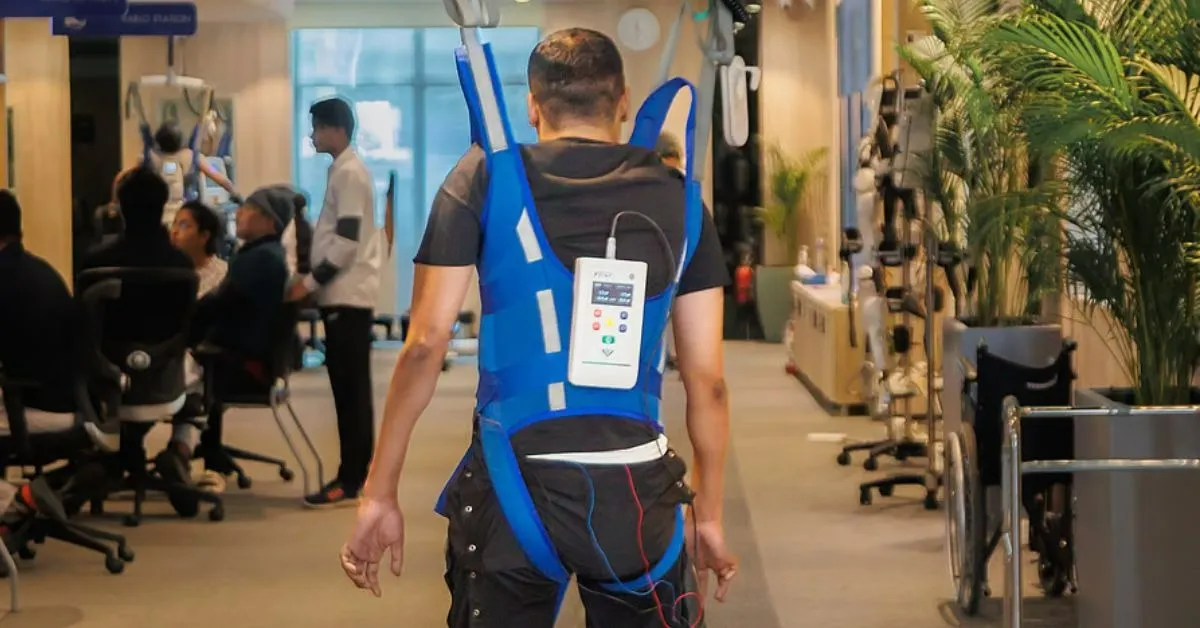
For 17 years, Dr Parag Gad has been working towards a moment many patients wait years to experience — a finger lifting, a leg responding, a small movement returning after paralysis.
What began as a PhD research project at the University of California, Los Angeles, grew into xStep, a non-surgical mobility device he now builds from Bengaluru. Designed for people with paralysis and cerebral palsy, the device is worn externally during rehabilitation and aims to support movement without implants or invasive procedures.
Today, through his company Vivatronix, Dr Gad is working to bring this technology closer to Indian patients — a journey that recently reached national audiences after his appearance on Shark Tank India Season 5.
So, how does it work?
Dr Gad’s innovation is built on the fact that movement is not controlled by the brain alone. It depends on ongoing communication between the brain, spinal cord, and muscles, which helps organise how we walk, grip, and stand.
When a spinal injury disrupts these signals, the body may struggle to move even if muscles remain capable. His research looked at whether mild electrical signals could help the brain and spinal cord communicate better.
xStep is worn outside the body during rehabilitation sessions. It sends mild electrical pulses that help activate nerves and muscles, supporting guided movement.
Some users notice early changes, such as finger or leg motion during sessions, and in a few cases, visible improvement has appeared within five minutes. The device has also reached patients outside India, including injured soldiers in Ukraine.
After years of research abroad, Dr Gad relocated to India in 2023 to bring the technology closer to patients. He formally founded Vivatronix in January 2025 to manufacture the device and expand its reach across rehabilitation centres.
From a research lab to Shark Tank India
On Shark Tank India Season 5, Dr Gad began his pitch by sharing the story of a child with cerebral palsy who struggled to achieve basic physical milestones. He followed this with videos of patients attempting movement after long periods of limited mobility using xStep during therapy.
During the pitch, Dr Gad invited Vineeta Singh for a live demonstration. As the device was applied and stimulation began, her fingers twitched and lifted involuntarily, drawing visible reactions from the panel.
He shared that the device currently costs about Rs 46,000 to manufacture and is sold at around Rs 3 lakh per unit, he hopes to reduce production costs to Rs 20,000 to Rs 25,000, which would make it more affordable over time.
In the end, Dr Gad accepted a three-shark deal from Namita Thapar, Vineeta Singh, and Kunal Bahl, securing Rs 1 crore for 10 percent equity to expand production and improve accessibility across rehabilitation networks.
As xStep grows, years of research now rest in moments that unfold inside therapy rooms — a finger lifting, a step attempted, a parent watching closely. If xStep can make those moments more frequent and more accessible, it could reshape what rehabilitation looks like for many families.
Sources
‘Namita Thapar calls Shark Tank India 5 pitcher ‘magical’ after he demonstrates device that can help Cerebral Palsy patients’: by The Indian Express, Published on 16 January 2026.
‘Can We Restore Mobility to Spinal Injury Patients?’: by Museum of Science (MOS), Published on 14 December 2020
‘Shark Tank India 5: Bengaluru Entrepreneur’s Mobility Device xStep Leaves Sharks Amazed’: by ABP Live Entertainment Desk for ABP Live, Published on 17 January 2026
‘Noninvasive Spinal Stimulation Method Enables Paralyzed People to Regain Use of Hands, Study Finds’: by Stuart Wolpert for UCLA Newsroom, Published on 25 April 2018.
Disclaimer : This story is auto aggregated by a computer programme and has not been created or edited by DOWNTHENEWS. Publisher: thebetterindia.com