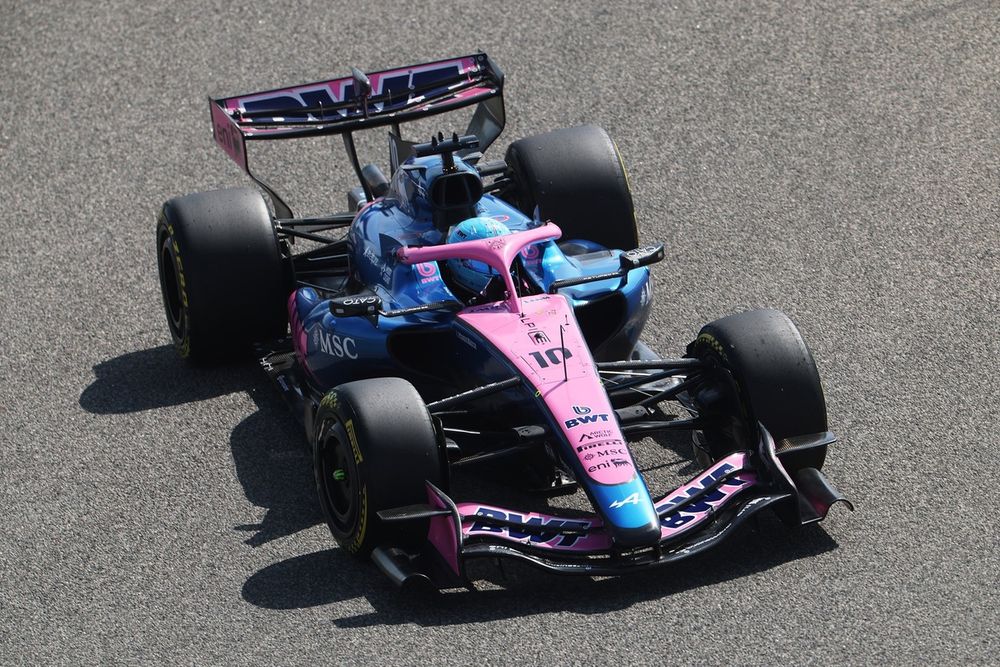
When Alpine’s A526 hit the track in Barcelona for ‘shakedown week’ at the end of January, it didn’t take long for eagle-eyed viewers to observe an unusual characteristic of the front wing. Even though pretty much the only external media present were watching through binoculars from a succession of nearby hills, frequently moved on by pointlessly heavy-handed security.
‘Team Enstone’ has a rich history of following its own path, even though it has gone through several iterations of technical leadership since its glory days as Renault in the mid-2000s. It pioneered radically undercut sidepods, now a ubiquitous F1 car characteristic; and under other names it introduced eccentricities such as front-mounted exhausts (ultimately rather less successful).
Among the unusual features of the A526 is pull-rod front suspension, a set up from which several other teams have moved away, and a rear wing flap that operates in the opposite direction from others. When the active aerodynamics are deployed, the actuator pushes the rear of the flap downwards rather than lifting the front of the flap upwards.
Pierre Gasly, Alpine
Photo by: Steven Tee / LAT Images via Getty Images
Though unlikely to be a game-changer, it naturally stands out as a point of difference, which may not necessarily offer any improvement.
Asked if the fact that nobody else had taken this approach made him nervous, Alpine managing director Steve Nielsen said: “Of course it does. I don’t know whether it’s the right one, or it would probably be a better question to answer later in the season.
“But, when you’ve had the year we had last year, of course you take comfort from things that are with the many…
“When something is unusual… It doesn’t mean it’s wrong and we did that for our own reasons. But, of course, you do think, ‘wow, that’s not the same.’
“It’s an obvious difference. But whether it’s the right direction or the wrong direction, who knows?”
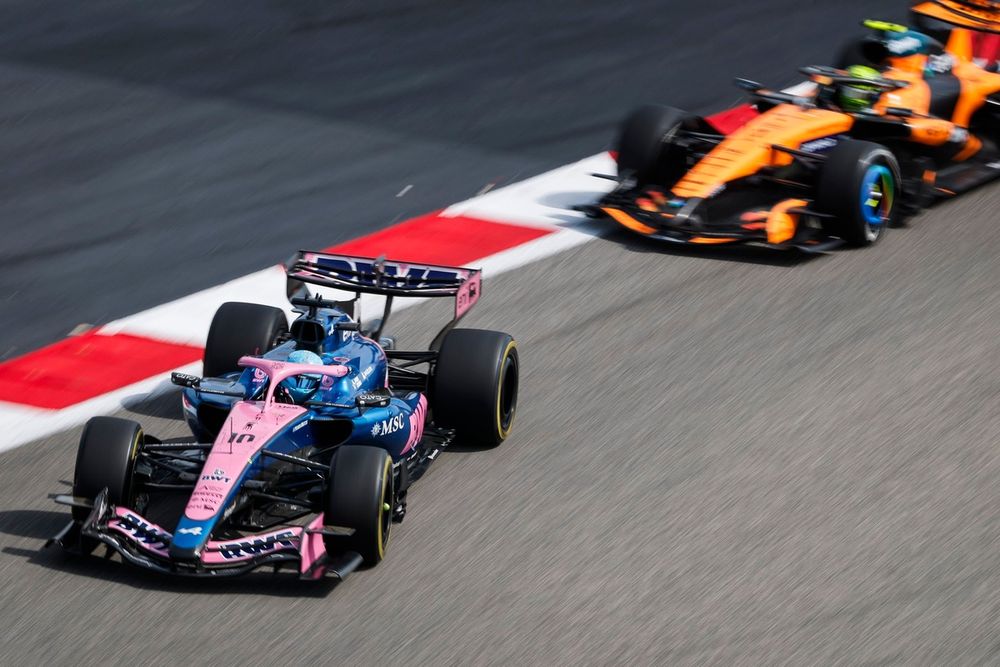
Lando Norris, McLaren, Pierre Gasly, Alpine
Photo by: Sam Bloxham / LAT Images via Getty Images
Rear-wing actuation may seem like a needless piece of minutiae to exercise the mind, but actually the mechanics of the active aerodynamics could play into the wider picture of competitive difference. Several leading engineers across different teams have pointed out that simulating the effects of the active aero on performance factors such as tyre loadings and rear ride height has been very difficult, as has accurately modelling phenomena such as flow reattachment when the wings close.
All these factors affect car balance and tyre life, as well as having second-order effects on stability as the active aero transitions between modes. Hence a lot of the running during the shakedown and first test has focused on practical measurement with flow-viz paint and pitot arrays.
This is the point of the season where teams are beginning to look at one another and identify what they might have missed. There will be a parallel process in which teams are trying to maximise their understanding of how their car works in real terms – while looking at how other teams have approached the same ruleset, and stealthily weighing up those solutions versus their own, plus whatever they have in the upgrade pipeline.
“We’re evaluating everything now. Absolutely everything,” said Nielsen. “Together with what we see on other cars. We see something, we model it, we try and reproduce it.”
We want your opinion!
What would you like to see on Motorsport.com?
– The Motorsport.com Team
Disclaimer : This story is auto aggregated by a computer programme and has not been created or edited by DOWNTHENEWS. Publisher: motorsport.com