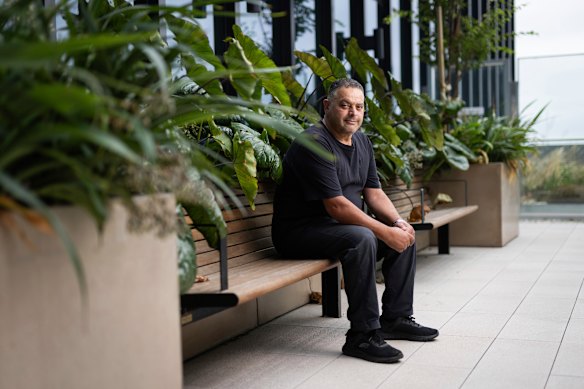

For 104 days, as he fought for his life in an intensive care unit, Rama El Souki didn’t know if it was night or day.
“It was a pretty dark place,” the father of four said of his lengthy stay at the old Footscray Hospital.
“I kept on asking, ‘What day is it? What is the time?’ I asked my wife to buy me a little digital clock that I put next to my bed.”
El Souki spent a total of six months in the dimly lit hospital in Melbourne’s west in 2024 after suffering a life-threatening bout of pancreatitis, a rare side effect of a popular weight-loss drug he was using. The 53-year-old lost most of his pancreas, his lung collapsed and he experienced kidney failure.
Next Wednesday, that “dark place” will be replaced by the new Footscray Hospital, a $1.5 billion health service on the corner of Ballarat and Geelong roads that harnesses natural light to help patients heal faster.
The design is backed by extensive research showing natural light helps patients establish a healthy circadian rhythm, leading to better sleep and a faster recovery time.
The Age this week toured the intensive care unit, which has sweeping views of the city and western suburbs. Unlike a traditional ICU set-up where the foot of the bed faces inwards, the ward’s 11 beds have been turned 90 degrees so that patients can see outside.
Professor Craig French, the intensive care unit director at Western Health, jokes that one of the rooms will be reserved for keen Bulldogs fans.
“It has a view directly over Whitten Oval,” said French, who treated El Souki during his hospitalisation.
The new hospital will accommodate more than 500 beds, with ICU patients able to be wheeled outdoors while in the comfort of their beds. More than 55,000 plants line the hospital’s balcony and ground level gardens.
A “medical services panel” housed in a glass box extends the ICU’s reach into the outdoors. It allows patients to remain tethered to oxygen and other medical equipment while experiencing natural light and fresh air. There’s also an outdoor button they can press if they need a nurse.
“They will be able to feel the sensation of having a breeze across their face,” French said.
French said intensive care units had traditionally done a poor job of providing a quiet place where patients can sleep.
“This will change that,” he said of the new hospital, which is just over a kilometre away from the old hospital on Gordon Street.
Every bed in the intensive care unit is located in a private, sound-proofed room. At the touch of a button, the windows running along the corridor can be frosted for privacy.
International research has found that hospital patients average only five hours of sleep per night, and fail to reach the seven to nine hours recommended for healthy cognitive and immune function.
This shortfall is often driven by environmental stressors such as noise. An Australian study found that noise levels in shared rooms in hospitals sometimes reached more than 100 decibels, which is comparable to the roar of a lawnmower.
Poor access to natural light has also been identified as an issue in hospitals.
Research has found that patients with beds near a window spend less time in hospital than those near a door. And those with access to high levels of natural light experience less distress. Light has also been found to prevent viral and staph infections and decrease a patient’s heart and pulse rates.
The 12-storey hospital, which was designed by Billard Leece Partnership and COX Architecture during the height of the pandemic, also includes a pandemic pod in the ICU. This pod can be used for patients with infectious diseases and is the only ICU room in Victoria that can be transformed into a completely negatively pressured space.
“It’s an insurance policy,” French said of the design. “It means that in a pandemic we’ll be able to completely separate the critically ill, infectious patients from the non-infectious patients.”
The growing prevalence of obesity in the community has also informed the design. The corridors and doorways have been widened for patients, and there’s a bariatric room with a larger chair and bed, and hoists in the ceiling that can be used to lift patients who weigh up to 500 kilograms.
Health Minister Mary-Anne Thomas said the new Footscray Hospital was one of the largest health investments in Victoria’s history.
“[It] will support families in the west for generations to come,” she said.
Footscray MP Katie Hall has strong family ties to the old red-brick Footscray Hospital. Her great-grandmother was on the hospital’s fundraising committee in the 1950s, and many of her relatives were born and died there.
She said while the old site had done a wonderful job servicing the community, the building was no longer fit for contemporary healthcare.
“To have this new hospital in the heart of Footscray is really important,” Hall said.
El Souki is now in a much better place with his health, and also visited the new hospital this week.
He’s a fan of the new family rooms, where people can be privately briefed by doctors about the condition of their loved ones. Medical scans can be flashed up on large screens in these rooms, to help families understand what is going on.
“It is a good environment for families,” El Souki said. “There are plenty of windows, and it is very spacious.”
Start the day with a summary of the day’s most important and interesting stories, analysis and insights. Sign up for our Morning Edition newsletter.
 Henrietta Cook is a senior reporter covering health for The Age. Henrietta joined The Age in 2012 and has previously covered state politics, education and consumer affairs.Connect via X, Facebook or email.
From our partners
Disclaimer : This story is auto aggregated by a computer programme and has not been created or edited by DOWNTHENEWS. Publisher: www.smh.com.au