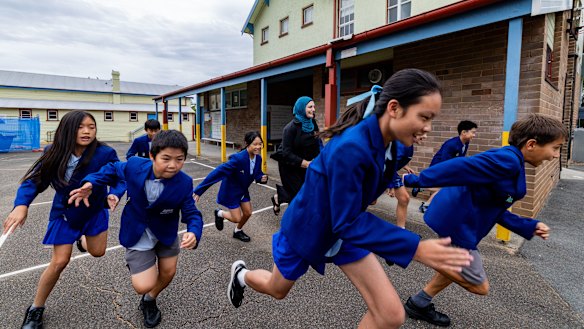

Bullied students would be given personalised safety plans that could include more supervision and their own “safe zone”, such as a library, under new bullying rules to be rolled out across all NSW schools next year.
Schools must prioritise student wellbeing, explicitly teach kindness, respect and inclusion, and counsel bullies rather than simply punishing them. Every incident must be recorded and responded to within two days, and all unkind behaviour must be addressed.
Schools will need a triage system that categorises bullying incidents into low, medium or high risk based on factors such as physical harm, emotional impact and recurrence. Each triggers a specific response, from counselling to external referrals.
The government-issued advice to public, private and Catholic schools is designed to help schools align their policies with an anti-bullying framework, with which every school must comply by 2027 or risk deregistration.
The new rules follow a 2024 directive from Education Minister Prue Car to the state’s school regulator to work with the education department, Catholic, and independent schools to develop an evidence-based, best-practice model to combat bullying.
A study of more than 20 countries found Australian students were among the most exposed to bullying, with nearly one in five saying others had made fun of them, and one in 10 saying they had been deliberately excluded.
The guidelines call for schools to use a range of techniques, including anonymously surveying students about their experiences, inviting children to help design anti-bullying campaigns, and classroom behaviour rules.
Teachers have been told to refrain from using labels such as “bully” or “victim” when dealing with incidents, and to teach students who bully others alternative ways to express emotions, resolve conflict and build relationships.
Teachers should “use guided discussions to help students who bully others to understand the impact of their actions and commit to change”, the guidelines say.
They recommend selecting students to become “cyber safety ambassadors” to promote respectful online behaviour, and they also suggest that teachers encourage students to “create videos, podcasts or social media content that showcase positive digital behaviour and promote anti-bullying messages”.
Students will be taught to support their classmates and alert staff when someone seems distressed or isolated; acts of kindness are to be publicly celebrated.
Teachers should be trained to explicitly teach skills such as empathy, emotional regulation, conflict resolution and responsible decision-making. They should also receive data analysis training to “interpret bullying data, recognise trends and understand how to respond strategically”.
The guidelines call for schools to develop personalised safety plans for victims, including additional supervision, safe zones and trusted adult contacts to ensure the children feel secure during and after school hours.
The framework is underpinned by research conducted by NSW behavioural expert Professor Donna Cross, who found “zero tolerance” policies that involve suspension and expulsion to be ineffective and potentially harmful.
Her research has also found that NSW public students who reported being bullied in the year before NAPLAN lost up to eight months of learning in literacy and numeracy.
“A zero tolerance policy as a blanket policy shows no care for children who engage in bullying,” she said. “If we don’t respond and teach them in a learning environment, which is what schools are, how to behave different, the evidence demonstrates that behaviour will continue.
“It will continue to the workforce, it will continue in their families. Those children as parents will have children who bully.”
Instead, Cross said that schools should work to rehabilitate bullies, offering them counselling and support to address the underlying motivation for their behaviour. Suspension and expulsion should be used only as a last resort.
“What the new guideline is doing is really helping the schools to be more bespoke and tailored in the way that they address bullying,” Cross said. “The anti‑bullying guidelines are really guardrails to say: here are the things that will make the most difference.”
At Lake Macquarie’s Heritage College, every day begins with a short assembly on a weekly virtue and college principal Simon Dodson says that teaching students how to be a good human must be a school’s primary objective.
“We put character education in the first order of importance,” Dodson said. “Not everyone’s going to succeed academically … but everyone needs to become a good person.”
Dodson draws a line between bad behaviour – a one-off insult or cruel comment, which still requires correction – and bullying, which is a repeated abuse of power. “Bullying can be eradicated … if everyone has a place and everyone’s valued and belongs,” he said.
Hurstville Public School – which meets the new mandatory criteria – has invested in a wellbeing hub and sensory play space. There are three part-time youth workers who attend the school each day, acting as an on-call support worker.
Support worker Eman Roumieh said prevention has made the biggest difference. “We’ve never reached suspension, which is fantastic to hear, but because of the whole preventative work that we do.”
 Emily Kowal is an education reporter for The Sydney Morning Herald.Connect via email.
From our partners
Disclaimer : This story is auto aggregated by a computer programme and has not been created or edited by DOWNTHENEWS. Publisher: www.smh.com.au