
Why do the leaves on specific trees outside your window change colour?
Why do ships float on water?
Why do magnets stick to the fridge?
Bengaluru-based Sonali Dasgupta’s 15-year-old daughter Srishti isn’t the only one who has these questions. Children across India do.
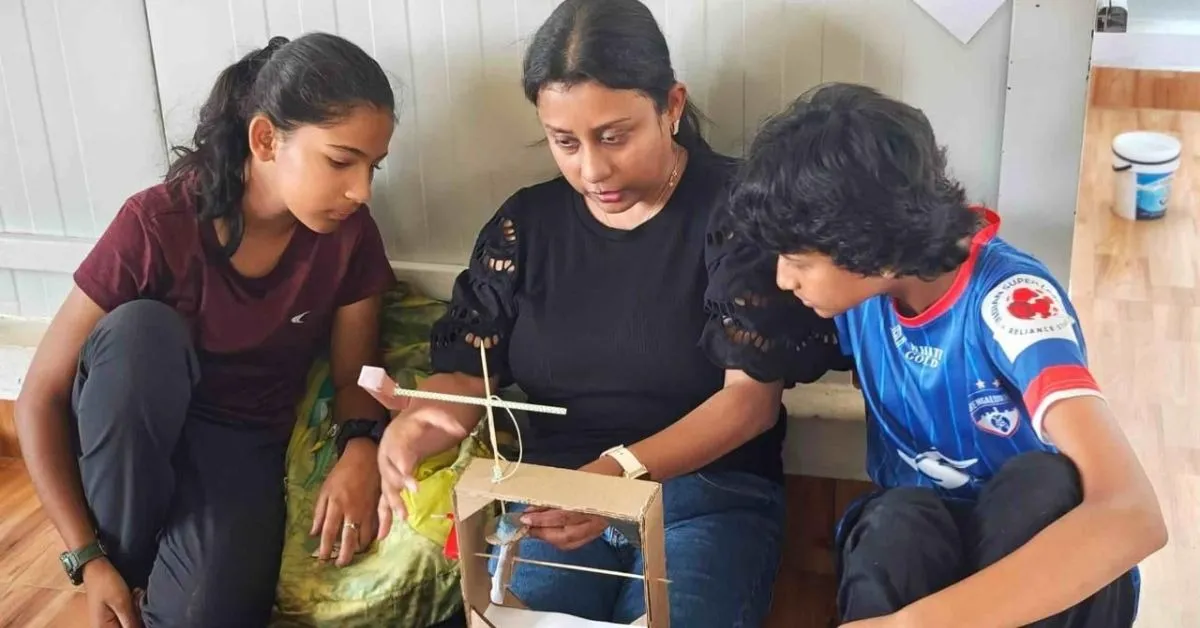
And instead of directing them towards a paragraph in a textbook, Sonali, a research scientist with a PhD in physics from IIT Delhi and 15 years of professional experience working with some of the best minds in science, develops an experiment to simplify the concept.
In an instant, a bullet point in a textbook is brought to life. These classes are part of ‘STEMonsters Education’, a learning ecosystem for students in classes 3 to 12 that bridges the gap between textbook theory and real-world application, transforming curious children into confident innovators.
The modules are a pivotal departure from the rote learning system that’s otherwise common across the Indian academic framework.
Bringing the lab into the home
The idea for STEMonsters Education was born out of her daughter’s curiosity, Sonali shares. Every time Srishti had a doubt, Sonali would construct a model or experiment to answer it. And the lockdown amplified these experiences, eventually leading to the Bengaluru mom launching STEMonsters Education during the second wave of the pandemic in 2021.
Sharing more about it, Sonali recalls how, when Srishti was younger, she would often bring home model samples from the lab or take Srishti along to work. The lockdown, however, brought these experiences to a halt. Determined to keep her daughter’s curiosity alive — the same curiosity that had guided her own journey — Sonali decided to recreate the lab environment at home.
Even as the world seemed to pause during the pandemic, their learning did not. Their days were filled with small experiments and hands-on activities, guided by a simple belief: the best way to understand something is by doing it.
“Often, academics in Indian schools do not think beyond definitions. While working in some of the best labs in the world, I was exposed to different approaches and watched how kids were introduced to science. I strongly believe our curriculum is one of the best, but it needs an overhaul in the way we introduce it to children,” Sonali shares.
/filters:format(webp)/english-betterindia/media/media_files/2026/02/13/education-1-2026-02-13-18-04-10.jpg)
She elaborates, “At STEMonsters Education, primary school children learn core concepts around shapes, solutions, simple machines, and colours, while middle school children explore interdisciplinary domains such as forensics, applied chemistry, genetics, and space science. High school modules are focused on quantum physics, aerodynamics, electromagnetism, zoology, and botany.”
Beyond the core science programs, children can also enrol in technical learning modules such as robotics, 3D design and printing, app design, and coding.
Through online classes and offline sessions — workshops conducted across schools, STEMonsters Education is reinventing the wheel of science education by shifting the focus from memorising concepts to experiencing them through curiosity-driven, hands-on learning.
/filters:format(webp)/english-betterindia/media/media_files/2026/02/13/education-2-2026-02-13-18-06-22.jpg)
And now, Sonali is calling children from across India not just to be an audience to experiments that make learning science fun, but to come up with their own. Elaborating on STEMXplore 2026, a flagship annual symposium organised by STEMonsters Education to celebrate National Science Day of India, she calls it “a celebration of discovery and creativity, where young minds transition from being mere consumers of technology to becoming creators and storytellers of innovation”.
Encouraging children to turn science into real projects
Elaborating on the various events children can sign up to compete in, Sonali shares that there is the Junior Hackathon for classes 4 to 6. Designed for young digital creators, this event will test logic, creativity, and the ability to build solutions in 72 hours.
The ‘Let’s Talk STEM’ competition is for classes 7 to 12 and will focus on the art of science, calling students to distill complex STEM concepts into a clear, engaging three-minute presentation. “It challenges them to prove that they truly understand the ‘how’ and ‘why’ of science by explaining it to a diverse audience,” Sonali shares, adding that the theme for this event is ‘Learning in the Age of AI: Efficiency vs Ability’.
/filters:format(webp)/english-betterindia/media/media_files/2026/02/13/education-3-2026-02-13-18-09-21.jpg)
Students from classes 7 to 12 can also participate in the ‘Story Behind My Tech’ competition, an innovation challenge where individuals or groups of up to four explore the engineering and research behind modern or original technologies. The theme is ‘Engineering Energy Efficient Communities’.
The grand finale of this journey takes place at the Indian Institute of Science (IISc), Bengaluru, where the winning students will get a chance to display their innovations and win prizes. If you are a school or a student who would like to participate, you can register here.
All pictures courtesy Sonali
Disclaimer : This story is auto aggregated by a computer programme and has not been created or edited by DOWNTHENEWS. Publisher: thebetterindia.com






