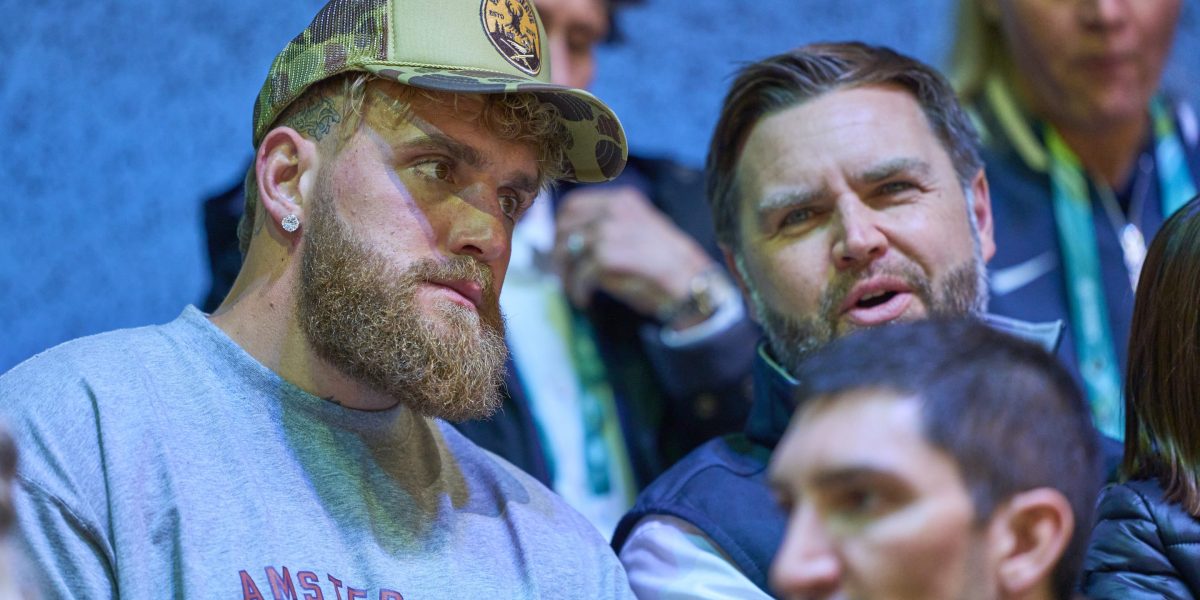
Jake Paul crossed paths with OpenAI CEO Sam Altman at President Donald Trump’s second inauguration ceremony last year, Paul said in an interview with TBPN alongside his business partner, entrepreneur Geoffrey Woo. Paul endorsed Trump in the run up to the 2024 presidential election and has since revolved around his orbit, most recently sitting shoulder to shoulder with Vice President JD Vance at the Winter Olympics in Milan.
At the inauguration, Paul, naturally, had thoughts to exchange about social media with Altman. After all, the Paul brothers, Jake and Logan, famously parlayed their viral YouTube presences into professional careers, Jake as a boxer and Logan as a wrestler. Last year, Jake ranked third on Forbes’ Top Creators list, with earnings of about $50 million. A deal was soon in the offing, as Paul became the first celebrity to license his name, image, and likeness to Sora, OpenAI’s text-to-video platform.
The internet was soon saturated with AI-generated iterations of Paul, portraying him, for instance, as a ballerina in a tutu, a pudgy robber at a fast-food store, or even clumsily applying makeup. While the deal sparked controversy and fanfare alike, it also reeled in over one billion impressions for a portfolio company part of Paul’s venture capital fund, Anti Fund.
Co-founded by Paul and Woo in 2021, and later adding Logan as a general partner, the Anti Fund positions itself around an “anti” or rebel ethos, aimed at supporting nontraditional, iconoclastic founders. It has transitioned from its 2021 roots as a rolling fund in Miami into a $30 million institutional-style firm, with over $65 million in assets under management—a small investment firm, to be sure, but above the median seed fund valuation, which was about $15 million in 2024, according to equity management platform Carta.
The new currency of Silicon Valley
Like Paul’s Anti Fund, a growing number of funds are positioning themselves as champions of the attention economy. a16z has built an in-house media agency—with a self-given nickname as “the Thiel fellowship for the chronically online”—to ensure their portfolio companies dominate the industry narrative. And First Round Capital uses its First Round Review to provide founders with all-in-one distribution engines and tactical marketing playbooks, as well as engineering, management, and design skills.
“That marketing distribution strategy has become a lot more valued in Silicon Valley,” Steve Han, a partner at Anti Fund, told Fortune. “I think that’s why Anti Fund is getting a lot of attention in its current world.”
Paul’s clout has unlocked access to highly exclusive “hot rounds” in companies including OpenAI, Anduril, Polymarket, and Ramp. And while Paul may not resemble a traditional investor, Han said founders often prefer working with Paul because he and Woo carry the “battle scars and wisdom” of being entrepreneurs themselves.
According to Han, Anti Fund helps tech startups with distribution—getting their products in front of customers—and their marketing narrative. Paul brings social-media savvy to the firm, having gone viral with absurdist YouTube music videos, including his 2017 song “It’s Everyday Bro,” which drew over 300 million viewers. His 2024 fight against Mike Tyson also went viral, attracting 108 million viewers, according to Netflix, making the event the biggest boxing gate outside of Las Vegas in U.S. history.
Woo, Paul’s co-founder, brings the brains of the operation, with a storied past as a serial entrepreneur and venture capitalist. Woo is a Stanford-trained computer scientist, and has founded several other companies outside of Anti Fund, including Ketone IQ, an energy shot brand.
The “Zynternet” and a cultural sea change
The convergence of influencer culture and venture capital is part of a broader shift reshaping America’s institutions. Trump 2.0 has given light to a new fleet of right-wing entrepreneurs, including the Paul brothers, whose core audiences include young men who treat investment as a machismo-fueled pursuit.
“They’re important nodes in a big network of masculinist, right-wing influencers,” Max Read told Fortune. Read, a former Gawker editor-in-chief who now runs his own Substack in between occasional appearances on The New York Times opinion page, coined the phrase “Zynternet” to describe the certain mix of macho, right-leaning entrepreneurialism that unites figures such as the Paul brothers and Joe Rogan. “The worlds of crypto, the worlds of the Paul brothers, the worlds of YouTube influencers, the world of Silicon Valley, are much closer than what you might expect,” he told Fortune.
Read added that he thinks leaders in tech and VC are responding to a real shift in the zeitgeist. “I think there’s this real sense in Silicon Valley among people like Altman, Zuckerberg, even your Tim Cooks, that a sea change in culture has happened,” Read said. “What they’re hearing from the employees they’re listening to, what they’re seeing in the election results is…the future is Jake and Logan Paul.”
The move to institutionalize Anti Fund is therefore only a logical response. “[They’re] trying to cash in while the cashing in is good,” Read said. “Starting a fund while Trump’s still in power, while there still is space online to be a Paul brother and be famous seems like a pretty smart move.”
The cost of attention
For a fund of its size, securing allocations in competitive growth rounds for companies like OpenAI and Anduril serves as an early signal of success, proving the firm can win space typically reserved for industry giants. Yet Anti Fund faces pressure to overcome Paul’s provocateur image. Most recently, Paul came under fire—even from his brother—for calling Bad Bunny a “fake American” ahead of the musician’s Super Bowl halftime show. He later walked back the comment. And in 2023, Paul reached a settlement with the SEC for illegally touting a crypto scheme.
That reputation could impact Anti Fund’s portfolio companies. Paul occasionally shares promotional posts on X to his 4.4 million followers. While the posts often gain millions of views, it’s sometimes for the wrong reasons. A post promoting AI company Cognition earned more than 2 million views but also ridicule over his credibility as an investor in AI.
Yet as the internet continues to debate Paul’s credentials, Han said he’s confident in Anti Fund’s ability to grow, something he says they’ll prove over social media. “We’re going to do amazing things in 2026,” Han said. “And then hopefully we’ll show it over YouTube.”
Disclaimer : This story is auto aggregated by a computer programme and has not been created or edited by DOWNTHENEWS. Publisher: fortune.com