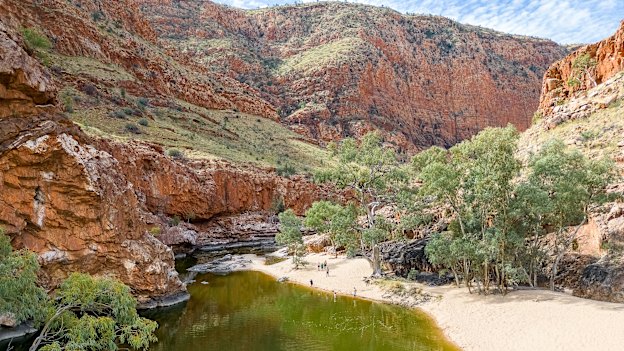
The water in the ancient Ormiston Gorge is still and deep, rippling as the man in Speedos straddles a pink unicorn and paddles into the waterhole. His companion, resplendent in a glittery mermaid outfit that frames his hirsute chest, steps into the chill water and raises his arms as Cher belts out the1998 gay anthem, Believe, her “maybe I’m too good for you” lyric echoing in the red-rock gorge.
Here, everyone is looking for something. Searching for healing. Seeking inspiration. Yearning for peace. Or even just hoping for their own Priscilla moment. They’ve all come to find it in Australia’s Red Centre.
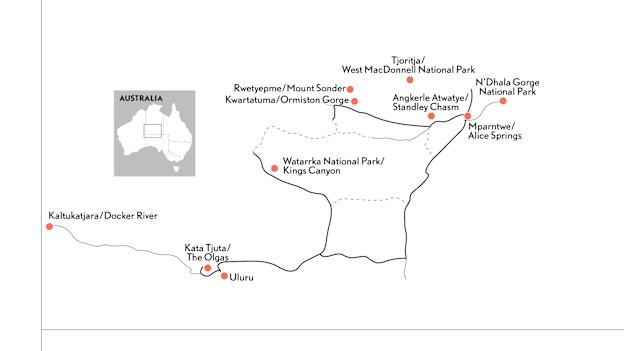
On an eight-day holiday, I’m driving the region’s iconic route, the Red Centre Way, to visit Kings Canyon and Uluru.
While the famous gonzo journalist, Hunter S. Thompson, might have packed hallucinogens and his lawyer for a road trip, for mine I’m packing three teenagers, a photographer and a whole lot of Weet- Bix.
Along the way, we meet grey nomads following a slow road, couples travelling fast and light as they tick off icons, and loads of families on the road and in campgrounds.
Sign up for the Traveller Deals newsletter
Get exclusive travel deals delivered straight to your inbox. Sign up now.
We camp beside Kombi vans full of Byron Bay “brothers and sisters” and convoys of rugged off-grid rigs designed for outback travel. Linked by shortwave radio and a tribal shorthand, each rig is unlikely to give you much change from half a million bucks.
The Red Centre’s not a new tourism destination, and it’s certainly not a new human desire to watch the sun rise over Uluru, as demonstrated by the hundreds gathered at Talinguru Nyakunytjaku, the sunrise viewing area east/south-east of Uluru.
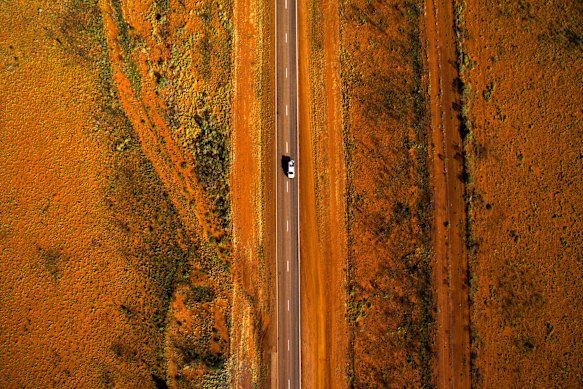
Parents rummage in bags for muesli bars to quell querulous children, a man shouts about stocks into his phone; I hear French, Japanese and German among the Australian accents. What is new is that we city dwellers can now “do” the outback in a much shorter amount of time, even across a weekend.
In the 11 years that Steven Baldwin has worked for NT Parks at Uluru, he’s seen a massive change in how we visit the Red Centre. “The majority of people used to come via vehicles, but that’s changed with budget airlines,” he tells me in the cool of Uluru’s administration centre. “We get more people flying in than driving. Most are time poor so they want three or four days at Uluru, tops.”
With soaring fuel prices and doable airfares even during school holidays into Uluru – note, not Alice Springs – it’s time and cost-effective to fly in and join a tour or, as we’ve done, hire a car or four-wheel drive locally.
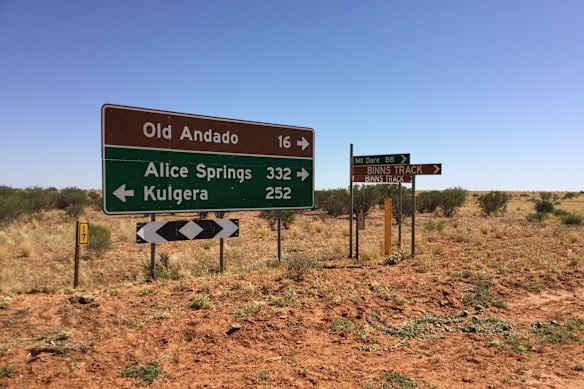
But first, let’s do the numbers for a refresher of the distances across our vast country. Uluru is a solid 2320 kilometres from Melbourne and 2850 kilometres from Sydney, which roughs up to a four to five-day drive.
Unless you’ve dropped out for the big lap around Australia, or fall into the grey nomad category, who’s got the time to spend 10 days driving to and from your destination? Throw in fuel that’s touching $3 a litre at popular stops such as Kings Creek Station or Curtin Springs Station, and a 3.5-hour flight with a budget carrier’s starting to look mighty appealing.
From flat whites to wild-eyed emus
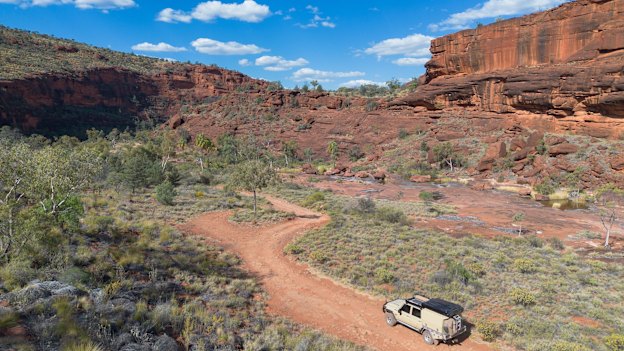
“Drive on the left!” signs for international drivers pop up roadside, as our hired Ford Ranger hurtles down Luritja Road. Kings Canyon is behind us, Uluru ahead in the distance.
The last time I drove this road, it was my mother, Brigid, in the passenger seat of the last hire car left in Yulara – a banged-up sedan. Devastated by end-stage cancer, this was her first and only visit to Uluru, a last wish fulfilled. As a rule-breaking 19-year-old, she’d hitchhiked around Australia in the late 1960s, but she couldn’t thumb a lift on the bone-crunching dirt track that connected Uluru to the Stuart Highway, which runs from Port Augusta in South Australia to Darwin.
While the first dirt roads to Uluru were built in 1948 for miners and a handful of travellers, an airstrip followed only 10 years later. The road, now Lasseters Highway, was sealed in 1983.
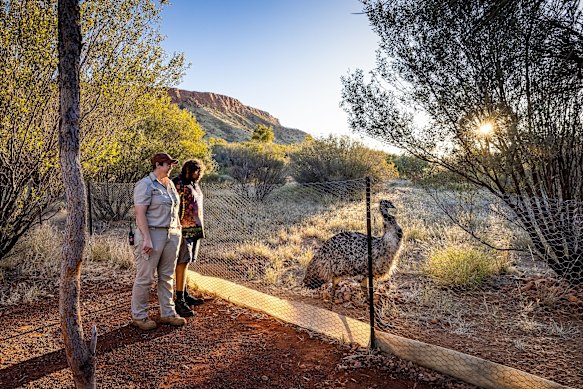
This time, we’re doing the full Red Centre Way loop, from Mparntwe to Tjoritja, to Watarrka, Uluru and Kata Tjuta, before returning to Mparntwe. Or, to put it in the language of my mother’s generation, from Alice Springs to the West MacDonnell Ranges, Kings Canyon and on to Ayers Rock and the Olgas, returning to Alice up the Stuart Highway, fuelled by $7 flat whites and selfies with wild-eyed emus at Erldunda Roadhouse.
Whether you’re speaking Pitjantjatjara, Yankunytjatjara, Luritja, Arrernte or English, it’s a 1100-kilometre round trip. The loop is sealed except for the 155-kilometre Mereenie Loop Road section, which requires an all-wheel-drive vehicle and like much of this drive route, passes through Aboriginal-owned lands.
It rained here a few days ago and a local along the West Macs warns me the road was recently graded, turning it into a backside-numbing sea of corrugation that will loosen molars. He’s not wrong.
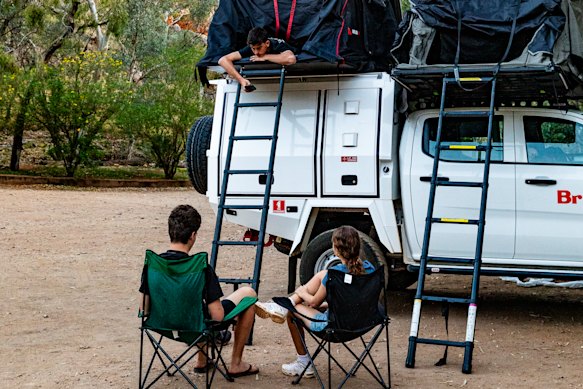
The traffic, all AWDs, thins noticeably. Our vehicle, with its two rooftop tents, holds the road well but it’s still a solid three-hour drive, including a stop for a small band of wild donkeys who pause for a photo shoot before sauntering off into the desert, and a mob of flighty young steers who disappear in a cloud of red dust.
“The sealing of the Mereenie Loop road is our No. 1 priority, completing the link from Alice Springs to Uluru to create one of the world’s great drive routes,” says Danial Rochford, chief executive of Tourism Central Australia, who notes it was first flagged in a tourism development plan in 1969, along with a luxury resort at Yulara, in what is now Ayers Rock Resort.
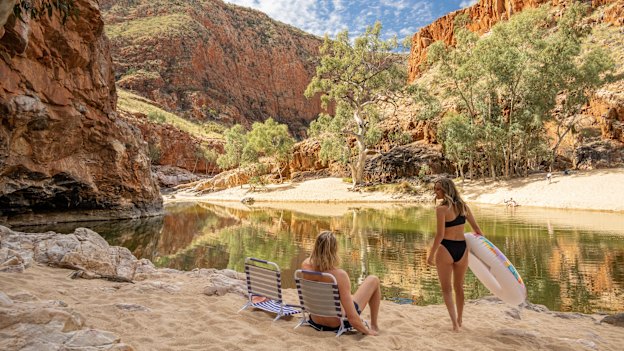
At the Ormiston Gorge kiosk, renowned for its beautiful location and its scones, the locals couldn’t agree more. “A lot of our people are on dialysis and they don’t have the money for big four-wheel drives,” says Arrernte man Michael O’Brien, while making me a coffee. “They drive the loop in their Commodores, and the corrugation is bad for cars. So for them, it’d be a good thing, and it’ll bring a lot more people to the area.”
For the Territory, the drive market is a key pillar in its charm offensive. The next decade may see some of its iconic AWD tracks sealed, including the 1013-kilometre Tanami Track, which runs from the Stuart Highway near Alice Springs, passing through Warlpiri lands and the Tanami Desert, to connect with the Great Northern Highway near Halls Creek in Western Australia.
Without pausing at its string of remote art galleries or the 300,000-year-old Karntimarlarl/Wolfe Creek Crater, it’s the fastest way from Alice to the Kimberley. In its current form, the Track’s not for the faint-hearted; there’s a 600-kilometre gap between fuel stops, and floods and washouts close it frequently during the rainy season (November to April).
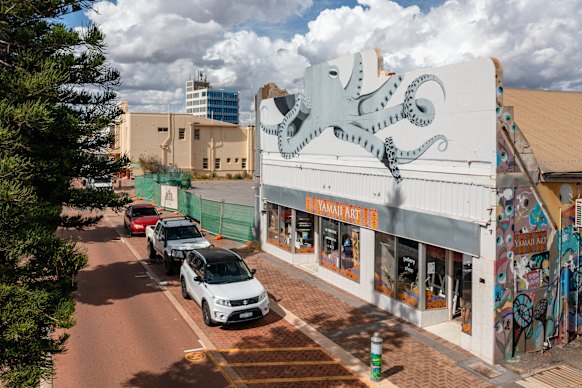
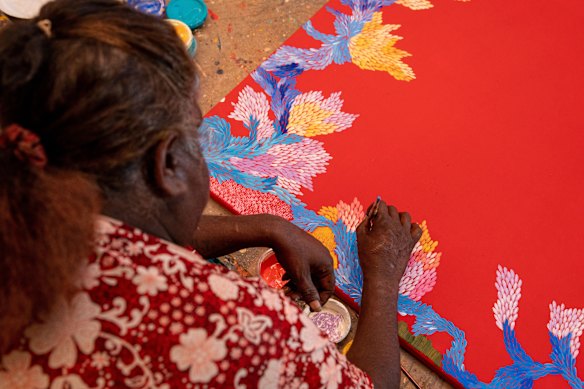
Road-sealing gangs are also at work on the east-west Outback Way. Billed as Australia’s longest shortcut, it runs from Winton in western Queensland to Laverton in Western Australia, 350 kilometres north of Kalgoorlie, passing through Uluru and on to Kaltukatjara/Docker River, on the NT-WA border. Stretching 2800 kilometres, the plan is to seal the entire route by 2032.
It will create the third transnational route across Australia joining the Eyre Highway, which crosses the Nullarbor in the south, and the Savannah Highway that runs along the top of the country.
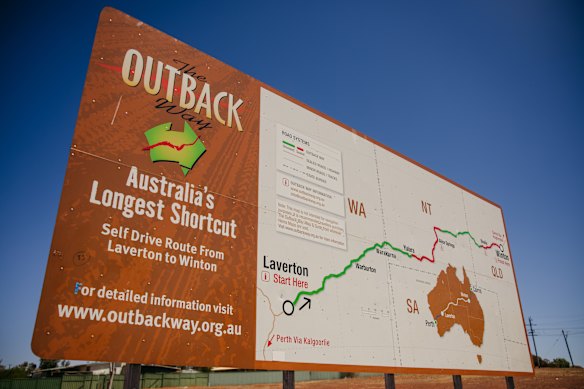
“A sealed Outback Way is a game changer for Central Australia” says Mel Forbes, general manager of the Outback Highway Development Council, which is overseeing the project.
“For tourists, it’ll be Australia’s Route 66,” she says, as it opens up the overlooked East MacDonnell Ranges to the east of the Stuart Highway. “It’s quite a challenge to bring focus from our coastlines to Australia’s interior. There are huge benefits for remote communities and so much development of cultural tourism along the Plenty Highway [from the Stuart Highway to the Queensland border].”
But, while one car door opens, another closes; and while sealing the tracks will allow even two-wheel drives into the heart of the outback, it also risks losing the AWD market. If it’s too successful, will it change the nature of tourism in the outback?
“I hear a wide spectrum of responses to the sealing of the road,” says Forbes, “including, ‘where am I going to drive my big 4WD now?’
But for people who live out there, they can’t wait. They deserve a sealed road and not having to carry two or three tyres in the back of their car.”
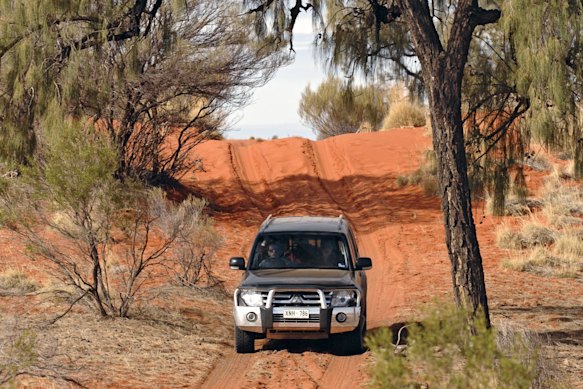
“For every sealed road, there are another three unsealed,” Rochford assures me and anyone lamenting the sealing of these iconic outback roads. “The Binns Track is one of the great AWD tourism routes going into the East Macs [MacDonnell Ranges]. It passes Ruby Gap, one of the best parks in the Territory, the reopened Arltunga Pub, Indigenous art galleries and Gemtree, where you can fossick for garnets.
“One of the charms of an unsealed road is that you won’t see the level of tourism you get in the West Macs and Kings Canyon,” he adds from his Tennant Creek office. “You’re going to be there almost by yourself, in the serenity.”
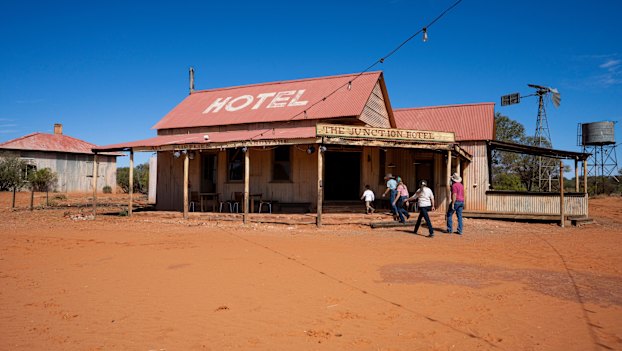
He’s right: our most unexpected stay on this trip is at Ooraminna Station, just 35 minutes’ drive from Alice Springs, south of the East MacDonnells.
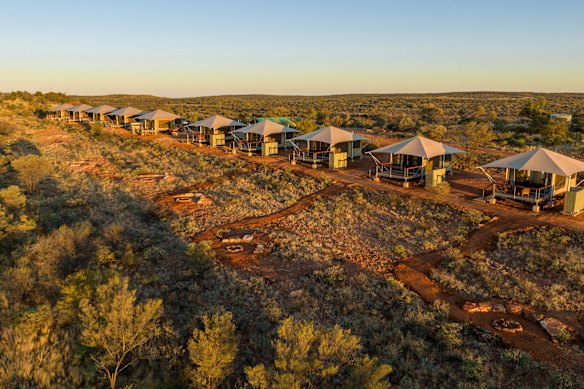
The 242-hectare property, which include glamping tents, a handful of tiny cottages and campsites, is like a gold-rush-town movie set. The old pub has a dusty piano and after threatening to throw the kids in the olde-time police lock-up, we set up camp by the glow of fairy lights strewn above the red-dirt “town” that is ours alone.
The next morning, I’m the only one keen for a dip in the homestead’s pool, where dragonflies skim the surface of the water warmed by the bright sun.
Of footprints ancient and modern
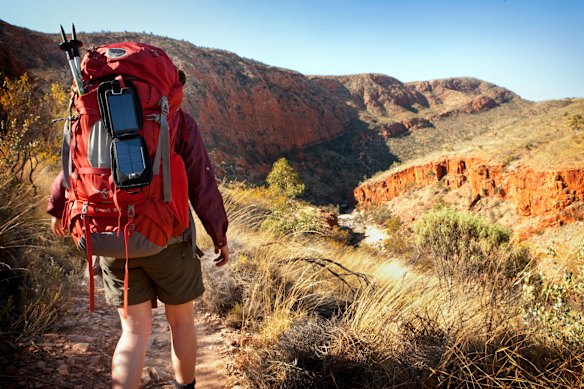
At the Ormiston Gorge campsite, it’s hours since sunset and the communal barbecue, when a hiker steps out of the shadows, pack sitting low on his hips.
He’s hiking the 223-kilometre Larapinta Trail, which runs from Alice Springs to Rwetyepme/Mount Sonder, the highest point in the West Macs. Fully opened in 2002, the Larapinta is one of the great long-distance walks of Australia, and is broken into 12 sections with designated hiker-only campsites.
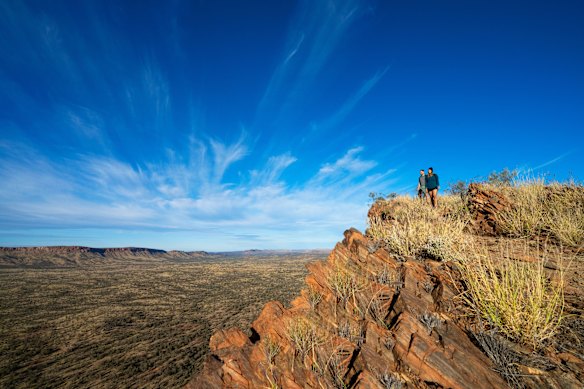
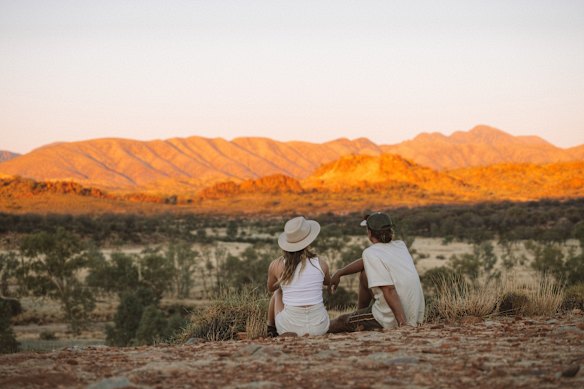
Come April, the Larapinta will be joined by the Uluru-Kata Tjuta Signature Walk. Operated by the Tasmanian Walking Company, the five-day, 54-kilometre walk connects the two majestic inselbergs, and advance bookings are selling faster than sausages at a charity sizzle.
Walkers will sleep in safari tents in private, off-grid desert camps that can be broken down and removed without a trace. Additional to the walk will be bush tucker experiences, benefits for traditional owners, escorted walking and luxury stays.
“It’s what New Zealand has been doing for years, and Australia’s catching up,” says Baldwin. “It’s really hit the market.”
The next multi-day walk on the drawing board is centred around the Watarrka National Park, home to Kings Canyon, and Rochford forecasts the walk, which is fully funded in partnership with traditional owners, will open in the next couple of years.
“Three of Australia’s iconic walking experiences will be in Central Australia and we are starting to see a significant rise in international visitors on our walking trails,” says Rochford.
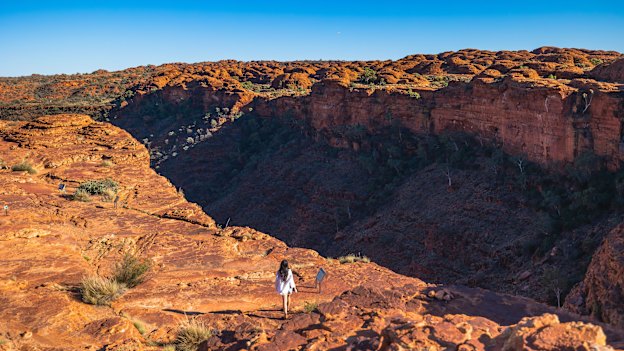
Your average stroller is not forgotten; the 10-kilometre Uluru Base Walk and the six-kilometre Rim Walk around Kings Canyon are two popular short walks in the region, but even they’re morphing with the times. The last time I was on the Rim Walk, an older man ahead of me, perhaps overestimating his ability, the heat and the climb, suffered a suspected heart attack. Now, I notice defibrillators and radio boxes along the walk. I meet a ranger, who catches her breath after a steep hike up the walls of the Lost City. “I just huff away,” she says, modestly.
She completely downplays the fact her giant backpack carries litres of water and first-aid equipment, as she checks on the groups along the path. This spring day, it’s a perfect 27 degrees; next week it’s forecast to hit 36, with heat restrictions in place. “Here, it doesn’t become summer. It just is summer,” she says.
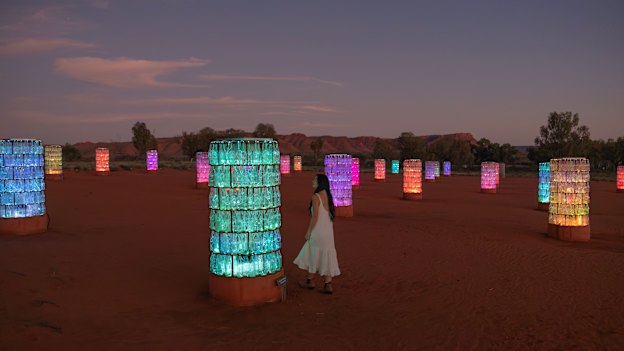
That night, walking through artist Bruce Munro’s Light-Towers installation at Discovery Resorts Kings Canyon, I meet a group of four who’ve arrived in very different circumstances. Two sisters zip through the highlights on a four-day AAT Kings bus tour for a couple of thousand bucks each, flights included. Meanwhile, the couple is travelling on the Ghan (the luxury train that runs from Adelaide to Darwin), and stop midway for some red dust; for them it’s an investment of 16 days and costs more than $10,000.
The Ghan is operated by Journey Beyond, an Australian-based tourism company owned by US private equity firm Crestview Partners, which is shaping up as a major player on Australia’s remote tourism scene.
The company, whose tourism businesses in Central Australia include the Indian Pacific and Outback Spirit Tours, has also struck a deal to buy the Ayers Rock Resort business from Voyages Indigenous Tourism Australia.
While the deal has been negotiated with traditional owners and commits profits to the Anangu Pitjantjatjara Yankunytjatjara, some local Indigenous people are concerned about the foreign management of this Australian icon.
However, the company says the experiences at the resort and its Indigenous training program won’t change as a result of the sale, which is expected to be completed early this year.
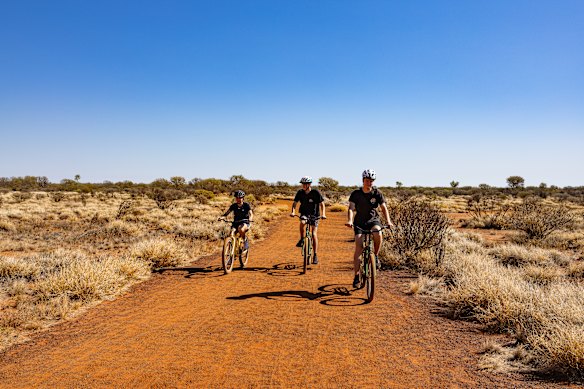
At Uluru’s base walk, while there are plenty of walkers, the Segway tours are so popular, they’re booked out well in advance. Hiring old-school beach cruisers and pedalling slowly between each of the interpretation panels is a winner for our trio of teens, and it still takes several hours, pausing beneath shady overhangs to read about the monolith’s role in Anangu culture and history.
Enthroned in the desert, Uluru and Kata Tjuta remain aloof, two constants in a fast-changing world. If anything, rules and regulations are determined to halt the clock, to keep the 550 million-year-old inselbergs pristine in a state of stasis.
It’s been six years since the rock climb was closed in October 2019, but the experiences around Uluru are booming. Sunrise Journeys is an ethereal art installation that floods the land with artwork designed by Anangu women Selina Kulitja, Denise Brady, and Valerie Brumby at dawn with Uluru in the distance.
The artwork is titled Ngura nganampa wiru mulapa, “Our Country is truly beautiful” in Pitjantjatjara. While the light installation washes over the land before us, the women’s voices are heard: “We dance, we sing, and heal our spirits. We feel connection in our heart. Now there are footprints from other places in our camp. We sit together and share food and knowledge. We share with love and respect.”
It is heartbreaking that they have to ask for respect in their homeland, but it is possibly the most beautiful, thought-provoking experience on offer at Uluru; the original work now hangs in the Gallery of Central Australia in Ayers Rock Resort.
“It should be compulsory for everyone who comes to Uluru,” a staff member at the gallery tells me. I cannot agree more.
Into the palace of princess parrots
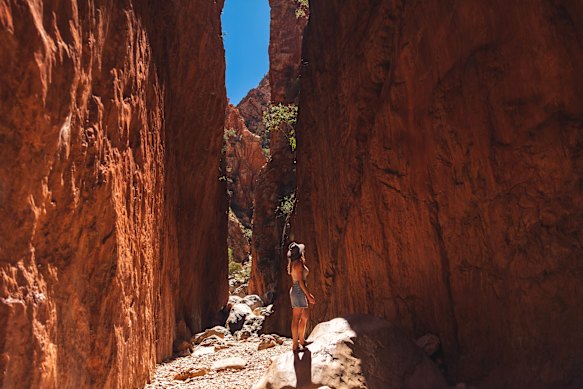
At Angkerle Atwatye/Standley Chasm, morning is heralded by a leaf blower and Miley Cyrus’ Party in the USA playing in a cafe. I meet Arrernte man William Palmer and as we walk into the dramatic chasm, I hear two male grey shrikethrushes fight for love, spy a pair of perky princess parrots and point to where I’d spotted rock wallabies the night before.
It’s a precursor to Palmer’s nature walks, Tjarnintja Tours, and a peaceful end to our eight days, driving more than 1100 kilometres, eating camel burgers and bush tucker high teas, walking creeks and escarpments, and swimming in every body of water big enough to contain me.
That I’ve enjoyed these experiences is a privilege that cannot be replicated anywhere else in the world. While one part of me selfishly wants to keep it untouched, don’t the residents of the Red Centre deserve better facilities, bought by roads and through tourism?
At a time when so many of us crave authenticity, perhaps we should celebrate our desert cultures and be proud others want to experience our unique beauty, too.
How to stay safe in the outback
Temperatures
Winter is peak season for travellers; late autumn and early spring are shoulder seasons. By September, temperatures can hit 36C, reaching 45C at Uluru. Many businesses close from November to the end of March.
Wildlife
Dingoes are common around Kings Canyon, so lock up your food and zip tents closed. Avoid driving at dawn and dusk when animals, especially kangaroos, are crossing roads.
Breakdowns
In case of car trouble, pull off the road and open your bonnet so others know you need help. Stay with your car. Mobile phone coverage can be patchy, even if you have Telstra.
Gear
Consider buying a Personal Locator Beacon, which uses satellite signals to activate an emergency response. Otherwise, Macpac hires beacons to customers. Carry printed maps as a back-up.
Water
Carry five to 10 litres of water per person in your car as well as food, and carry water even when going on short walks. See northernterritory.com/drive
Five of the best Central Australian festivals
Desert Mob
Exhibitions, artist talks, markets and workshops are the highlights of this annual Aboriginal art festival held in Alice Springs. See desertmob.com
Australian Outback Marathon
A flat course on red dirt, the 42-kilometre course starts in front of Uluru, 25 July. See australianoutbackmarathon.com
Parrtjima
The MacDonnell Ranges is illuminated with light shows and artworks during this 10-day, free festival held on Arrernte Country, April 10 to 19. See parrtjimaaustralia.com.au
Blacken
N’Dhala Gorge, in the East MacDonnell Ranges, hosts this heavy-metal music festival with an international line-up. See blackenopenair.com
FabAlice
Four days of drag and diversity in the desert, March 26-29 March. See fabalice.com
THE DETAILS
VISIT
Peak season for travel in the Red Centre is between May and September when daytime temperatures range between 20 and 30 degrees.
STAY
NT government campgrounds, from $25 for a family of four. See nt.gov.au
Ooraminna Station campsites, from $55. Other accommodation includes cottages, glamping tents. See ooraminna.com.au
Kings Creek Station campsites, from $33 a person. Also, permanent bush tents and glamping. See kingscreekstation.com.au
Ayers Rock Resort campsites, from $50 a night; its hotels include the five-star Sails in the Desert. See ayersrockresort.com.au
Unpowered campsites at Angkerle Atwatye/Standley Chasm, from $26. See standleychasm.com.au
EXPERIENCE
The Uluru Kata Tjuta Signature Walk begins April 2026, from $5395 a person/twin share. A four-day Uluru-Kata Tjuta Lodge Walk launches in June and costs from $3995. See taswalkingco.com.au
William Palmer’s birding and culture private one-hour tour, from $528. See tjarnintjatours.com
Sunrise Journeys, daily at Uluru, $125 adults. See ayersrockresort.com.au
Alice Springs Desert Park visits, from $40 adults. See alicespringsdesertpark.com.au
Light Towers by Bruce Munro at Discovery Resorts Kings Canyon, from $30 adults. See discoveryholidayparks.com.au
The writer was a guest of Tourism and Events Northern Territory. See northernterritory.com
Disclaimer : This story is auto aggregated by a computer programme and has not been created or edited by DOWNTHENEWS. Publisher: www.smh.com.au