The State of Origin was not terrible. It was actually good. It was not NRL Origin-good, but that was never going to be the outcome, but still, it was entertaining.
It was not a blow out. The best players typically played and played well. And people turned up – of course it was Perth so you have to have something to do other than go to Cottesloe beach.
It felt more All Stars game than a this-is-as-big-as-the-grand final NRL origin match in terms of passion. A concept that was shelved for lack of enthusiasm from clubs and players was energised by the interest the players showed and the 58,000 attending offered, especially when the margin narrowed to six points in the last quarter.
It was a game that could have devolved into a quasi exhibition match with all the pressure that a witch’s hat can offer, but it didn’t. It was good football played at tempo and with heat. No, that undersells it, when the chains of play came the quality of the players out their meant the ball zinged.
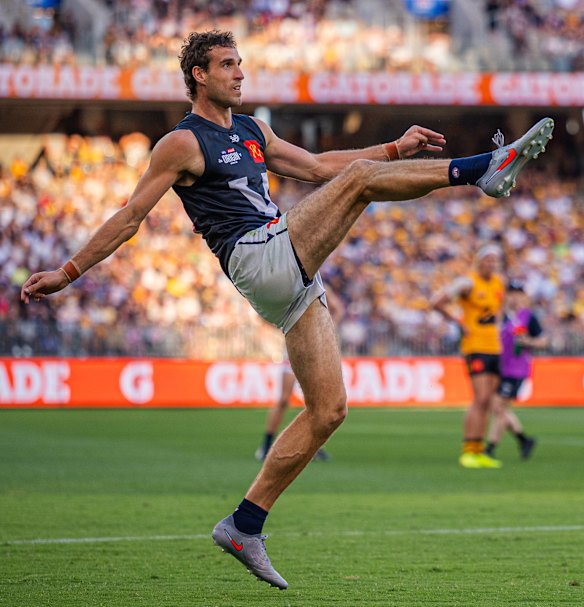
Ben King leans back and kicks for goal for the Vics.Credit: AFL Photos
Watching Bont give to Daicos, Butters find McCluggage and run through midfield had a pleasingly Lockett to Dunstall feel about it. It was good in the way that watching a team train in grand final week and the ball goes doesn’t touch the ground looks good.
As Toby Greene said afterwards “I would rather play this than a practice match”.
The AFL, desperate for new revenue streams where they can find them given the assault on broadcast rights revenues worldwide, seem keen to persist with the concept. The players, always keen for new revenue streams for themselves, liked the fact they were paid for this game (see Toby’s comment above).
The AFL though spent more effort on marketing than they did working through the broader concept, which still remains not fully thought through. That is fair enough for a toe back in the water attempt. But what comes next? Is it a carnival? Is it two games a pre-season not one?
Weitering Moment
The entire resurgent concept could have fallen at the first hurdle, if that that hurdle was the falling of two big bodies onto Jacob Weitering before even a half a quarter had been played.
When Weitering was collapsed under the 200kg heft of two players and had his ribs, shoulder and head crushed such that he was shuttled off the ground on a cart and taken to hospital, it could have ended any future State of Origin game right there.
It was the moment akin to Andy Collins playing for Victoria running down South Australia’s Tony Hall, his Hawthorn teammate, and Hall’s leg buckled under him. Decades ago it wrecked his knee and the origin games in one tackle. Fans, clubs and players will tolerate injuries up to a point.
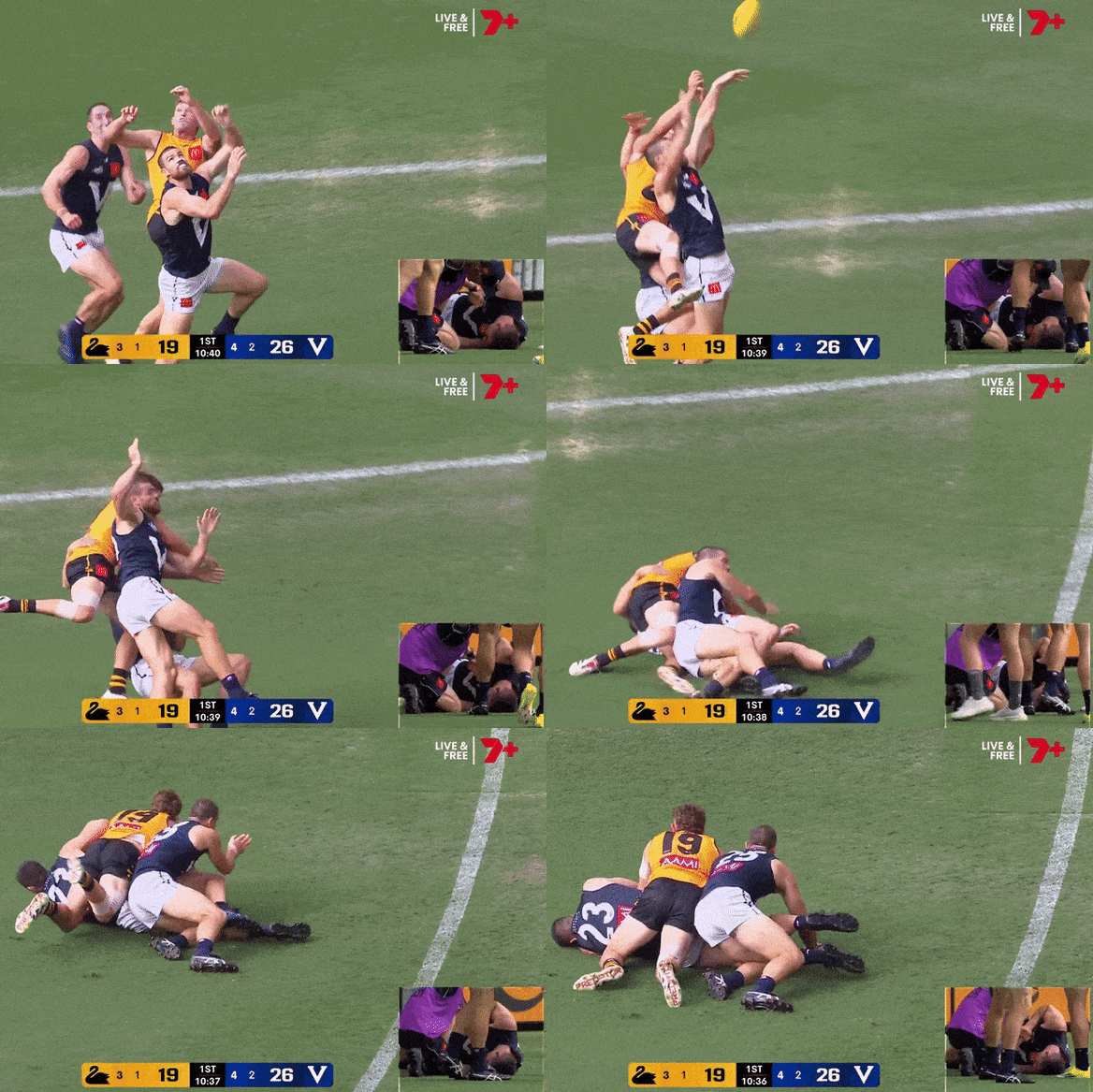
Jacob Weitering is crunched early in the game.Credit: Seven
The number of clubs calling Carlton and sending messages of concern for Weitering after the match was a measure of how anxious they all were about their own players in the game.
As is often pointed out, players get injured in training and in practice matches. You need look no further back than Tom Green doing his knee at GWS training on Friday.
But there is something about getting injured playing for someone else than makes the injury slightly less palatable. Which brings us to the point that needs to be explored in more detail if the AFL is to convince clubs of the merit of the concept as more than a one-off.
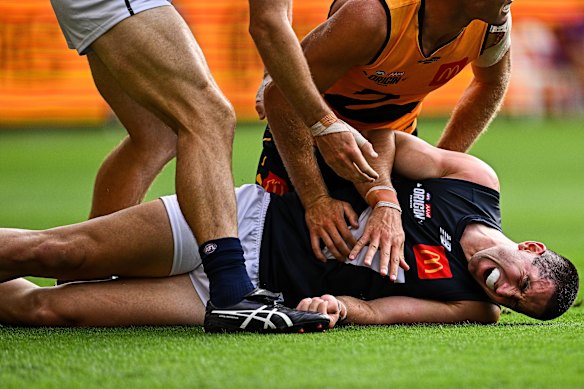
Jacob Weitering’s State of Origin game ended in injury.Credit: AFL Photos
Weitering, mercifully did not sustain a serious injury from the incident. But what if he did?
Clubs who asked the AFL about insurance coverage of Origin players last year when the game was first mooted said they had the idea of insurance pushed back on them.
OK. So what if in this instance instead of being OK Weitering was injured and missed say eight weeks of the season for argument’s sake. Carlton have a contract with Weitering for the year and suddenly they don’t get their player for a chunk of the season because he played a game for the league and not his direct employer.
As one club person said, let’s say Weitering was on $920,000 a year (the salaries of Origin players would average out at a million a year so it’s a fair number). In broad terms it would equate to $40,000 per game for 23 games for the season excluding finals (this is Carlton after all). And yes, players are paid for the whole year including pre-season training and not just for games, but for the sake of the argument lets look at it as $40k/game.
So in this instance of him missing eight games Carlton should theoretically be entitled to $320,000 compensation (eight missed games at $40k per game).
Presently, the club carry all of the financial risk. To persuade them to continue to make their players available for this concept which is designed to bring more money in the game, the AFL needs to at least share the financial risk. They need to make better provision to compensate clubs if they lose a player from the season for an injury playing Origin.
At the very least if the compensation is not directly financial in paying at least a portion of the missed games then there needs to be salary cap relief of some sort as a sop to the club for losing one of their best players. Which is the other point of this, it is the clubs’ best players who are recruited to Origin games, not replaceable second stringers.
The only way the concept continues beyond an enjoyable one-off is with club support.
Now that the game has been played and will be deemed a success the AFL needs to construct a proper framework for it.
Perhaps it’s a four-year rotation around the country. South Australia premier Peter Malinauskas has shown a love for bringing events to his state and so would doubtless push for an SA game against Victoria or WA next year.
The AFL is investing heavily in northern markets, an Allies team of Queensland and NSW is logical even if it bites against the very rivalry that makes the NRL origin concept work.
The State of Origin concept proved itself worthy of continuing, but to do so more work needs to be done to fix the flaws, or it will be undermined and eroded before it takes hold.
Most Viewed in Sport
Disclaimer : This story is auto aggregated by a computer programme and has not been created or edited by DOWNTHENEWS. Publisher: www.smh.com.au