Many years ago, on a blistering summer afternoon in Latur district, the air once carried the sound of quarrels. Villagers in Bansawargaon would gather around tanker trucks, fighting for a few buckets of water. Wells drilled down to 700 feet yielded nothing but dust.
Crops withered, livelihoods collapsed, and disputes became routine. “We had lost faith in the soil,” recalls farmer Haribhau Sarkale. “Even the earth seemed to have given up on us.”
For decades, Bansawargaon — a village of around 1,300 residents spread across 421 hectares in Chakur taluka — lived with a harsh reality familiar to much of Marathwada. Agriculture depended on erratic rainfall and poorly regulated groundwater.
When the Groundwater Survey and Development Agency (GSDA) declared its aquifers “over-exploited”, the village was barred from digging new wells. Borewells plunged to depths of 700–1,000 feet, driving over-extraction, unemployment, and social conflict. Farming shrank to rain-fed seasonal crops, migration increased, and each summer, drinking water arrived only by tanker.
The first drops of change
In 2017, a spark of hope emerged. Youth leader Nilesh Bhande was elected sarpanch and addressed the panchayat with a simple message: “Our problem is not poverty; it is water. If we solve irrigation, everything else will change.”
His conviction cut through years of resignation, and for the first time in a long while, villagers felt change was possible.
Change, however, needed money that the village did not have. Support slowly came together. The Sakal Relief Fund contributed Rs 2 lakh, Latur citizens living abroad added another Rs 2 lakh, and funds followed from the local MLA’s office and the tehsildar, Bharat Suryavanshi.
“Every rupee was like a drop of water for us,” recalls Bhande. “We knew we had to use it wisely.”
Digging for a future
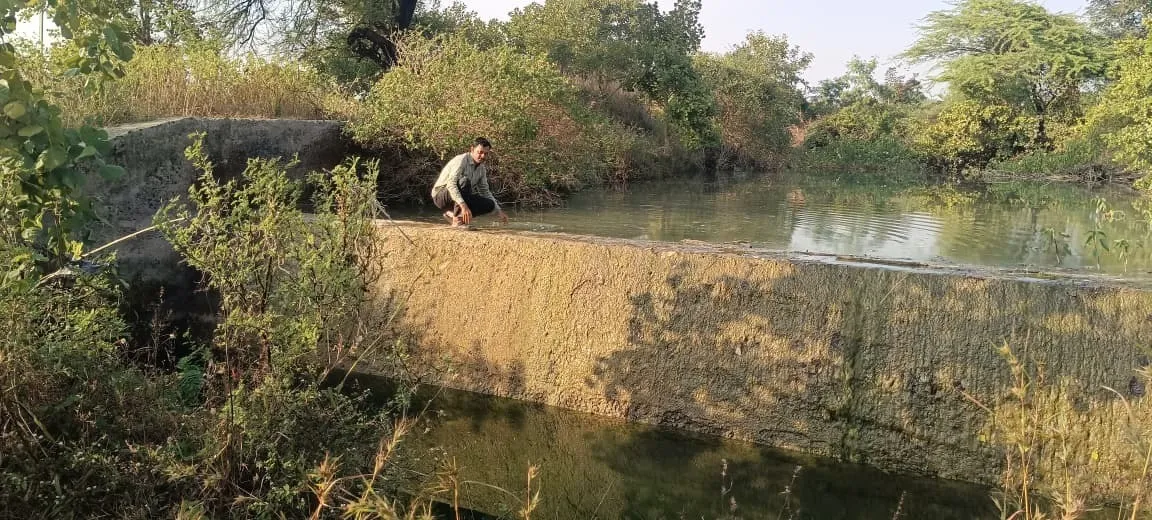
With resources in hand, villagers began reshaping their landscape. Two main irrigation canals were deepened and widened. Under the Jalyukt Shivar Abhiyan, canals were straightened, bunds repaired, and new Kolhapuri-style bunds constructed.
By 2024, recharge shafts were installed under the Atal Bhujal Yojana (ABY), allowing rainwater to seep back into the earth. Within seven years, groundwater levels rose to around 150 feet, ending dependence on tankers and enabling nearly 100 new farm wells.
/filters:format(webp)/english-betterindia/media/media_files/2026/02/13/villagers-stading-atop-a-kolhapuri-weir-raised-in-banswargaon-2026-02-13-15-36-02.jpg)
“Our problem is not poverty; it is water. If we solve irrigation, everything else will change.”
Farmers adopted drip and micro-irrigation for crops such as turmeric, cabbage, and tomatoes. Sugarcane cultivation expanded across 20 hectares, alongside dairy farming, goat rearing, and sericulture. The village exited the ‘over-exploited’ groundwater category, with further plans for soak pits and road paving.
The work was gruelling. Men and women laboured side by side, digging, repairing, and hauling soil under a harsh sun.
After 2017, the next gram panchayat elections were held in 2022. This time, Ushatai Kamble was elected sarpanch, with Nilesh Bhande taking on the role of deputy sarpanch — ensuring continuity in the village’s water-led vision.
“Every spade of soil we turned was a promise to our children,” says Kamble, her voice steady with pride.
A culture of conservation
The transformation was not only technical — it was cultural. Roof-water harvesting systems appeared at the Mahadev and Khandoba temples. Solar panels began cutting electricity costs for irrigation pumps.
By the end of 2024, the village had installed 15 solar irrigation pumps, each of 5 HP capacity. These were supported under Maharashtra’s solar pump schemes, including the Mukhyamantri Saur Krushi Pump Yojana launched in 2019, under which the government covers 90–95 per cent of costs. The scheme aims to replace diesel and electric pumps with sustainable, off-grid solar alternatives.
The village installed water meters on the main canal outlets and on all 20 irrigation wells, tracking withdrawals and helping resolve disputes before they flared. Farmers widely adopted drip and sprinkler irrigation, while around 150 households built soak pits to recycle wastewater.
/filters:format(webp)/english-betterindia/media/media_files/2026/02/13/maha-village-2026-02-13-15-36-24.png)
“We have witnessed a one-metre rise in groundwater levels,” says GSDA geologist Pradeep Nagargoje, crediting awareness camps, rain gauges, and the training of ‘Bhujal Mitras’ — local groundwater volunteers.
Under the Atal Bhujal Yojana, Bhujal Mitras are trained through structured capacity-building programmes held at state, district, taluka, and gram panchayat levels. Over 22,000 sessions have been conducted across 1,133 gram panchayats, reaching more than 5 lakh rural residents. Training focuses on water budgeting, crop planning, social audits, and groundwater management, particularly in over-exploited regions.
“We learned that saving water is as important as finding it,” says villager Vithal Bombale, pointing to the soak pit outside his home. “Earlier, wastewater flowed into the streets. Now it flows back into the soil.”
The panchayat has ensured conservation works are maintained year after year, with most members re-elected unopposed — a rare display of unity in a politically divided region.
“This was not about winning elections,” Bhande explains. “It was about winning back our future.”
The miracle in the fields
Seven years on, the change is visible across the village. Groundwater, once elusive, now lies close to the surface. Summer tankers have disappeared from village lanes, making Bansawargaon ‘tanker-mukt’ — free from dependence on water tankers during dry months.
Agriculture has flourished. Turmeric, cauliflower, tomatoes, and coriander grow alongside sugarcane. Dairy sheds hum with activity, goats graze in new pens, and sericulture has taken root.
“Earlier, we fought over water,” says fourth-generation farmer Subhash Jadhav with a laugh. “Now we fight over who grows the best tomatoes.”
Beyond survival
The village itself has changed along with its economy. Around 20 kms of farm roads have been laid, encroachments cleared, and cement-paved lanes now gleam under the sun. Children walk to school past canals that hold water year-round.
“This is not just about farming,” says Suryavanshi, now posted as tehsildar at Degloor in Nanded district. “It is about dignity. Bansawargaon has shown that collective will can rewrite destiny.”
/filters:format(webp)/english-betterindia/media/media_files/2026/02/13/facebook_1770649614501_7426642760703719049-1-2026-02-13-15-36-38.jpg)
With water security restored, livelihoods have diversified. Forty cattle sheds have been sanctioned under MGNREGA, and more farmers have taken up dairy, goat rearing, and sericulture as reliable income sources.
“We no longer think only of survival,” says farmer Ramesh Kamble. “We think of growth.”
A living model for others
Bansawargaon has also embraced technology. Solar-powered pumps reduce energy costs, while water meters ensure accountability in a system once marked by overuse. Roof-water harvesting is planned for schools and panchayat buildings, and additional soak pits will be dug under MGNREGA to capture run-off in farm fields.
The village’s journey has drawn delegations from neighbouring settlements keen to study its canals, bunds, and recharge shafts.
“We are proud to be called a model village,” says Bhande, now deputy sarpanch. “But more than pride, it is a responsibility. We must keep showing that conservation works.”
The success has also encouraged policymakers, offering tangible proof that initiatives such as Jalyukt Shivar Abhiyan and the Atal Bhujal Yojana can restore water security in drought-prone regions like Marathwada.
The human spirit
At its core, Bansawargaon’s transformation is a story of human spirit — of villagers who refused to accept despair, leaders who looked beyond politics, and a community that dug deep, literally and figuratively, to reclaim its future.
Standing by a canal that now glistens with water, farmer Prabhakar Swami reflects, “We once thought our village was cursed. Today, we know it was only thirst — and we learned how to quench that thirst together.”
From scarcity to sustainability, Bansawargaon’s journey stands as a testament to what collective resolve can achieve when a community decides that water — and its future — belongs to everyone.
Disclaimer : This story is auto aggregated by a computer programme and has not been created or edited by DOWNTHENEWS. Publisher: thebetterindia.com