
Thanks Australia, it was fun while it lasted.
Let’s not kid ourselves – the Kangaroos will be the biggest losers as a result of the changes to the State of Origin international eligibility rules.
The NRL on Monday announced players eligible to play for NSW or Queensland were now free to choose what nation they wanted to represent on the world stage.
Previously, Origin players could not represent tier-one nations New Zealand or England – the two sides that have historically posed the biggest threat to Australia. However, there was nothing stopping them playing for tier-two nations like Tonga or Samoa.
But all bets are off now – and that’s bad news for the Kangaroos.
The thing that gives origin its edge is the genuine hatred between NSW and Queensland. Who can forget Maroons favourite Cameron Munster refusing to set foot inside the NSW Blues’ training facility when the Storm used the facilities before an NRL clash with South Sydney a few years ago?
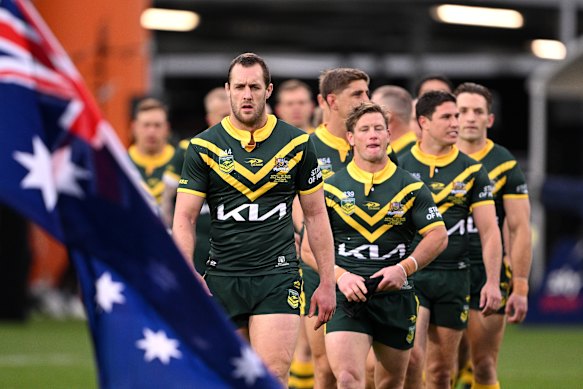
Isaah Yeo led the Kangaroos at last year’s Pacific Championships.Credit: Getty Images
“I’m not going in there,” a smiling Munster told the Herald at the time. “I’d rather stink a bit longer and walk back to the hotel to shower. I’m not welcome in there, and I don’t want to be welcomed in there.”
Those same NSW and Queensland players would – more often than not – park their differences when they pulled on the green and gold for Australia.
Former Australian coach Mal Meninga used to refer to the Origin series as an unofficial Kangaroos trial. After all, if you were passionate about your state, you were passionate about your country.
It was a no-brainer. The last time we checked, NSW was in Australia. And Queensland? Well, that’s in Queensland. None of that matters any more.
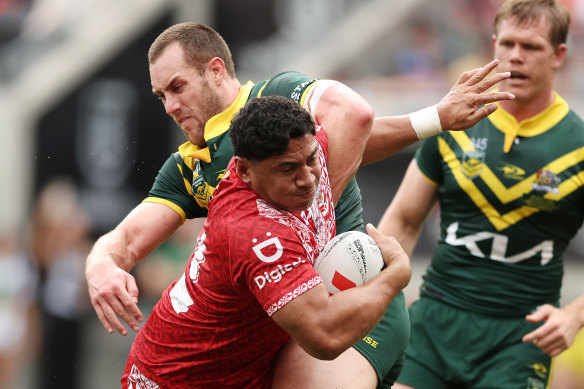
Tonga’s Jason Taumalolo breaks through the Kangaroos line.Credit: Getty Images
Jason Taumalolo and Andrew Fifita defected to Tonga in 2017. It made the Pacific Island nation genuinely competitive and sparked an international league revolution.
Samoa have since become a powerhouse, too, even making the 2022 World Cup final, where they lost to Australia. Fiji have some of the most exciting players in the game while England, at least on paper, are an international threat.
International rugby league is now something close to an actual world game. But how many more beatings can Australia handle?
Payne Haas has already pledged allegiance to Samoa, along with Jarome Luai, Stephen Crichton, Spencer Leniu and Brian To’o.
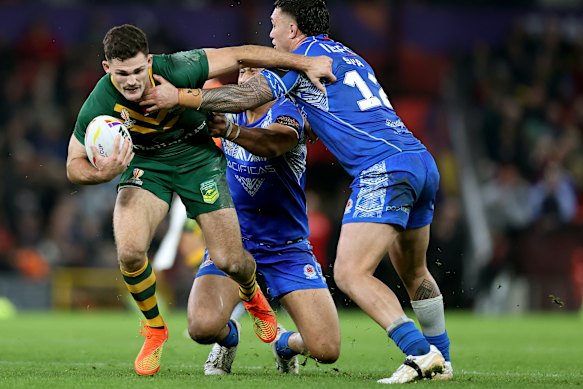
Samoa’s Jaydn Su’a tackles Nathan Cleary during the Rugby League World Cup Final in 2022.Credit: Getty
Kalyn Ponga was non-committal on Monday but is leaning towards representing New Zealand. Victor Radley has chosen to represent England, as has AJ Brimson, while a player like Sam Walker might be tempted to pledge his allegiance to the old enemy now that the new rules now do not prevent him representing Queensland in Origin.
The eligibility changes should not have a drastic impact on the Kangaroos side that won last year’s Ashes. Of that squad, Tino Fa’asuamaleaui, Kotoni Staggs and Keaon Koloamatangi could jump ship to Samoa and Tonga respectively.
But what about the future years? How many of today’s up-and-coming stars will actually aspire to play for Australia?
Two of the strongest rugby league nurseries in the country are in western Sydney and south-eastern Queensland, which have huge New Zealand and Pasifika communities. The talent pool is only so deep.
Now England and the Kiwis have been invited into the Origin cauldron, it will work against Australia in Test matches.
When we called him on Monday, Meninga was for any changes that promoted the international game. But he did concede the Kangaroos could suffer moving forward.
“My fear is for the kid who actually wants to play for Australia, but is overlooked for Origin,” Meninga said.
We should just re-name Origin the NSW and Queensland All Stars. It will be easier to digest for the locals when Origin takes a game across the Tasman to New Zealand next year.
ARL Commission chairman Peter V’landys also runs NSW horse racing, where a fair race is ensured by giving the better horses more weight. Monday’s news effectively asks Australia – rugby league’s equivalent of Winx – to carry the grandstand.
“At the end of the day, we want international rugby league to be powerful and strong, and if a player wants to play for a certain country, we shouldn’t impede that,” V’landys said. “We see what Payne Haas has done for Samoa. He’s a hero. He’s helping motivate young kids play our game.
“The ratings for the Pacific Championships games last year were through the roof. The 2am games featuring Australia and England were through the roof. People want international rugby league.
“Australia will always be strong – we’ve got some of the best players in the world, so why wouldn’t we be strong?”
New Zealand Rugby League chief Greg Peters was singing from the same hymn sheet on Monday.
“I think having players being able to make an informed decision without a barrier is a good thing,” he said. “Australia has truckloads of talent at many levels. To a certain extent, it might help level the international playing field. Everyone wants to see a competitive international game.
“There’s no point seeing one team win all the time, otherwise it’s not a real sports contest.”
Australia are favourites for the World Cup this year. It could be the last time.
Most Viewed in Sport
Disclaimer : This story is auto aggregated by a computer programme and has not been created or edited by DOWNTHENEWS. Publisher: www.smh.com.au


