
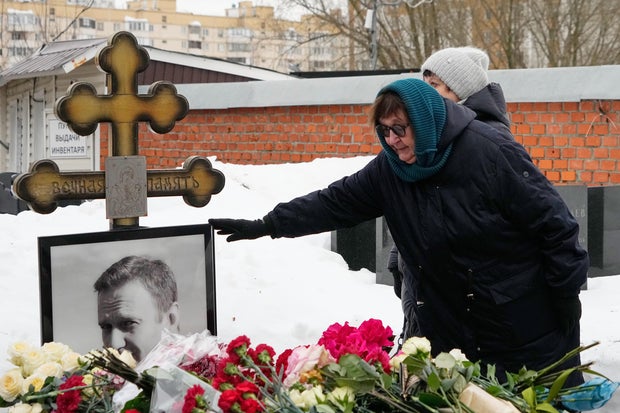
The mother of deceased Russian opposition leader Alexey Navalny said Monday she felt vindicated by a European assessment that her son died of poisoning in a remote penal colony. She called for justice as Russia’s government rejected the European claim, and as the late dissident’s supporters marked two years since his death.
Navalny, Russian President Vladimir Putin’s fiercest domestic opponent, died in an Arctic prison colony in February 2024 while serving a 19-year sentence.
Britain, Sweden, France, Germany and the Netherlands issued a joint statement Saturday saying they believed he was poisoned with epibatidine, a toxin found in poison dart frogs. They based their assessment on samples taken from his body, the statement said.
“This confirms what we knew from the very beginning. We knew that our son did not simply die in prison, he was murdered,” Navalny’s mother Lyudmila Navalnaya told reporters outside the cemetery where he was buried in Moscow. “I think it will take some time, but we will find out who did it. Of course, we want this to happen in our country, and we want justice to prevail.”
Alexander Zemlianichenko/AP
“Naturally, we do not accept such accusations. We disagree with them,” Kremlin spokesman Dmitry Peskov told reporters in Moscow on Monday. “We consider them biased and unfounded. And, in fact, we strongly reject them.”
Russian authorities had designated Navalny and his organization “extremist” before his death, and anyone who mentions him or his exiled anti-corruption foundation is liable for prosecution.
Officials in Russia have never offered much detail on the cause of Navalny’s death.
His widow Yulia Navalnaya, who lives in exile with an outstanding warrant for her arrest in Russia, said about six months after her husband’s death that she was told by Russian investigators he died from a combination of “a dozen different diseases,” and that he finally succumbed to arrhythmia, or an irregular heartbeat, after a walk.
Navalnaya said her husband exhibited no instances of heart disease before he was imprisoned.
Sebastian Christoph Gollnow/AP 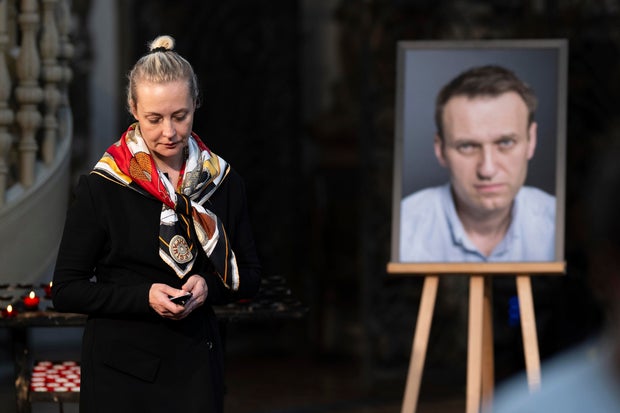
“Russia claimed that Navalny died of natural causes,” the European nations said in their joint statement over the weekend. “But given the toxicity of epibatidine and reported symptoms, poisoning was highly likely the cause of his death. Navalny died while held in prison, meaning Russia had the means, motive and opportunity to administer this poison to him.”
British Foreign Secretary Yvette Cooper said in a statement that “Russia saw Navalny as a threat” and poisoned him as a show of strength.
“By using this form of poison, the Russian state demonstrated the despicable tools it has at its disposal and the overwhelming fear it has of political opposition,” Cooper said.
The United Kingdom’s foreign office said “only the Russian state had the means, motive and opportunity to deploy this lethal toxin to target Navalny” and that they “hold it responsible for his death.”
Hector RETAMAL/AFP/Getty 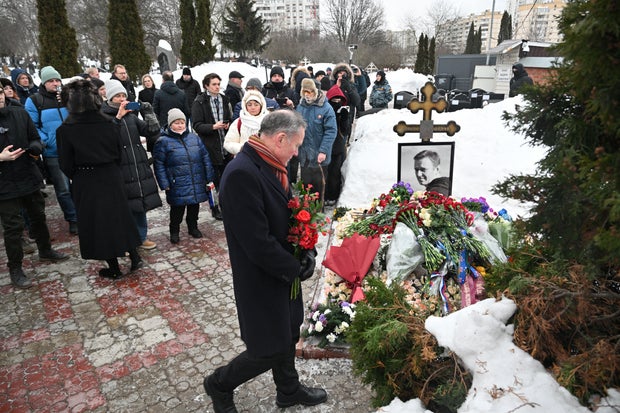
Dozens of people visited his grave early Monday, among them foreign diplomats, according to an AFP reporter at the scene. Some of those who attended wore masks or scarves over their faces.
Navalny had crusaded for years against official corruption and staged massive anti-Kremlin protests. He was previously poisoned with the Soviet-era nerve agent Novichok while flying from Moscow to Siberia in 2020, eventually recovering after a long period of treatment in Germany. He told 60 Minutes’ Lesley Stahl later that he believed the poisoning was an assassination attempt engineered by Putin — another claim that Russian officials have always denied.
Navalny returned to Moscow in 2021, knowing he faced certain arrest. He was convicted three times on various charges and sentenced to 19 years for extremism-related charges, which he always dismissed as politically motivated.
He was imprisoned in January 2021 and then moved almost three years later to the Arctic penal colony, where he died in February 2024.
Disclaimer : This story is auto aggregated by a computer programme and has not been created or edited by DOWNTHENEWS. Publisher: cbsnews.com



