

Researchers and citizen scientists will, for the first time, tag and track 10,000 bogong moths as they travel hundreds of kilometres, from the Australian Alps to breeding grounds across the country’s south-east.
The massive moth tagging project was modelled on monarch watch, a citizen science program that has traced the migration of monarch butterflies across North America over decades. Both species undertake long-distance journeys, with butterflies travelling by day and bogong moths by night.
A team of scientists and volunteers will next week travel to Mt Kosciuszko to begin attaching numbered paper tags – each the size of a piece of confetti – to 10,000 moths using eyelash glue.
Sign up: AU Breaking News email
“It’s low-tech, high-effort tagging, where you put a little sticker on an individual moth and see if you can catch it again,” said Dr Kate Umbers, an associate professor in zoology at Western Sydney University and the managing director of Invertebrates Australia.
For bogong moths, it was “the very first time this has ever been tried”.
The aim was to address knowledge gaps about where the moths breed and the routes they take to get there – gaps that saw the species knocked back from being listed as threatened under national environment laws. The bogong moth has been on the International Union for the Conservation of Nature’s global endangered list since 2021.
While there were indirect tools for mapping the moths’ journey, such as using genetic and chemical analysis, tagging was the only sure way to know that “an individual has travelled from point A to point B”, Umbers said.
Attaching a tiny tag to a critter the size of a bottle cap wasn’t as hard as people might think.
“It’s laborious and time-consuming,” Umbers said. “You have to be precise, but it’s not difficult.”
Each moth would be cooled down and temporarily anaesthetised using carbon dioxide before the tiny paper label was attached to its wing. Then it was free to go. The procedure had been thoroughly studied in the lab, and researchers were confident the tags wouldn’t hurt the moths or affect their behaviour.
The goal of 10,000 tags was set to increase the odds of moths being re-sighted. But the task was “quite doable” once the work was divided among 20 researchers and volunteers over 10 days.
From there, people in south-eastern states were encouraged to keep an eye out for tagged moths along their journey.
Drawn to the light of dozens of households
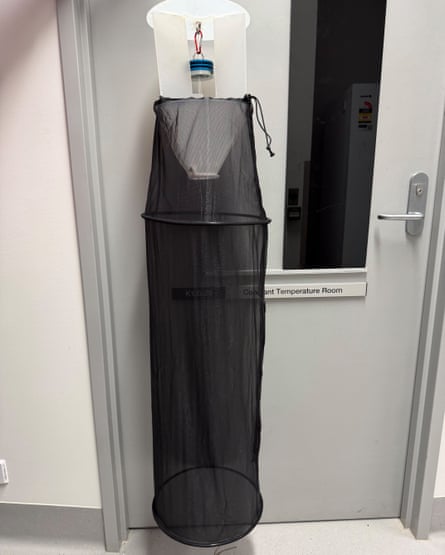
More than 50 households, spread in all directions from Mt Kosciuszko, have been chosen to act as “sentinels”, hosting bug lanterns and monitoring moths between March and May.
Louise Freckelton, who runs a sheep farm near Adelong in the NSW Riverina, was excited to be chosen.
She already had an interest in the nocturnal environment. The property has a farm-stay certified by DarkSky International for its commitment to limiting artificial light at night, and two-thirds of the land is protected for conservation.
“We’re deeply interested in the environment and ecology, and we know the pygmy possums up in the mountains rely on the bogong moths to turn up when they wake up out of their winter hibernation,” Freckelton said. “We know the perils for them and the pygmy possums.
“We are very conscious we live in both a climate and an extinction crisis, and this is a tiny way we can help.”
Suzanne Newnham, who lives on a bush block outside Wee Jasper, about 45km from Canberra, was also thrilled to be selected. “I love bugs,” she said. When the lights were on inside, bogong moths often gathered at the windows.
“If we put a light on outside, we have so many moths it’s not funny. I thought it’d be interesting to be able to track them.”
If a member of the public is lucky enough to spot one of the tagged moths, they are encouraged to take a photo, or record the two-letter, two-number code on the paper, and submit it via bogong.org.
“We need eyes out, all over, all of the time,” Umbers said.
Even a single sighting of a tagged moth would provide powerful evidence, Umbers said.
“If we saw 100 of our tagged moths again, it would be an amazing success.”
Disclaimer : This story is auto aggregated by a computer programme and has not been created or edited by DOWNTHENEWS. Publisher: theguardian.com



