
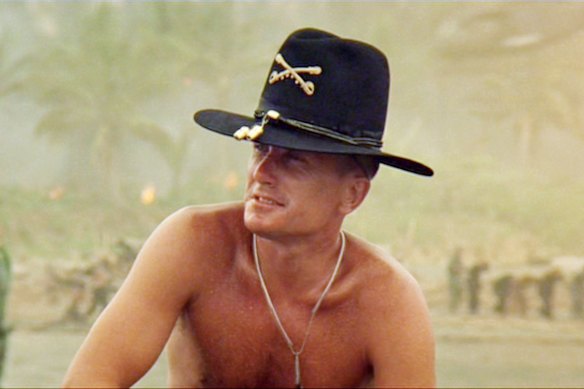

Robert Duvall – the man they called the Laurence Olivier of the American acting canon – was one of the greatest actors of all time. Duvall has died aged 95, but in an era where fame is insubstantial and glory is often cheap, he stands tall as an icon of the cinema screen.
As an actor, his excellence is demonstrated in a body of work which is both illuminating and haunting. He was one of the central figures in the naturalistic, gritty evolution of American cinema in the 1970s.
In 2026, however, he is an actor who is difficult to capture. Either because streaming and the fractured content landscape leaves his best work scattered to the far corners of the content globe – or simply inaccessible – or because, as his celebrity dimmed in the final decades of his life, he quietly stepped off the movie stage that had defined him for the best part of a century.
With more than 100 credits to his name – from True Grit (1969), M*A*S*H (1970) and THX 1138 (1971), to Days of Thunder (1990), The Paper (1994), Jack Reacher (2012) and Hustle (2022) – it is difficult to capture the entirety of his work. But in the history of cinema these six performances stand out.
The role you know him for: Tom Hagen in The Godfather and The Godfather Part II (1972, 1974)
“Italians have a little joke, that the world is so hard a man must have two fathers to look after him,” Tom Hagen said. “That’s why they have godfathers.” One of the most compelling cinema performances of all time, Hagen was the German-Irish consigliere to the Corleone mafia dynasty, a man who bridged two worlds: the traditional, where blood mattered more than friendship, and the line of succession was all that mattered, and the modern, where crime syndicates and corporations started to look more and more alike.
“He is perfect,” wrote Los Angeles Times critic Charles Champlin. “The quiet and appalled eye of the hurricane.”
The role that won him his Oscar: Mac Sledge in Tender Mercies (1983)
In a career where many performances were highlighted by their scale and power – The Godfather, Apocalypse Now – this was a demonstration of Duvall’s quiet strength. Mac Sledge was a washed-up, alcoholic country singer, whose journey out of fame comes at great cost, and who finds redemption through a tender, slowly blossoming relationship with a younger woman in rural Texas. In one scene, he is stopped and asked if he really is Mac Sledge. “Yes, ma’am, I guess I was,” he replies, the exchange heavy with melancholy.
In 1983, Newsweek’s David Ansen described it as “a small miracle of underplaying. He doesn’t do anything for show; he lets us watch him thinking, feeling, and changing.”
The role he loved the most: Augustus “Gus” McCrae in Lonesome Dove (1989)
A retired Texas Ranger turned cattle drover in a television miniseries, Gus McCrae might have quietly faded into the cinema history books, were it not that both Duvall himself and his fans often cite the performance as a career favourite. In a nod back to the infancy of cinema itself, when westerns ruled the screen, Duvall often said that Gus, the character, was the man on screen most like the actor himself. And, in a gentle swipe to theatre’s cognoscenti, he quipped: “I would rather play Augustus McCrae than Hamlet.”
Writing in The New York Times in 1989, critic Walter Goodman praised Duvall for making “a simple, sentimental creation seem complex, heroic [and] always human”.
The role that best showcased him as an actor: Lt. Col. Bill Kilgore in Apocalypse Now (1979)
In the exchange rate of minutes to sheer movie-making power, Kilgore is a big return off a lean investment. He’s on-screen for barely 15 minutes of the film, but Duvall turned this character into one of his career-defining performances. Indeed, the film’s most memorable line – “I love the smell of napalm in the morning” – is his.
Kilgore is a war-consumed soldier, who illuminated the incredible disconnection between the brutality of the Vietnam War and the detached ease of some who fought it. Duvall’s performance is electrifying. And he was, according to Vincent Canby in The New York Times in 1979, “played with breathtaking force and charm … a frightening, funny, completely realised character.”
The role that was decades ahead of its time: Frank Hackett in Network (1976)
Hackett’s character description in Sidney Lumet’s media masterpiece – a ruthless television executive obsessed with ratings – ought to make him more at home in 2026 than 1976. And yet, there he was, decades before the media landscape fractured and traditional television began a bruising evolution that is still taking place: Frank Hackett, the executive floor hatchet man.
“We’re not a respectable network. We’re a whorehouse network, and we have to take whatever we can get,” he screamed in one of many memorable scenes. Charles Champlin, writing in the Los Angeles Times in 1976, described him as “a terrifying figure of modern efficiency, played with a scary, unblinking conviction”.
And his first, briefest and perhaps best role: Arthur “Boo” Radley in To Kill a Mockingbird (1962)
With no lines in the script, and only a brief appearance in the film’s denouement, Boo Radley was the reclusive and misunderstood neighbour of Atticus Finch, the Maycomb County, Alabama, lawyer whose journey through the trial of Tom Robinson turns this film into a cinematic masterpiece. Radley is a complex piece of writing – an innocent and gentle man, terrified of the outside world, who conquers his own fears to save two children he loves – who becomes a talisman for the film’s (and book’s) themes: a man feared as a malevolent phantom, who is in truth nothing of the sort.
In 1961, writing in Look Magazine, critic Leo Rosten praised Duvall’s performance for “convey[ing] a lifetime of loneliness without speaking a word. It is a haunting debut”.
Must-see movies, interviews and all the latest from the world of film delivered to your inbox. Sign up for our Screening Room newsletter.
 Michael Idato is the culture editor-at-large of The Sydney Morning Herald and The Age.Connect via X or email.
From our partners
Disclaimer : This story is auto aggregated by a computer programme and has not been created or edited by DOWNTHENEWS. Publisher: www.smh.com.au





