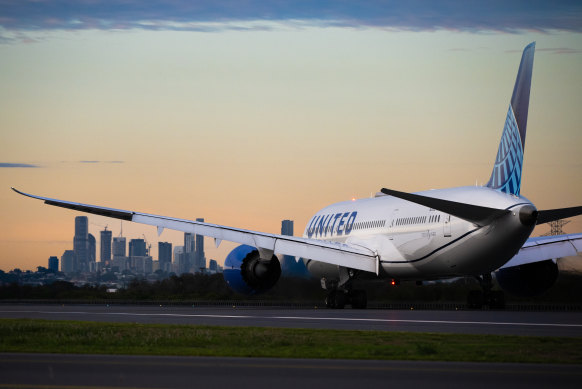

Brisbane residents are collectively losing up to $100 million a year to sleep disruption, health risks, and depressed land values, a new study released by an anti-aircraft noise group has found.
The report, authored by University of Queensland economist Professor John Quiggin, was released by the Brisbane Flight Path Community Alliance late on Monday.
The alliance raised $5000 for the report, which it told potential donors would be “instrumental in shifting public policy”.
Quiggin’s report finds a nighttime curfew of 10pm to 6am, similar to the one at Sydney’s Mascot airport, would come at a “modest” cost to Brisbane’s economy.
“A curfew would not ground the economy, but it would finally let Brisbane residents sleep,” he said.
“On conservative estimates, Brisbane residents are collectively losing up to $100 million per year in the form of sleep disruption, elevated health risks, reduced quality of life, and depressed land values.”
In his report, Quiggin puts the economic cost of a curfew at $10 million a year, “or even less”.
“By contrast, the potential health and economic benefits of a curfew are valued at $50 million or more,” he said.
The report cast doubt on the need for Brisbane Airport’s second runway, given that passenger movements had remained static for about a decade. The Brisbane Airport Corporation’s 2024 annual report shows 22.6 million passengers went through the airport in 2023-24 – a post-COVID high, but still less than the 23.6 million in 2017-18.
“An obvious implication is that the massive increase in aircraft noise associated with the introduction of the second runway has so far been unnecessary,” Quiggin says in the report.
“The old runway was capable of handling a larger volume of passengers than are using the airport at present.”
The report found the cost of a curfew would be mostly borne by the Brisbane Airport Corporation, with smaller costs to freight operators and their customers, and international air travellers.
It also recommended nighttime freight flights be directed to Toowoomba Wellcamp Airport, about 160 kilometres west of Brisbane Airport by road. The extra cost for freight would be about 16¢ a kilogram, adding up to $1.2 million a year, the report found.
“The persistent suggestion that aviation should be exempt from regulatory constraint because it is an essential service is analytically unsound,” Quiggin said.
“Industries that generate externalities – whether transport, manufacturing, or energy – are commonly subject to operating limits, particularly during sensitive night hours.
“It is time to bring Brisbane Airport into line with the rest of the country. A curfew is standard policy, not radical reform.”
Brisbane Airport spokesman Henry Tuttiett said the report understated the real-world harm, such as higher airfares and weaker international connections, that flight caps would inflict on Queensland.
“The report relies on assumptions that have already been academically analysed and disputed, particularly claims about property value impacts,” he said.
“Queensland University of Technology analysis of more than 180,000 residential sales over 36 years found no evidence of long-term price reductions or weaker capital growth in suburbs under flight paths.”
That QUT analysis, commissioned by Brisbane Airport Corporation, attracted criticism in Quiggin’s separate submission to a 2024 Senate inquiry into aircraft noise for its lack of hedonic pricing – an unbundling of a total price to determine what each individual feature was worth.
In response to that criticism, QUT report authors Dr Andrea Blake and Professor Chris Eves submitted to the Senate inquiry that hedonic modelling provided an “illusion of legitimacy and accuracy” that was sometimes not warranted.
Tuttiett said Brisbane Airport’s 24-hour operation was critical to the industries that underpinned Queensland’s economy, particularly tourism and time-sensitive exports.
“The impact of caps and a curfew on Queensland would be profound,” he said.
“Previous economic analysis has estimated the real reduction in activity at $2.3 billion by 2031-32; and $5.5 billion by 2041-42. The reduction in employment is estimated at 24,542 jobs by 2031-32; and 57,922 jobs by 2041-42.”
Tuttiett said there were better ways to deliver relief to communities affected by noise from the new runway that would be less economically damaging.
Those included improved flight paths, more operations over Moreton Bay, and the accelerated rollout of newer, quieter aircraft.
“Brisbane Airport welcomed the outcomes of the Senate inquiry into the mitigation of aircraft noise, and is committed to working closely with airlines, Airservices Australia, and government to minimise aircraft noise for local communities,” he said.
Start the day with a summary of the day’s most important and interesting stories, analysis and insights. Sign up for our Morning Edition newsletter.
From our partners
Disclaimer : This story is auto aggregated by a computer programme and has not been created or edited by DOWNTHENEWS. Publisher: www.smh.com.au