
Updated ,first published
Coles has conceded it made a mistake when it “discounted” tins of dog food to $4.50 that had been selling for $4 just eight days earlier, declaring it usually had guardrails requiring items to be at a base price for a month before putting them on special.
On Tuesday, the second day of the landmark case by the Australian Competition and Consumer Commission against the supermarket over alleged illusory discounts, Coles’ legal team claimed the watchdog’s overall focus on the “Down Down” ad jingle was “a bit of a furphy”.
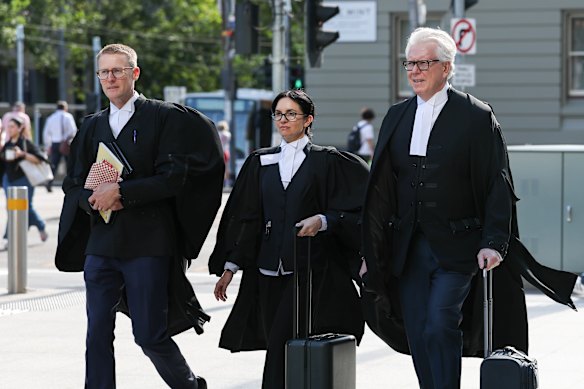
Coles’ lead barrister, John Sheahan, KC, noted how lawyers for the ACCC had played two TV ads promoting the “Down Down” campaign for the court to illustrate the context in which consumers viewed pricing tickets for items that were “discounted” after being briefly increased in price.
Sheahan argued evidence about the broader advertising context was irrelevant because the ACCC’s legal complaint was focused on movements in prices for a range of supermarket items.
“It’s all, with respect, a bit of a furphy,” Sheahan told Justice Michael O’Bryan.
The watchdog’s complaint alleges that Coles moved an item from its regular price, known as price one, to an artificially higher price for a deliberately short period, before reducing it to a third “Down Down” price that was often higher than it started at. The “Down Down” promotions included a “was/is” price demonstrating the difference between the third and second price.
When it opened its case on Monday, the ACCC examined price fluctuations in 1.2kg tins of chicken and vegetable Nature’s Gift Wet Dog Food, which was priced at $4 between April 18, 2022, and February 7, 2023, and then spiked to a $6 for just seven days before Coles introduced its “Down Down” price of $4.50.
On Tuesday, Sheahan said Coles acknowledged this as a “mistake” and an outlier. He said the supermarket largely relied on guardrails dictating that when a product’s price went up, it should sit at that amount for at least four weeks before a longer term “Down Down” discount applied.
This admission followed evidence from a Coles internal email on Monday showing a senior manager warned that advertising a product’s price as “Down Down” when it was cheaper just four weeks earlier was not in the spirit of the marketing campaign.
Many of Coles’ arguments that were aired on Tuesday focused on consumers’ sense of time and attention spans, while emphasising that commercial forces such as suppliers’ costs were a key influence on supermarkets’ pricing decisions.
Sheahan said the “Down Down” advertising campaign and the big red hand were not advertising a specific discount, but a broader indication the supermarket was “trying to keep prices low”.
Sheahan also conceded an argument the ACCC made on Monday that Coles, when setting a second, higher “establishing” price for a product before a “Down Down” discount, had planned and agreed on the third “Down Down” price at the time the second price came into effect.
But he suggested that while this might be true, it was not as important as market and inflation pressures on pricing. “In the end, all prices are temporary, nothing lasts forever,” he said.
Sheehan also said ACCC’s argument assumed a thought process from shoppers that was unrealistically complex.
He said that in a high-inflation environment, people understood prices would be changing, and that “Down Down” ticket labels with a was/is price were “a legitimate sign, a genuine sign, of good value today”.
“The idea of a previous regular price in the sense of one that is not relatively short … is too complex to credibly attribute to an ordinary, reasonable consumer walking down an aisle at Coles,” Sheahan said.
He said the ACCC needed to prove its claim that the second, “ephemeral price” was not genuine to prove that its subsequent “Down Down” prices were not genuine.
The case centres on a sample of items including dog food, Shapes biscuits and Coca-Cola sold between January 2021 and May 2023, which the ACCC’s lawyers said had been sold under a strategy that suggested discounts which were “utterly misleading” or a “half-truth”. The hearing will continue for the rest of this week and the next, with witnesses expected to begin appearing from Wednesday.
The Market Recap newsletter is a wrap of the day’s trading. Get it each weekday afternoon.
 Elias Visontay is a National Consumer Affairs Reporter at The Sydney Morning Herald and The Age.Connect via email.
From our partners
Disclaimer : This story is auto aggregated by a computer programme and has not been created or edited by DOWNTHENEWS. Publisher: www.smh.com.au