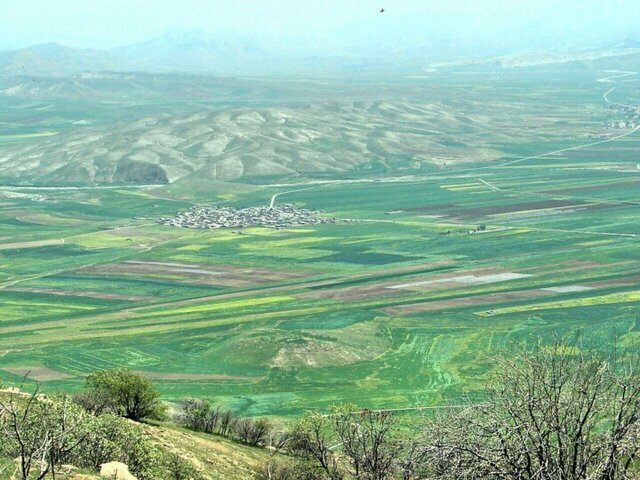
TEHRAN–Initial studies show that human settlement was established in the hill of Sarcham in Holeylan county, Ilam province, from prehistoric to historical eras, as well as the Bronze Age.
Announcing this, Habibollah Mahmoudian, a specialist in prehistoric archaeology, told ISNA that the prehistoric hill of Sarcham is located 700 meters northeast of Sarcham village in Holeylan district. The asphalted Holeylan-Piyazabad road extends from the northern edge of the hill, he added.
He explained that the geographical area of Zardalan is one of the subordinate areas of Holeylan county, and Zardalan rural district, centered on Piyazabad village, is located in the farthest reaches of Ilam province.
The height of the site is 952 meters above the sea level, and the permanent Seymareh river flows in the eastern and southeastern parts of the studied area, he pointed out.
The archaeologist stated that Zardalan includes two different climatic zones; The northern part has high altitudes and is more than 2,500 meters above the sea level and enjoys a temperate mountainous climate. “However, the southern lowland area and the banks of the Seymareh river, which includes the area of this monument, have temperate and warm winters.”
Mahmoudian noted that Sarcham hill is located in the eastern part of the road between Towhid city and Piyazabad village in Zardalan region, in the middle of agricultural lands. Erosion caused by the flow of Pol Jamshid seasonal river has exposed a major part of the ancient layers of the monument at a depth of five meters, he said.
He added: “The economic activity of the people of this region is based on agriculture and animal husbandry, and the cultivated lands in this region include irrigated and dry crops.”
“This site, located south of the Sarcham site, contains stone pottery, blades, stone tools, and bone remains, the most important surface findings of the Sarcham hill. The pottery is simple and decorated, and is mostly handmade. The density of pottery and stone blades shows the importance of this hill.”
Mahmoudian noted that during the investigation and identification of the Zardalan area, a total of 26 pieces of potteries and 14 pieces of stone tools and blades were removed from the surface of the hill and studied. The inner coating of the pottery was brown and red clay, and their designs were parallel lines and stripes, he added.
“The chronology of the surface markers of the site, which includes stone tools and blades in the side elevations of the Pol Jamshid valley, shows that this work also belongs to prehistoric periods.”
Ilam province is located in western Iran and shares about 425 kilometers of border with Iraq. It also borders the Iranian provinces of Kermanshah, Lorestan and Khuzestan.
The name ‘Ilam’ comes from ‘Elam’ the pre-historic civilization that ruled the area in modern southwest Iran from 2700 BC to 539 BC. Archaeological findings date human settlement of the area to around 5000 BC.
KD
Disclaimer : This story is auto aggregated by a computer programme and has not been created or edited by DOWNTHENEWS. Publisher: tehrantimes.com