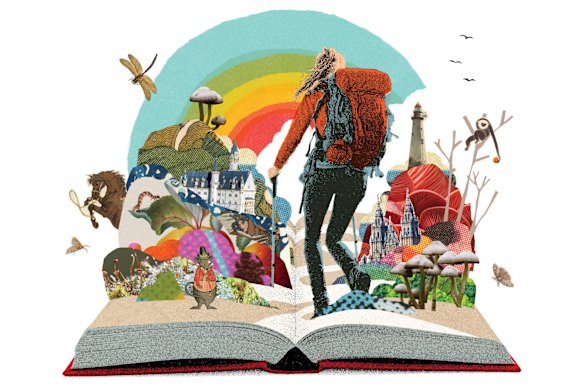
She was alone and lost in a forest as dusk approached – but instead of fear, she had a surprising revelation.
Late one afternoon, I was slithering down the side of a mountain above Natzwiller in France. The path I was following had become more and more indistinct until I could no longer convince myself it was a path at all. I was lost. But instead of anxiety and fear – I was after all a woman of a certain age, lost in a forest as dusk approached – there was a surge of delight. In that moment, after 15 years of long-distance walking, I suddenly understood why I did it.
I’ve walked most of the way from Geneva to Santiago de Compostela; across the Cathar Way in south-east France and over the Vosges Mountains; from the Mediterranean to the Atlantic. I’ve written articles and a book about walking, and still hadn’t understood the impulse to create weary muscles and blisters until that afternoon above Natzwiller.
I had supposed it was for all the usual reasons that people pull on hiking boots, pick up poles and head across country: the beauty and peace of nature, the physical and mental health benefits, the strangers who become friends, the free-ranging freedom of the creative mind when it’s set to a walking pace. And they are all excellent reasons.
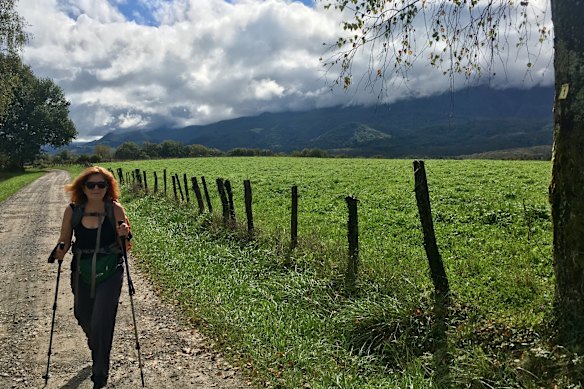
Walking through wilderness and farmland from village to village brings the intense beauty of nature into close focus. The world is mostly a few metres wide – either side of the track – although on mountain tops there is also the expanse of a faraway horizon. Each day there is a close-up of ants, snakes, squirrels, wombats (depending where one is walking); oaks, eucalypts, wild blackberries, fungi; rocks, ancient volcanoes, glacial valleys; and the earth itself. Here is the physical world and it does not care for our questions and problems; it simply continues coming into being and breaking down again. It is endlessly complex, without judgment, nourishing to the heart and soul.
The health benefits of walking are so numerous it almost seems a panacea. It can improve heart and lung action, strengthen muscle and increase joint flexibility, improve circulation and balance, decrease the risk of strokes and dementia, help reduce bone density loss and slow memory decline. But for me, never particularly athletic, it’s the feeling of power as I clamber up the side of a mountain or when I leap from rock to rock over a stream.
At the same time, I can hear the arguments of my mind settle as irritations and judgments slip into perspective. The mind becomes quietly alert, aware of branches moving, birds suddenly lifting, a pattern of prints in the mud, but unworried. There’s a heady, invincible feeling that I could walk forever.
Then there’s the walking community. On a popular trail like the Camino de Santiago, the walking community is a caravanserai of characters plucked from The Canterbury Tales. I remember the devoted young woman, who was making a religious pilgrimage to Lourdes, hiding behind a bus stop to cheat a ride to the next town, and in a hostel in Spain, the Australian man with a hidden wound visible only in his eyes. For me, though, walking is more about solitude, the long, quiet spaces where there is no need for words.
The situation was dangerous – I should have been stressed – but I was excited.
It’s in this quiet that the mind begins its creative work. Apparently, the rhythm of walking provides just the right amount of oxygen for maximum creativity, and the rhythm lulls the busy, logical brain to “sleep” so the creative brain starts to play. Nearly all of my writing has begun while I am walking; a thought appears, a sentence; whole paragraphs. As Nietzsche wrote, “It is our habit to think outdoors: walking, leaping, climbing, dancing, preferably on lovely mountains or near the sea where even trails become thoughtful.”
When anyone asks, I’ve given all these reasons for walking hundreds of kilometres – they are all true – but that afternoon on the side of the mountain, I suddenly saw the fundamental reason, the thing that initiated the whole obsession.
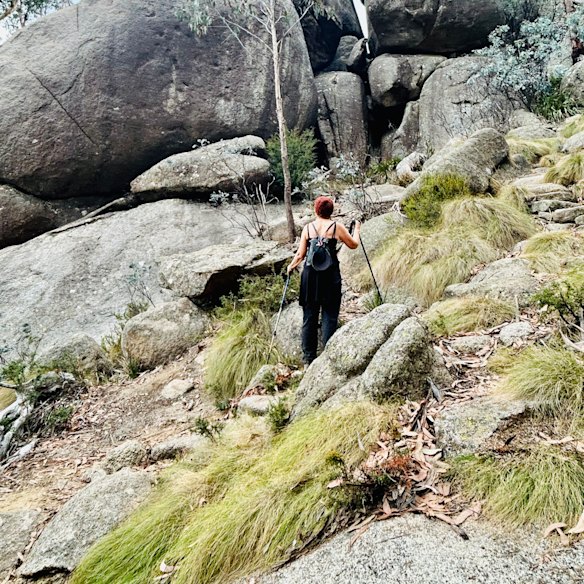
It was the sudden thrill that gave it away. The situation was dangerous – I should have been stressed – but I was excited. Curiously, in my not-young body, I sensed a 10- or 11-year-old girl: her energy, her determination, her delight in extending herself. It was a girl who wanted to have fierce adventures like the girls in all the books she read.
That was it! I was having an adventure as I’d longed to do as a child. I remembered the restless longing for something to happen, for danger and challenge, for paths, islands, caves, mountains, for secrets and treasure, for getting there in the end. It was an 11-year-old girl longing for the whole wide world and all it -offered. I knew without doubt that was why I did it; to have the life of a girl in a book.
Get the best of Good Weekend delivered to your inbox every Saturday morning. Sign up for our newsletter.
Disclaimer : This story is auto aggregated by a computer programme and has not been created or edited by DOWNTHENEWS. Publisher: www.smh.com.au