Chris Moss
Many aviation enthusiasts are sad that the skies no longer boom to the sound of the Concorde. It’s not so much the lack of a superfast service to New York, but the more generalised regret that aeroplanes don’t seem to be evolving as they once did.
Sure, double decks and double beds are impressive, and planes are getting quieter and more economical, but where is the innovation of the early days? Where are the new biplanes and fire-free balloons or, at least, crazily fast jets like the Blackbird?
Leonardo da Vinci designed helicopters (or aerial screws) in the 1480s. You’d think by now they’d have five rotors, and could carry hundreds of us.
Not all modern engineers have played it safe, though. Here’s a round-up of eight left-field aviation experiments. Some of them can be seen in museums, one or two in the air and others can’t be seen anywhere.
The Noviplano
Sign up for the Traveller newsletter
The latest travel news, tips and inspiration delivered to your inbox. Sign up now.
Almost as cumbersome-looking as its name, the Caproni Ca.60 Transaereo (better known as the Noviplano) was the experimental prototype of a large nine-wing flying boat, intended to become a 100-passenger transatlantic airliner. It featured eight engines, and three sets of triple wings. Panoramic windows would afford passengers superb views of the land below – and the thunderheads around them.
Only one example of the aircraft, designed and built by pioneering Italian engineer Gianni Caproni, was ever produced. It was tested on Feb 12 or March 2 1921 on Lake Maggiore with a second flight on March 4, when, shortly after take-off, it crashed in the water and broke up on impact. As it was being towed, it suffered further damage. The project was abandoned because of its excessive cost.
Where can I see it? Surviving parts are on display at the Gianni Caproni Museum of Aeronautics, Italy’s oldest aviation museum, in Trento.
V-22 Osprey
The aeroplane and the helicopter both have their fanatical admirers, but only a few designers have tried to combine their engineering to get the most out of an airframe. The Bell Boeing V-22 Osprey is an American tilt-rotor military aircraft, combining fixed wings and rotors. Targeted at personnel transport and cargo, it’s capable of vertical and short take-off and landing, and can fly a good distance at a high maximum speed – 509km/h.
It first flew in 1989 and, after a long process of development, was put in operation in 2007. The rotors can pivot to allow a helicopter-style hover. V-22s are based at RAF Mildenhall in Suffolk, and flown by pilots in the USAF’s 7th Special Operations Squadron.
Where can I see it? There’s one on display at the National Museum of the United States Air Force in Dayton, Ohio. They sometimes visit the Muckleburgh Military Collection at Weybourne in North Norfolk.
NASA Ad-1
Oblique wings are the kind of design touch you’d probably associate with Wallace of 62 West Wallaby Street, Wigan. But a slewed, or skewed wing, when it’s moveable, can be pivoted to reduce drag at high speed and returned to perpendicular when the plane needs to slow down. It’s a variation on the swing-wing idea used in some fighter jets.
The Ad-1, nicknamed the “scissor wings”, was a one-off, built in 1979, and flown 79 times over a three-year research programme. Its inventor, aeronautical engineer Robert T Jones of NASA’s Ames Research Center in California, hoped his prototype would inform future supersonic designs.
A model he built showed a supersonic oblique winged plane would have twice the fuel economy of a traditional airframe, would make less noise during take off, have a softer sonic boom and have an increased range. In the end, the mechanism and materials needed to apply it to a supersonic jet – such as titanium – proved too costly to permit further development.
Where can I see it? At the Hiller Aviation Museum in San Carlos, California.
British Rail flying saucer
Aimed at the interplanetary market, British Rail’s 1970 patent for a “space vehicle” was inspired by science fiction, as was its intended fuel – a “controlled thermonuclear fusion reaction… ignited by one or more pulsed laser beams”. With a passenger compartment upstairs, round windows and a “homopolar generator”, its designer, Charles Osmond Frederick, said the disc would be cheap to run and ultra-fast.
The application was made on behalf of the British Railways Board and the patent was granted in March 1973. The proposals were unearthed on the European Patent Office website in 2006. “Space-travel-sickness would be potentially avoided,” according to the inventor, as “the prolonged acceleration of the vehicle may in some circumstances be used to simulate gravity.”
The patent later lapsed because of non-payment of renewal fees and British Rail got on with designing the Advanced Passenger Train, which also failed to take off. The US and USSR also patented flying saucer designs, including some models for flying inside Earth’s atmosphere.
Where can I see it? Alas, you can’t.
Hughes H-4 Hercules
More commonly known as the Spruce Goose, the H-4 was a prototype flying boat designed and built by the Hughes Aircraft Company, owned by business magnate and film producer Howard Hughes. Intended for transatlantic service during the Second World War, it wasn’t finished in time, and the aircraft made one brief flight, on November 2, 1947, before the project was shelved.
Because of wartime restrictions on the use of aluminium, and to keep its weight under control, the Spruce Goose was built from plywood. It remains the largest seaplane ever built, and had the largest wingspan of any aircraft ever flown until 2019, when the twin-fuselage Scaled Composites Model 351 Stratolaunch – built to carry air-launch to orbit rockets – made its debut.
Where can I see it? The H4 is on show at the Evergreen Aviation & Space Museum in McMinnville, Oregon.
Convair B-36 Peacemaker
This big beast holds the record for the most engines on a mass-produced aircraft: 10 – six piston engines and four jet engines. A strategic bomber, it was built between 1946-54, and originally conceived as a fall-back should German forces shut off USAF access to British bases. In reality, B-36s were used as nuclear deterrence, aerial reconnaissance, ultra-high and ultra-long-distance exercises and image gathering in the Soviet Arctic and Manchuria.
A total of 383 Peacemakers were built at Fort Worth, Texas. The aircraft was sometimes spotted darkening the skies over Burtonwood base in Lancashire. The Peacemaker still holds the engine-count record for a production plane, though there were experimental designs such as the dart-shaped Rolls-Royce Griffith VTO concept, which featured dozens of powertrains –12 main and 56 lift jets.
Where can I see it? A B-36 is on show at the Pima Air & Space Museum in Tucson, Arizona.
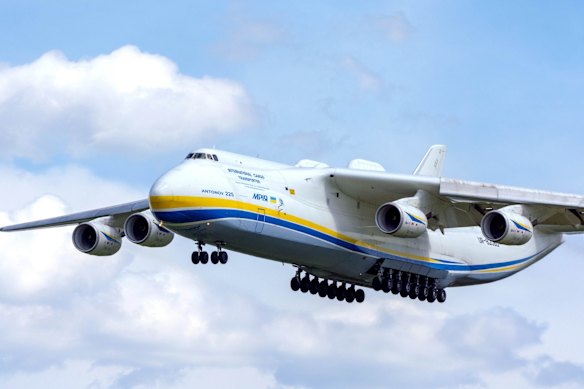
Antonov An-225 Mriya
Only one Mriya – “dream” in Ukrainian – was ever built. It was the largest cargo aircraft in the world, and the only aircraft to feature six turbofan engines. Capable of transporting up to 250 tonnes of cargo, it could haul a single piece weighing up to 200 tonnes – twice as much as a Boeing 747 freighter.
It was originally tasked with transporting the Soviet space shuttle equivalent – the Buran space craft – and made its international debut landing at the 1989 Paris Air Show with the spaceplane on its back. The plane’s last commercial mission took place between February 2-5 2022, collecting almost 90 tonnes of Covid-19 test kits from Tianjin, China.
Where can I see it? You can’t. Russian forces destroyed the aircraft later that year during the Battle of Antonov Airport.
Starr Bumble Bee II
Ever heard someone argue that bee flight is illogical given the size of a bee’s body and its wings? Robert H Starr decided to reveal the science behind the seeming miracle by building the world’s smallest plane – which would also win him an entry in the Guinness Book of Records.
His experimental biplane had a wingspan of just 1.68 metres and weighed less than 181 kilograms when empty. Power came from an 85 horsepower engine. Though it broke the record for the smallest piloted plane on April 2, 1988, the Bumble Bee II crashed on its third flight a month later, severely injuring Starr.
Where can I see it? The tiny aircraft is on display at the Pima Air & Space Museum.
The Telegraph, London
From our partners
Disclaimer : This story is auto aggregated by a computer programme and has not been created or edited by DOWNTHENEWS. Publisher: www.smh.com.au