The President of the United States of America, Donald Trump, announced a massive trade deal with Japan, marking one of the most significant economic agreements of his presidency.
The deal promises to reshape U.S-Japan relations and bolster America’s industrial might.
Japan’s Prime Minister Sanae Takaichi also made the announcement on X, praising the pact as a “strategic partnership” that aligns Japan’s strengths with America’s economic resurgence. The pledge was made in exchange for reducing threatened US tariffs of 25 percent to 15 percent on Japanese imports.
US-Japan Trade Deal: Core of the Agreement
At the core of this historic U.S-Japan trade pact, President Trump announced Japan’s binding pledge to invest $550 billion directly into the United States.
These substantial funds are strategically directed toward revitalising America’s industrial base, which has faced decades of decline due to offshoring and foreign competition, according to President Trump.
(@takaichi_sanae) February 18, 2026
The investments are designed to generate hundreds of thousands of high-quality, well-paying jobs in manufacturing, energy, and technology sectors, breathing new life into Rust Belt states and beyond.
Simultaneously, the agreement bolsters U.S national security by targeting vulnerabilities in critical areas like energy production and rare earth minerals, reducing dependence on adversarial nations such as China.
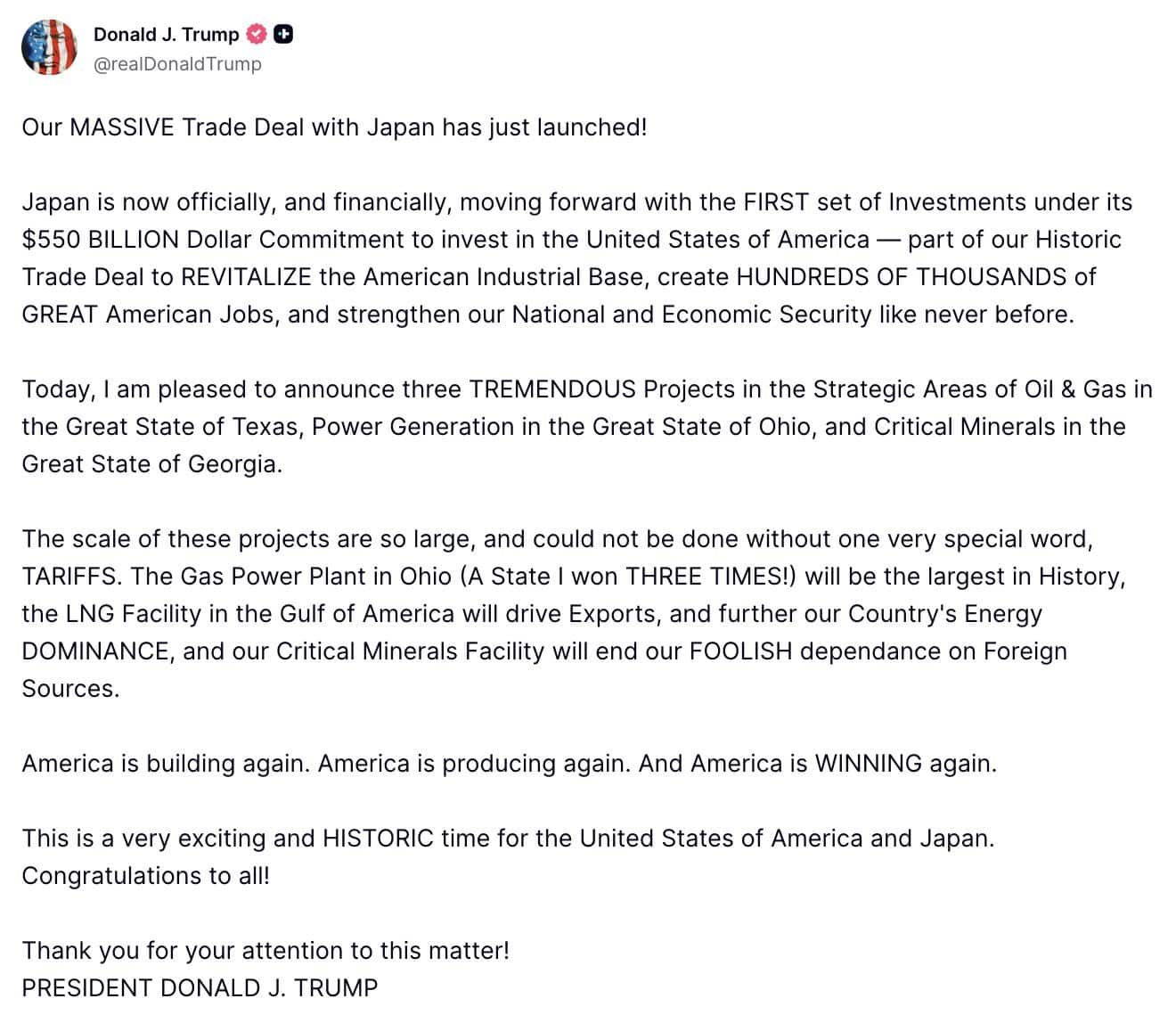 According to the announcements made by both leaders, early projects include a massive LNG facility in Texas for energy exports, the world’s largest gas power plant in Ohio, and a minerals processing plant in Georgia, all enabled by Trump’s tariff policies to ensure their unprecedented scale.
This dual focus on economic revival and strategic independence positions the deal as a cornerstone of the US President’s “America First” agenda.
Countering China’s Critical Mineral Monopoly
While the US-Japan trade deal fits into a broader pattern of U.S. bilateral trade pacts. President Trump has again targeted China’s Critical Mineral monopoly.
In the US-Japan trade deal, Trump counterbalances China’s dominance in global trade, particularly as Beijing weaponizes export controls on rare earths and critical minerals amid escalating Indo-Pacific tensions.
By ramping up its own production of critical minerals and semiconductors, the United States seeks to break free from dependence on China, a point emphasized by Howard Lutnick.
Amid escalating tensions across the Taiwan Strait, including U.S. arms sales to Taiwan and Japan’s firm support for the island, Washington views strategic trade and business deals as a vital lever to constrain Beijing’s influence.
Disclaimer : This story is auto aggregated by a computer programme and has not been created or edited by DOWNTHENEWS. Publisher: ZEE News