
Updated ,first published
Washington: The United States is continuing to surge military assets to Eastern Europe and the Middle East, including fighter jets and refuelling tankers, increasing speculation that President Donald Trump is headed for war with Iran despite some progress in recent talks.
Several media outlets, including CNN, citing sources familiar with the matter, suggest the US military could be ready to carry out strikes as soon as this weekend, though Trump has yet to make a final decision.
Meanwhile, Trump again warned British Prime Minister Keir Starmer not to cede control of the Indian Ocean island of Diego Garcia to Mauritius, saying the US may need to use the island and its air base to defend against Iranian attacks in the event the Islamic Republic does not make a deal.
The developments came as White House press secretary Karoline Leavitt said there were “many reasons” for a strike against Iran, though the president’s first preference was always diplomacy.
Flight tracking data indicated dozens of military aircraft, including refuelling tankers, left the continental US heading east, or moved across Europe, overnight into Wednesday (Washington time), adding to the growing military build-up in the region.
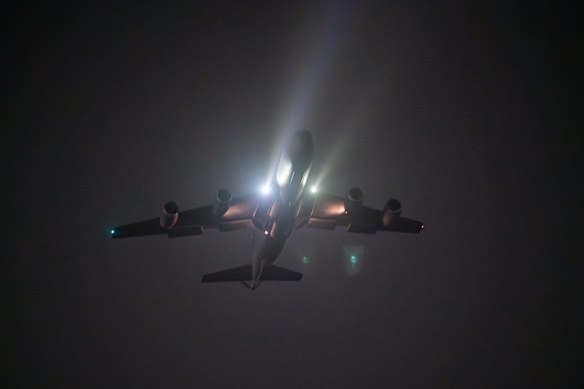
Popular tracking site FlightRadar24 said at one point overnight, all of its nine most-tracked flights were US Air Force Boeing KC-135 Stratotankers, an aircraft used to refuel other planes in midair.
Records show one such flight left Tampa, Florida, on Tuesday night bound for Sofia, Bulgaria. There was also a high level of activity around Mildenhall air force base in England, a key US military hub.
US news website Axios reported another 50 fighter jets headed to the region within 24 hours. Its prominent foreign policy correspondent, Barak Ravid, who is in direct contact with Trump, reported that “the Trump administration is closer to a major war in the Middle East than most Americans realise”.
At a think tank event in Washington on Wednesday, the director of the Middle East program at the Centre for Strategic and International Studies, Mona Yacoubian, said the US military build-up “seems unprecedented, at least in recent memory”, with “all kinds of military assets being flooded into the region”.
The USS Abraham Lincoln aircraft carrier is already in the area, with the BBC tracking it to the Arabian Sea off the coast of Oman earlier this week using satellite imagery. Another strike group, led by the USS Gerald Ford, is on its way to the Gulf and could arrive within a week.
“Every aircraft carrier can hold at least 75 aircraft. That’s a big, big power,” said Susan Ziadeh, a former US ambassador to Qatar, at the CSIS event on Wednesday.
The ongoing buildup comes despite another round of indirect talks between the US and Iran this week in Geneva, mediated by Oman, which were led on the US side by Trump’s special envoy, Steve Witkoff, and the president’s son-in-law, Jared Kushner.
Both sides flagged a level of progress, with Iran saying there was agreement on “guiding principles”, and a US official saying the Iranians would present detailed proposals to address differences “in the next two weeks”.
However, analysts noted that when Trump bombed Iran’s nuclear facilities in June, he had just two days earlier indicated he would decide “within two weeks”.
At a press briefing on Wednesday, Leavitt said there was some progress made in Geneva, but the two sides were still “very far apart on some issues”. The president would “continue to watch how this plays out”.
“There’s many reasons and arguments that one could make for a strike against Iran,” Leavitt told reporters. “The president has always been very clear [that] diplomacy is always his first option, and Iran would be very wise to make a deal.
“He’s talking to many people – of course, his national security team first and foremost. This is something that obviously the president takes seriously.”
Trump has repeatedly stressed his preference for a diplomatic solution that would prevent Iran developing nuclear weapons following the destructive US air strikes in June. But the US also wants wider restrictions on Tehran’s uranium enrichment, ballistic missiles and funding of terrorist proxies in the region.
Israeli Prime Minister Benjamin Netanyahu has warned Trump that Iran cannot be trusted to honour a deal. US Secretary of State Marco Rubio is now due to fly to Israel at the end of February to discuss Iran with Netanyahu, Reuters reported on Wednesday, following a national security meeting at the White House.
Iran, meanwhile, briefly closed parts of the crucial Strait of Hormuz for live naval exercises on Tuesday. The strait, through which more than a fifth of the world’s oil supply passes, has never been fully closed, and it is expected Tehran would seek to use it strategically in the event of war.
Middle East expert Aaron David Miller, who has advised several presidents, said Trump appeared to have “put himself in a box” through his rhetoric and the “staggering” build-up of military assets in the region.
“He has now assembled an extraordinary degree of military power. You have the Gerald Ford carrier strike group, probably due within a matter of days. You have F-22s, F-35s, F-15s. You’ve got defensive missile systems,” Miller told this masthead.
“Against all of this, you have a negotiating process which at the moment seems to me to be unable to produce an outcome which would give the president a sense that the Iranians have really offered something.
“This is not a normal administration, this is not a normal American president, and what he’s contemplating with the amount of hardware that is out there is staggering.”
Climbing down from that position would be difficult, Miller said. “How do you justify and rationalise doing nothing, or doing something that appears to be inconsequential?”
Get a note directly from our foreign correspondents on what’s making headlines around the world. Sign up for our weekly What in the World newsletter.
 Michael Koziol is the North America correspondent for The Age and Sydney Morning Herald. He is a former Sydney editor, Sun-Herald deputy editor and a federal political reporter in Canberra.Connect via X or email.
From our partners
Disclaimer : This story is auto aggregated by a computer programme and has not been created or edited by DOWNTHENEWS. Publisher: www.smh.com.au