
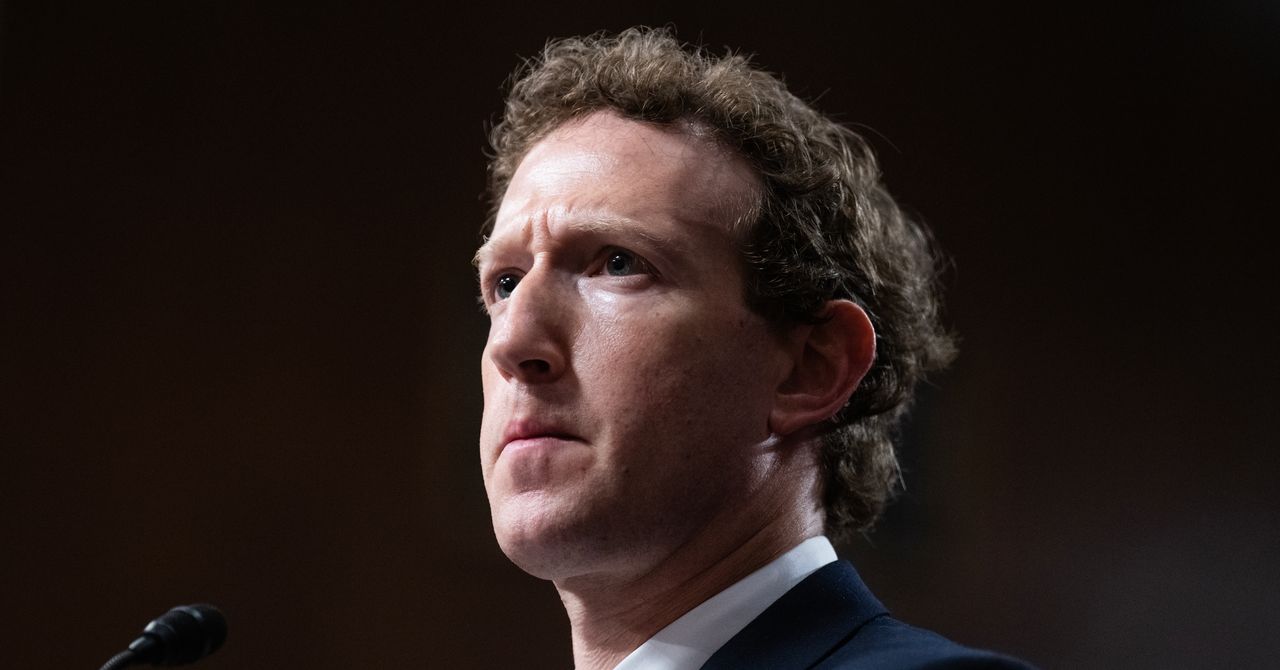
Mark Zuckerberg walked somewhat stiffly into a courtroom of the Superior Court of Los Angeles County at 9 am on the dot on Wednesday, having first been escorted into the building by a security detail that included two Department of Homeland Security officers. The venue, overseen by judge Carolyn Kuhl, was bursting with spectators and media, many crammed elbow-to-elbow on benches, all there to witness the Meta CEO testify before a jury about allegations that his company’s products pose serious risks to younger users.
Specifically, Zuckerberg was on hand to answer questions as to whether Meta products such as Facebook and Instagram were intentionally engineered to be addictive—as well as allegations that the tech giant had deliberately targeted tweens and teens with engagement-boosting strategies that led to mental health crises. It was to be a crucial showdown in a lawsuit brought by a now 20-year-old Californian identified as K.G.M. (although her counsel usually referred to her by her first name, Kaley) and her mother against Meta, YouTube, Snap, and TikTok back in 2023. They allege that her compulsive use of those platforms accounts at an extremely young age caused severe psychological damage.
After Meta and Google failed to get the case dismissed in November, Snap and TikTok settled out of court, leaving the other companies to face the first of nearly two dozen so-called bellwether trials about social media addiction currently on the docket in Los Angeles. These are the cases selected as representative of a much larger pool of litigants—some 1,600 in total—who have filed suits against the same brands on similar grounds, alleging that their children fell victim to depression, dysmorphia, and suicide after they got hooked on apps that absorbed their attention. The families of some of these children were among those vying for a chance to finally see Zuckerberg in the hot seat on Wednesday.
K.G.M.’s counsel, Mark Lanier, launched into his examination of Zuckerberg by putting the 41-year-old executive’s credibility under the microscope. Lanier picked apart claims Zuckerberg had made under oath in January 2024 during Congressional testimony about online child safety. While Zuckerberg had claimed that children under 13 are not allowed on Instagram, Lanier showed that in 2015 the platform internally estimated that there were then 4 million Instagram users under age 13, comprising 30 percent of 10-to-12-year-olds in the US. While Zuckerberg previously claimed that the Meta team does not receive directives to increase the time users spend on their platforms, Lanier produced a 2015 goal-setting email from Zuckerberg that listed this as the first item.
Elsewhere, Lanier sought to establish Zuckerberg’s ultimate decision-making authority over Meta, and quoted a remark he made in an interview with Joe Rogan last year: “Because I control our company, I have the benefit of not having to convince the board not to fire me,” he’d told the podcast host. Zuckerberg insisted in court that this was merely a “simplified” version of the truth.
Over the course of his testimony, Zuckerberg was oddly evasive about even insignificant details and basic definitions. He was not quite prepared to confirm that his relevant Congressional testimony had taken place on January 31, 2024, for example, and was hesitant to agree with Lanier’s proposition that when something is “addictive,” people “do it more” He ultimately hedged: “Maybe in the near term.” Zuckerberg also preferred to acknowledge any past comment, in probabilistic fashion, by saying “It sounds like something I would have said.” Likewise, when asked whether internal documents appeared to suggest Meta’s interest in maximizing “total teen time spent” on their apps, he often replied, “That’s what the document says.”
Zuckerberg repeatedly fell back on accusing Lanier of “mischaracterizing” his previous statements. When it came to emails, Zuckerberg typically objected based on how old the message was, or his lack of familiarity with the Meta employees involved. “I don’t think so, no,” he replied when directed to clarify if he knew Karina Newton, Instagram’s head of public policy in 2021. And Zuckerberg never failed to point out when he wasn’t actually on an email thread entered as evidence.
Perhaps anticipating these detached and repetitive talking points from Zuckerberg—who claimed over and over that any increased engagement from a user on Facebook or Instagram merely reflected the “value” of those apps—Lanier early on suggested that the CEO has been coached to address these issues. “You have extensive media training,” he said. “I think I’m sort of well-known to be pretty bad at this,” Zuckerberg protested, getting a rare laugh from the courtroom. Lanier went on to present Meta documents outlining communication strategies for Zuckerberg, describing his team as “telling you what kind of answers to give,” including in a context such as testifying under oath. “I’m not sure what you’re trying to imply,” Zuckerberg said. In the afternoon, Meta counsel Paul Schmidt returned to that line of questioning, asking if Zuckerberg had to speak to the media because of his role as head of a major business. “More than I would like,” Zuckerberg said, to more laughter.
In an even more, well, “meta” moment after the court had returned from lunch, Kuhl struck a stern tone by warning all in the room that anyone wearing “glasses that record”—such as the AI-equipped Oakley and Ray-Ban glasses sold by Meta for up to $499—had to remove them while attending the proceedings, where both video and audio recordings are prohibited.
K.G.M.’s suit and the others to follow are novel in their sidestepping of Section 230, a law that has protected tech companies from liability for content created by users on their platforms. As such, Zuckerberg stuck to a playbook that framed the lawsuit as a fundamental misunderstanding of how Meta works. When Lanier presented evidence that Meta teams were working on increasing the minutes users spent on their platforms each day, Zuckerberg countered that the company had long ago moved on from those objectives, or that those numbers were not even “goals” per se, just metrics of competitiveness within the industry. When Lanier questioned if Meta was merely hiding behind an age limit policy that was “unenforced” and maybe “unenforceable,” per an email from Nick Clegg, Meta’s former president of global affairs, Zuckerberg calmly deflected with a narrative about people circumventing their safeguards despite continual improvements on that front.
Lanier, though, could always return to K.G.M., who he said had signed up for Instagram at the age of 9, some five years before the app started asking users for their birthday in 2019. While Zuckerberg could more or less brush off internal data on, say, the need to convert tweens into loyal teen users, or Meta’s apparent rejection of the alarming expert analysis they had commissioned on the risks of Instagram’s “beauty filters,” he didn’t have a prepackaged response to Lanier’s grand finale: a billboard-sized tarp, which took up half the width of the courtroom and required seven people to hold, of hundreds of posts from K.G.M.’s Instagram account. As Zuckerberg blinked hard at the vast display, visible only to himself, Kuhl, and the jury, Lanier said it was a measure of the sheer amount of time K.G.M. had poured into the app. “In a sense, y’all own these pictures,” he added. “I’m not sure that’s accurate,” Zuckerberg replied.
When Lanier had finished and Schmidt was given the chance to set Zuckerberg up for an alternate vision of Meta as a utopia of connection and free expression, the founder quickly gained his stride again. “I wanted people to have a good experience with it,” he said of the company’s platforms. Then, a moment later: “People shift their time naturally according to what they find valuable.”
Disclaimer : This story is auto aggregated by a computer programme and has not been created or edited by DOWNTHENEWS. Publisher: wired.com



