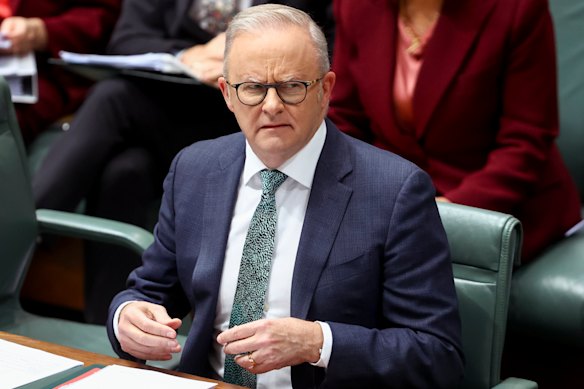

Anthony Albanese has declared he holds contempt for the Australian women stranded in a camp in Syria as the opposition questions why they were provided with passports to return from the Middle East.
As the government prepares for a group of women and children to again attempt to leave the Roj camp in north-east Syria and fly to Australia, Albanese insisted the government would not provide support to help them return home.
“I have nothing but contempt for these people,” Albanese told ABC radio.
“The government is providing no support for the repatriation of these people or any support whatsoever.”
Pressed on the stranded children who had no say over travelling to be part of the Islamic State caliphate, Albanese said: “I have contempt for their parents who have put these children in that situation.
“We have a firm position, which is that the mothers in this case who made this decision to travel overseas against Australia’s national interest are the responsible ones who’ve put their children in this position … We will do nothing to assist these people coming back to Australia.”
Opposition Leader Angus Taylor said the government should “shut the door” on the women returning to Australia.
“I don’t believe people who want to bring hate and violence from another part of the world to Australia – people who do not believe in our core beliefs – should be coming into the country,” he said.
“It’s as simple as that. This government has not answered the most basic questions about why these people are coming back to Australia.”
Taylor said the government “should be doing everything it can” to stop the women returning to Australia.
“And if we need to work with the government and pass legislation, to tighten legislation, to make sure that they can’t come back, we will do that,” he said.
Home Affairs Minister Tony Burke on Tuesday night confirmed reporting in this masthead that 34 women and children had been provided with Australian passports, saying “if anyone applies for a passport, as a citizen, they are issued with a passport”.
Opposition foreign affairs spokesman Jonno Duniam said it was wrong for the government to suggest all Australians are eligible to receive a passport.
“An application for a passport can be refused on national security grounds,” he said.
“So why is the government issuing passports and providing support to this cohort, and how can it claim it is not assisting repatriation?
“These are people who chose to go to Syria to support the ISIS death cult – a listed terrorist organisation that inspired the Bondi terrorist attack.”
Duniam also questioned why the government had only imposed a temporary exclusion order on one of the women, rather than all of them.
Assistant immigration minister Matt Thistlethwaite said earlier that receiving a passport was “a right that everyone has as an Australian citizen. So I, as a government official or others can’t stop that.”
Greens senator Mehreen Faruqi said it was “pretty disgraceful” that the government was not actively facilitating the return of the women and children, as it did for a cohort in 2022 and the Morrison government did in 2019.
“These are Australian citizens. They need to be brought back and the concerns should be dealt with in Australia,” Faruqi said.
“These people have been left to languish in refugee camps for too long. If there are concerns, they need to be brought back and these are people Australia can’t just turn into stateless people,” she says.
Save the Children Australia chief executive Mat Tinkler said the women had agreed to work with security agencies when they returned to Australia.
“In the past, they volunteered to be subjected to terrorism control orders, which would be conditions placed on who they meet, where they live, how they communicate with people,” he told the ABC.
“The best way to mitigate any risk that they pose is to put faith in our security and enforcement agencies.”
He said the Roj camp was “one of the most difficult places in the world to be a child”.
 Matthew Knott is the foreign affairs and national security correspondent for The Sydney Morning Herald and The Age.Connect via X, Facebook or email.
From our partners
Disclaimer : This story is auto aggregated by a computer programme and has not been created or edited by DOWNTHENEWS. Publisher: www.smh.com.au