
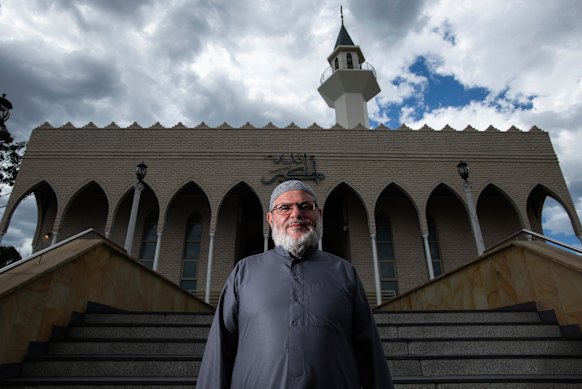
While political freedom is a must for democracy, we must draw the line at Pauline Hanson’s divisive and hateful attack against Muslims (“Lakemba Mosque receives third threat as leaders slam Hanson”, February 19). Her fear of things that are different to her white Australian mind shows an ignorance of what she is against. I have had the privilege of spending many years working in the Middle East and interacting with Muslims daily for both work and pleasure, and not once were there any issues. In fact, I felt safer there than in many places in Australia where I am sure many of Hanson’s white supporters live. I find Muslims to be like anyone else; they want their children to grow up and be successful, they want a roof over their head, they want food on their table, and they want to live in peace. There are reportedly more than 2 billion Muslims in the world, of which fewer than 1 per cent are radical. Victor Marshall, Meander (Tas)
I was in Campsie (near Lakemba) last week, and what I found was a vibrant main street with shops full of interesting foods and other things. The shopkeepers were polite and friendly, and the other customers were just ordinary people going about their daily lives, trying to raise a family. I felt very safe. But it was daytime. I haven’t been there at night. In Wollongong, it’s much the same – in the daytime. At night, I wouldn’t go out unless it was necessary. It’s scary being confronted by louts who are fuelled by alcohol, drive cars like they’re on a racetrack, and are keen to relieve me of my possessions so that they can get their next drug fix. So, Pauline Hanson, just because the people you saw don’t speak your language, don’t write them all off as bad eggs. As for their religion, at least they have one. Did you see the last census figures about how many “Australians” have no religion? “Those people” have come to Australia for a better life, for a new start from a war-torn country, and “those people” don’t need you to bad-mouth them.Mia David, Wollongong
The Bondi Junction security guard Faraz Tahir made the ultimate sacrifice by confronting the serial stabber with zero hesitation. Tahir’s boldness undoubtedly saved many more lives, yet according to Pauline Hanson, there are no “good Muslims”. This Muslim-Australian immigrant national hero from Pakistan gave his life to his adopted homeland on his first shift. If he is not a “good Muslim” in Hanson’s books then what does that make him? Naosheyrvaan Nasir, Quakers Hill
The 19th-century British prime minister Benjamin Disraeli remarked that the legacy of a hero is the inheritance of a great example. Syrian-born Muslim migrant Ahmed al Ahmed has given that example to Australians with his courage in disarming the younger Bondi shooter while being wounded himself. Conversely, anti-migrant rhetoric from Australian politicians is highly counter-productive macro-messaging. Barriers to social and workforce participation can result, yielding marginalisation, poverty and loss of hope, which exacerbate disadvantage and fracture society. Australia deserves, and needs, politicians who do not diminish us. Barbara Chapman, South Yarra (Vic)
Like many citizens, I can only assume Muslims are more concerned with their immediate family, children’s education, health, employment and community. And that religion would be subordinated as a not over-determined preoccupation. Mike Fogarty, Weston (ACT)
ISIS brides in limbo
If the Australian children stranded in the refugee camps in Syria were here, they would be subject to mandatory reporting to child protection agencies (“Burke bans ISIS bride from returning home”, February 19). Indeed, it would be an offence for any professional aware of their dire living circumstances not to report. Why do we not offer Australian children offshore the same protection? Louise Sorbello, Leichhardt
There is not one valid reason that these women and their children should be allowed to return to Australia. They turned their backs on their country to follow their husbands who were fighting with the terrorist group ISIS. Their children are not Australian; their nationality is where they were born. The brides have lived so long in an environment of terrorist ideology and been indoctrinated into that ideology that it would not be safe for the Australian community for them to return. I sincerely hope that the prime minister and government stand by the decision not to allow these people to return Australia, no matter how much noise the do-gooders in the community make. Alan Leitch, Austins Ferry (Tas)
” loading=”eager” src=”https://static.ffx.io/images/$zoom_0.317%2C$multiply_0.7725%2C$ratio_1.5%2C$width_756%2C$x_51%2C$y_0/t_crop_custom/q_86%2Cf_auto/8c6f466ade7cfb1f351b694d631d8a6cf5088cfa” srcset=”https://static.ffx.io/images/$zoom_0.317%2C$multiply_0.7725%2C$ratio_1.5%2C$width_756%2C$x_51%2C$y_0/t_crop_custom/q_86%2Cf_auto/8c6f466ade7cfb1f351b694d631d8a6cf5088cfa, https://static.ffx.io/images/$zoom_0.317%2C$multiply_1.545%2C$ratio_1.5%2C$width_756%2C$x_51%2C$y_0/t_crop_custom/q_62%2Cf_auto/8c6f466ade7cfb1f351b694d631d8a6cf5088cfa 2x” class=”sc-d34e428-1 bnWZMz”>
How selfish can we Australians be? We left the fight against ISIS to others, namely the Kurds, who lost thousands of their own people to secure the safety for all, and now we leave the expense of feeding and housing our nationals to them. Bring them back. Charge them if that is the correct thing to do and set their innocent children on a path to education, tolerance and the kindness Anthony Albanese likes to champion. Marion Wood, Mosman
Given that many of the wives accompanied their Islamic State fighting husbands who supported the abhorrent ideology, could it possibly be interpreted as a form of coercive control? This is an offence in most states and territories. Charlie Dodd-Somerton, Ultimo
It’s hard to imagine living in a Syrian refugee camp for seven years and the effects it has had on the women and children currently stuck in that situation. In 2022 Australia repatriated four women and 13 children in an identical situation and has not experienced any detrimental experiences for this act of clemency. Can’t we show the world that a merciful gesture of humanity could serve as a balm in times of the harsh rhetoric coming out of the Hanson-Liberal camp? It would take some moral courage after the Bondi massacre but such humanity is needed to counter today’s Trump-induced climate of intolerance. Larry Woldenberg, Forest Lodge
Protest for protests?
It is not just the Labor faithful who are concerned about the premier’s repressive stance (“NSW Labor faithful to push Minns on protests”, February 19). Our state and federal leaders should be reminded that much of what we hold dear in our community has come through protest, including universal suffrage, the eight-hour (and less) day with safe working conditions, Indigenous recognition and rights, and environmental safeguards. Now it seems we will have to protest in favour of the right to protest. Rene Vogelzang, Haberfield
Repeated rhetoric
Yes, we all make mistakes, but the weird thing about Angus Taylor and Jane Hume is that while admitting their election errors they appear determined to repeat them (“The dubious rise of Taylor and Hume”, February 19). Dusting off their poorly costed, poorly explained nuclear policy as an answer to rising fuel prices is hardly a vote-winner. Then there’s the thinly veiled anti-immigrant rhetoric, which once worked for John Howard but in 2026 is a great way of alienating migrants still getting to grips with Don Bradman’s batting average. There are plenty of ways the federal government could be called to account, but right now the current Liberal leadership team is one of the best things Albanese has going for him. Nick Franklin, Katoomba
I’ve now heard Angus Taylor confuse “amount” and “number”, “less” and “fewer”, and “reticent” and “reluctant”. It’s time for the Liberals to replace him as leader. Rob Jackson, Cheltenham
High-speed rail beats AUKUS
Many of your correspondents (Letters, February 19) have contributed their views on the latest cost estimates for the very fast train, but they need to equate it with other commitments by our federal government. The current total cost for the VFT is less than the promised commitment to buy just one of the nuclear-powered submarines from the US, for which advance payments are already being made. Many military commentators question whether we will ever receive any of the three submarines for which we have committed $380 billion. High-speed rail brings greater benefits than one of the imaginary submarines. There was a time when our leaders were able to provide infrastructure ahead of community need, so we had housing, schools, hospitals and transport available for our expanding population. Recent decades of total neglect to construct these facilities to meet predicted growth means we now have high costs to catch up with urgent need. High-speed rail is one of these neglected areas, and it is essential that an east coast fast train is built as soon as practicable, as is happening in comparable countries around the world. Doug Hewitt, Hamilton
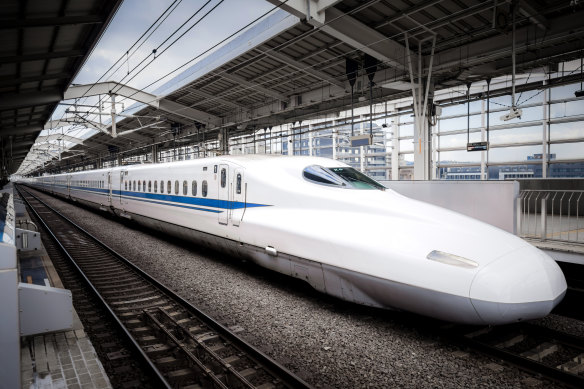
One of your correspondents suggests a modern tilt train as an alternative to the proposed $90 billion high-speed rail. However, trains that operate frequently can only progress as fast as the slowest trains that share the same route, unless additional parallel lines/sidings are built for overtaking them. There would be little benefit for faster tilt trains until these substantial and disruptive track upgrades are built and/or the removal of the slower passenger and freight trains along this Sydney-Newcastle route. Building a new high-speed rail alignment would significantly increase passenger capacity while allowing the older line – that dates from 1889 – to service the slower trains and existing stations and avoid transport disruption. Brian Hastings, Drummoyne
While I would love to see high-speed rail between Sydney and Newcastle, it is sadly uneconomic. With an RBA interest rate of about 4 per cent, we would need to pay about $3.6 billion a year to service the $90 billion loan. And if the train moved 15 million passengers a year (the current number), that would cost $240 per passenger, a figure that you could double once you include the need to repay the principal, along with depreciation and running costs. Few passengers would be willing to pay that much.
We should instead use the money to upgrade existing lines to high-speed rail standards throughout the inter-city network, but first where this can be done relatively cheaply. By picking the low-hanging fruit first, we could see many trains running at 160 to 180km/h, rather than the dismal 50 to 80km/h currently managed by the Canberra to Sydney train. If we do go ahead with the Newcastle link, we must build the southern section first, not last. That way, when the costs blow out and we realise the whole project is uneconomic, we will at least be left with something we can use, not a white elephant line running from Newcastle to the Central Coast. Nicholas Reid, Hughes (ACT)
The debate over a Sydney-Newcastle fast train is a bit all-or-nothing, except for the idea that tilt trains coupled with track improvements could form a staged approach.
Let’s start that sooner rather than later. We also need to ask the question: what is the cost of not building it? M1 gridlock, more fatal accidents, and reduced business and employment opportunities. We are spending $368 billion on phantom subs over a shorter period, most of that going to the US and UK. Stage 1 of a VFT sounds cheap. Ronald Watts, Newcastle
Anthony Albanese, with justification, says Australia is alone, compared to peer nations, in not having high-speed rail which is set to cost up to $90 billion for Sydney to Newcastle. Rather than copycat, I suggest an alternative multi-jurisdictional nation-building project as a more urgent economic and security imperative, ie: providing electricity, with the added attraction of uniqueness by taking account of Australia’s geography. The NSW and Queensland “outback” could readily host large hybrid solar and wind farms, providing continuous power (day solar, night from the nocturnal low-level jet stream), combined with efficient high-voltage direct current (HVDC) transmission delivering electricity to the eastern seaboard. Add offshore wind farms off Victoria and Tasmania, providing plentiful energy thanks to the Roaring Forties. Such an integrated national project, the contemporary equivalent of last century’s “big picture” Snowy Hydro Scheme, will provide an abundance of reliable electricity, potentiating decades of prosperity. And fortuitously, satisfies the so-called “trilemma” (sustainability, affordability and energy security), as renewables are the clear winner, irrespective which of the three is prioritised. Carlo Ursida, Kensington (Vic)
I can understand commuters in NSW wanting quality trains going in all directions from Sydney. Last Saturday the commuters from Lithgow to Sydney would have been happy to have a working toilet on one of the new trains recently introduced to the Blue Mountains line. Robyn Lewis, Raglan
Swimming equity
Your correspondent’s letter (February 19) about the swimming carnival was very depressing. Now, 30 per cent of schools do not do swimming lessons.
Others have several 50-metre pools. Where is the equity? This is a travesty. All Australian kids need to be funded into life-saving swimming programs. Jill Stephenson, Woolwich
Countless doubts
A recent crossword clue: A Sydney suburb with 12 letters? Not being a Sydney native, I scratched my head and reverted to a cheating moment. Answer according to AI? “Lilli Pilli is a suburb in Sydney with 12 letters in its name”. Astonished, I magnified the print and counted the letters several times. I will never believe anything that is attributed to AI. Maureen Donlon, Wagga Wagga
- To submit a letter to the Sydney Morning Herald, email letters@smh.com.au. Click here for tips on how to submit letters.
- The Opinion newsletter is a weekly wrap of views that will challenge, champion and inform. Sign up here.
Disclaimer : This story is auto aggregated by a computer programme and has not been created or edited by DOWNTHENEWS. Publisher: www.smh.com.au


