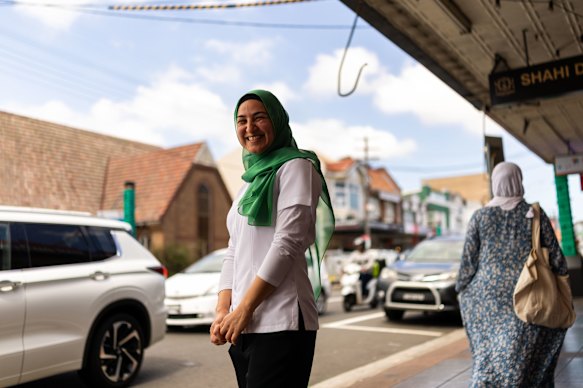

Fatma Youssef woke about 4.30am, downed two espressos and ate some Nutella on Lebanese bread before the start of the day’s Ramadan fast.
Then, after prayers and a little more sleep, she went to her job as a pharmacist in Lakemba, the south-west Sydney suburb that One Nation leader Pauline Hanson this week portrayed as an unsafe, inhospitable enclave.
“I’ve never felt it was not safe,” said Youssef, who has attended the Eid prayers at Lakemba Mosque nearly every year. As for Hanson’s comments, she said, “The more you meet people, the more educated you get, the less scared you get.”
On Thursday, the suburb was gearing up for the first evening of the Ramadan night markets, which attracted more than 1 million visitors to Lakemba last year. Many of the visitors will be non-Muslims, like the “white Australian” cherry farmers Youssef met who had travelled all the way from Young in the state’s south-west.
Sally, a shop assistant, said Hanson was being “a bit childish”.
“Whatever she says, it’s not logic,” Sally, who came to Australia from Lebanon 50 years ago, said. “We actually welcome people that are not Muslim.”
The Queensland senator singled out Lakemba in an interview on Wednesday when pressed to name the parts of the country people “can’t go into” without feeling unwelcome or unsafe. The comments followed an interview earlier in the week in which she asked “How can you tell me there are good Muslims?”
Prime Minister Anthony Albanese labelled Hanson’s remarks “disgraceful” on Thursday.
Lakemba had a sleepy feel in the middle of the day. People sat in chairs outside cafes in the shade. Ibises lined the railway fence and crows bunched together in the branches of a cedar, the national symbol of Lebanon, the source of much of the suburb’s immigration.
Across the street, large plastic bags full of carrots were stacked nearly to the ceiling of Abu Cham Bakery, which runs a trade in carrot juice during the daytime hours in the Muslim holy month.
Owner Helm Abu Cham, who came from Lebanon in 2004, said, “I was born there but I don’t belong there, I belong here.” In the unlikely event of a war between Australia and Lebanon,“I stand up for Australia”.
Asked about Hanson’s remarks, he said, “I can’t say anything to her because she doesn’t understand.” He pointed out that hundreds of thousands of people came to Lakemba for the night markets. “All that people are feeling unsafe? How is she saying something like that?”
Along with the Lebanese pizzas at his bakery, there’s a vivid array of food on offer in Lakemba: Bangladeshi sweets, fish curries, brain masala, and one shop offering “Authentic Cocos (Keeling) and Christmas Island fusion cuisine”.
Siddikur Rahman chuckled when asked what led him to his halal-certified restaurant Pizza Boss, explaining it was his kids and their hunger for European-style food.
“Before coming to Lakemba I heard so many bad things,” Rahman said. But in the 15 years he has run businesses in the suburb, he has found it to be safe. He had never experienced difficulties with crime or robberies.
The recent violent threats mailed to the Lakemba Mosque down the road, however, troubled him. “Violence, for me, it’s zero tolerance,” he said. “Doesn’t matter if you’re attacking a mosque or a church or a synagogue.”
Lakemba may have a Muslim population far higher than most Australian suburbs, but a significant minority identify as Catholic, like Mercedes, sitting in the shade of a tree outside a church.
“We are all close together like sisters and brothers because we all belong to one God,” the Philippines-born woman said, a gold crucifix hanging around her neck.
Remembering Hanson’s stunt, in which the senator wore a burqa onto the floor of the Senate and received a suspension, Mercedes laughed: “She’s a very crazy woman.”
Yassin Arabi is more solemn. “To be in politics, you have to serve the people, not go against the people because you have your personal racism issue,” said Arabi, a Muslim from Italy who had lived in Lakemba for six years. “It hurts a bit, you know. People are working hard.”
The cafe he manages will stay open until the early hours of the morning, catering to the night-time rush. He says his regular customers come from all kinds of backgrounds, including Australian, Moroccan, Tunisian, Pakistani, Fijian, Italian and Greek.
For Youssef, the pharmacist, Hanson’s comments ignored the tradition of hospitality in which Muslims are raised. “I’m sure if Pauline Hanson rocked up to somebody’s house, they would be like: ‘Do you want to eat some tabbouleh?’”
Start the day with a summary of the day’s most important and interesting stories, analysis and insights. Sign up for our Morning Edition newsletter.
From our partners
Disclaimer : This story is auto aggregated by a computer programme and has not been created or edited by DOWNTHENEWS. Publisher: www.smh.com.au