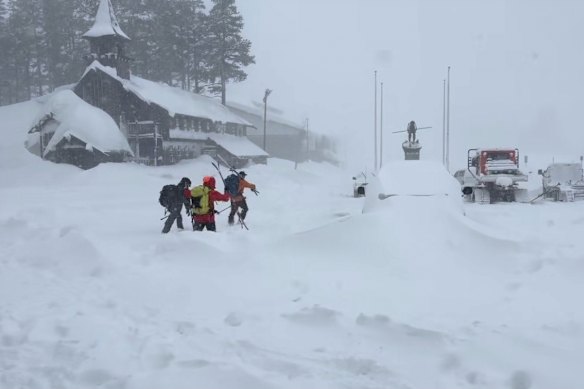

This week alone, avalanches have claimed the lives of at least eight people in California’s Sierra Nevada mountains, three in the French Alps, and two on the Italian side of Mont Blanc.
The disaster in the Lake Tahoe back country is one of the deadliest single avalanches in US history, and one person is still missing.
In Europe, avalanches have already killed more than 90 people since October in one of the deadliest seasons in years, European Avalanche Warning Services figures show, compared with only 36 people in the same time period last year. France and Italy have borne the brunt, with dozens of avalanche-related deaths since the start of this year.
Avalanches have also featured among Japan’s severe run of snow country deaths this year, alongside blizzards and chairlift accidents.
But what causes avalanches, and is climate change making it worse?
Two types of avalanches
There are two types of avalanches. The first is a “loose snow avalanche”, when surface-level snow moves downhill from a single point. The second is a “slab avalanche”, which are much less predictable and more dangerous.
Craig Sheppard, program manager for the Mountain Safety Collective, says this is caused by the interaction of the different layers in a snowpack.
“Whenever there’s a break in weather, it allows the crystals to change, and depending on what the weather is, they’ll change in different ways – some weather will make the snow grains stronger, some weather will make the snow grains weaker,” Sheppard says. “If you get a weak layer underneath a strong layer, then that is a recipe for avalanches.”
When it does not snow for some time, the surface snow is exposed to warming during the day and colder temperatures at night, and it can form “facets” or weak crystals. When there is a fresh snow dump, it remains as an unstable layer below the surface.
“It forms these really feathery crystals, and they’re very beautiful, very delicate, but they stand up tall and it’s like standing up a deck of cards on their end all the way across the snow pack,” he says. “Then you’re putting the next snowfall on these feathery crystals, and you obviously have a recipe for avalanches because you have snow sitting on a really weak grain.”
Or as Tyson Millar, an accredited avalanche safety expert from Protect Our Winters, a group that campaigns on the effect of climate change on the snow season, describes it: “That faceted snow is almost akin to having ball bearings in the layers of snow.”
This is exactly what occurred in Europe and the West Coast of North America this season, Millar says, because there was barely any snow fall for most of January, followed by dumps in February. Japan, by contrast, has had heavy snowfall all season.
Terrain for avalanches
Avalanches are less common in Australia because it is “maritime snowpack”, meaning the climate is affected by the proximity of the ocean. This is in contrast with the intercontinental or continental snowpacks that occur further inland in places such as the Rocky Mountains.
“Avalanches do happen, but they don’t happen with the same frequency as the intercontinental or continental snowpack,” Sheppard says.
The dangers in Australia lean more towards whiteout conditions that can cause people to become disoriented, and surface crusts on steep, icy slopes that can lead to hazardous “slide for life conditions”, he says.
Millar says New Zealand and coastal US resorts are also considered maritime snowpack. However, despite being an archipelago, Japan gets a lot of wind off Siberia rather than warm, moist ocean air.
Associate Professor Nathalie Vriend at the University of Colorado Boulder writes in The Conversation that slopes between 25 and 40 degrees run the greatest risk of avalanches.
“Those are also ideal for skiing, of course,” Vriend says. “If the slope is less than 25 degrees, there might be little slips, but the snow won’t pick up speed. If it’s over 40 degrees, the snow typically cannot accumulate, clearing away the avalanche risk.”
Changing climate
Global warming could make avalanches less common because there is less snow. However, there are other ways that climate change is increasing the frequency and intensity of avalanches.
Professor Steven Sherwood at the University of NSW Climate Change Research Centre says ski seasons are getting shorter nearly everywhere in the world because of higher temperatures.
“The snow is becoming more variable, in the sense that they can still get really big dumps, but they’re probably coming less often, and the snow isn’t lasting as long, and also because they’re getting a higher fraction of rain to snow,” Sherwood says.
The lower altitudes would get more rain – including rain falling on snow – and moving up the mountain, the snow could be softer, he says.
Sheppard says variability of snow seasons with long periods of no snowfall and temperature fluctuations, rain on snow and soft snow are all factors that increase avalanche risk.
A 2018 paper in PNAS found an increase in avalanche activity in the Himalayas was linked to contemporaneous climate warming, contradicting “the intuitive assumption that warming results in less snow, and thus fewer snow avalanches in the region”.
A 2024 peer-reviewed article in Nature Reviews Earth & Environment says climate change could influence the “number, magnitude, flow regime, release, flowing snow type and seasonality of avalanches, as well as the types of terrains prone to avalanches”.
The paper reported a projected increase in wet avalanches – usually a result of thaw conditions where slushy snow slides over bonded snow – in the French Alps, central Rocky Mountains and western Norway. More data was needed to fully understand the impact of climate change on avalanche risk, including indirect factors such as the rise of the treeline or the retreat of the glaciers, the researchers said.
Get to the heart of what’s happening with climate change and the environment. Sign up for our fortnightly Environment newsletter.
 Caitlin Fitzsimmons is the environment and climate reporter for The Sydney Morning Herald. She was previously the social affairs reporter and the Money editor.Connect via email.
From our partners
Disclaimer : This story is auto aggregated by a computer programme and has not been created or edited by DOWNTHENEWS. Publisher: www.smh.com.au