
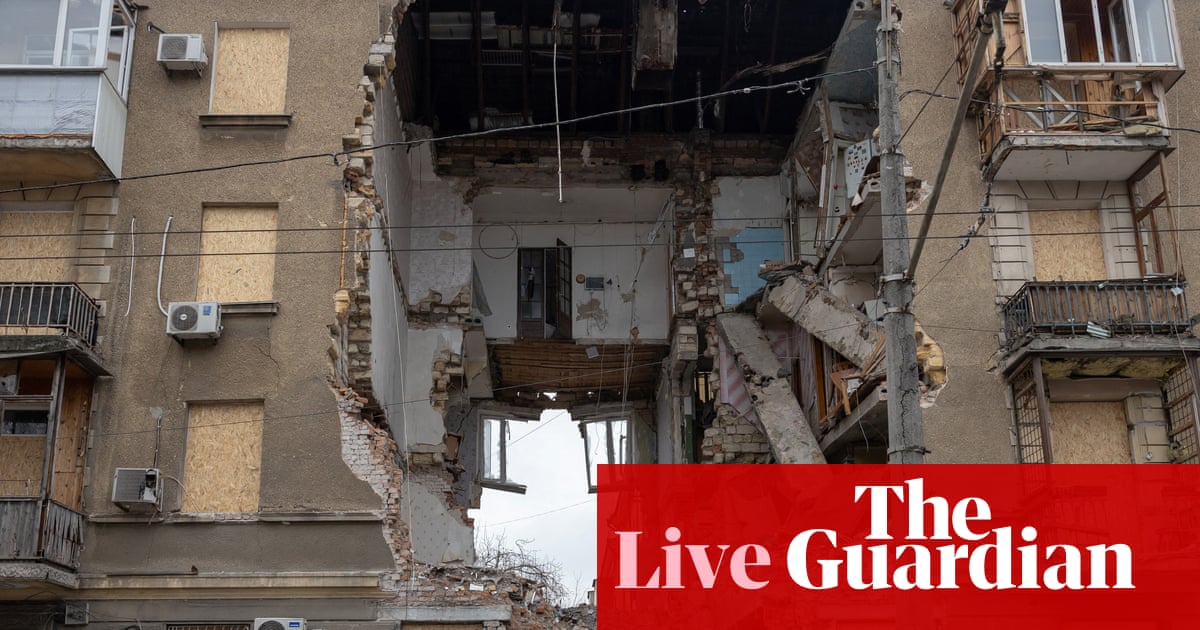
The EU sees “no tangible signs that Russia is engaging seriously” with the aim of securing peace in Ukraine, its spokesperson said, responding to the latest round of talks in Geneva.
Speaking at the European Commission’s midday briefing in Geneva, EU foreign affairs spokesperson Anouar El Anouni said:
“We see that Russia continues its relentless attacks on Ukraine. This does reflect that Russia is not ready for peace. We still do not see tangible signs that Russia is engaging seriously on peace. …
Even this week, ahead of the peace talks, Ukraine experienced another massive missile and drone strike, according to Ukrainian authorities. …
As long as the bloodshed continues, we will continue to put pressure on Russia.”
He also added that “nothing can be decided about Ukraine without Europe at the negotiating table.”
The EU also confirmed that it was aware that national security advisers from France, Germany, Italy, UK were involved in the talks.
… and on that note, it’s a wrap for today!
As mentioned earlier, several European countries are attending the Board of Peace’s meeting in Washington, although only a few of them as actual member of the new body (14:50).
During the event so far, Hungary’s Viktor Orbán has received another high profile endorsement from the US president, Donald Trump (15:49, 17:05), while Romania’s Nicușor Dan received an unexpect invitation to address the event, offering his support for the Board’s efforts in Palestine (15:47, 15:58, 16:39, 17:15).
For further coverage of the Board of Peace’s meeting, follow our US live blog here:
Meanwhile, in Europe:
-
The European Union has said there were “no tangible signs that Russia is engaging seriously” with the aim of securing peace in Ukraine, stressing that nothing can be decided about Ukraine without Europe at the negotiating table” (12:58).
-
Trump-endorsed Hungarian prime minister Viktor Orbán has clashed with the opposition leader, Péter Magyar, over his depiction of the opposition forces as promoting Hungary’s involvement in the Russian invasion of Ukraine (13:48).
-
President of the European Commission Ursula von der Leyen will travel to Greenland next month in a show of solidarity with Denmark and its semi-autonomous territory, the EU has announced (12:49).
-
Poland’s prime minister Donald Tusk has urged Polish citizens to immediately leave Iran, adding that “under no circumstances anyone should be travelling to that country” as he warned that the prospect of active conflict is “very, very real” (11:11).
And that’s all from me, Jakub Krupa, for today.
If you have any tips, comments or suggestions, email me at jakub.krupa@theguardian.com.
I am also on Bluesky at @jakubkrupa.bsky.social and on X at @jakubkrupa.
Romania’s president Nicușor Dan has just been speaking (15:47), offering Romania’s support for Trump’s “comprehensive and stable” plan in Gaza and his “efforts and results in other parts of the world.”
He says Romania could “increase the number of flights to extract children with diseases to treat them in the Romanian hospitals,” scholarships for Palestinian students, and help with “rebuilding the Gazan institutions” such as police and public administration.
The opening speeches are not over yet, but Hungary’s Viktor Orbán is also already trying capitalise on Trump’s comments about him, posting a clip of his endorsement on social media (15:49).
For what it’s worth, Norway just clarified (16:18) that while it plans to host a meeting this spring of the Ad-Hoc Liaison Committee for Palestinian aid, which the country has led for decades, it is not joining Donald Trump’s Board of Peace, the country’s foreign ministry said.
Meanwhile, Romania’s Dan is so keen to highlight his participation in today’s Board of Peace event that he has just posted a snap of a TV screen showing his handshake with US president Donald Trump.
For all the talks about peace, we didn’t hear much about Ukraine and Russia in Trump’s speech, apart from Trump’s usual claims on how many wars he ended, how much he wants to end this one too, and the brags about his great relationships with Putin and Zelenskyy.
Our foreign correspondent Luke Harding offered this assessment of where we are in the talks on last night’s Latest podcast:
“This has been a consistent pattern ever since Donald Trump came back to the White House just over a year ago. He’s put enormous pressure on the Ukrainians and none on the Russians. …
And I think there’s one pretty blunt conclusion, which is that either Trump supports Russia or he doesn’t care really what happens to Ukraine – he just wants a deal and possibly the Nobel Peace Prize or both.
We’re just in this kind of repeating cycle where nothing is going on, where there are very few meaningful American sanctions against the Russians.
The Europeans, meanwhile, who, by the way, were involved to some degree … in Geneva for these two days of peace talks, they are supporting Ukraine.
The bottom line is the Russians don’t want to stop. They think they can win either militarily or politically via a sympathetic American administration. And so my prediction, my strong prediction is the war will continue this year and probably well beyond.”
Watch the entire episode here:
Back to Washington, Trump praises Europe and incorrectly claims that many countries want to become full members of his Board of Peace (they do not).
He says:
“So many of our friends in Europe are attending today, and we’re eager to have them become full members. They all want to become full members. And we’ve had a great response from Europe.
And Europe is, you know, it’s where I come from, where so many people come from that are in the United States. But we have a great relationship with Europe.”
He also says that Norway has agreed to host a Board of Peace event in the future, but brings up his frustration with not getting a Nobel peace prize on that occassion.
“Oh, I thought when I saw this note, ‘I’m excited to announce that Norway,’ I thought they were going to say that they’re giving me the Nobel Prize… Oh, this is less exciting.”
But then in a typical comment of someone who does not care about something, he says he absolutely does not care about the Nobel peace prize anyway.
Just to make sure you understand just how much he does not care about it, he later brings it up again, saying he was “screwed by” Norway.
Russian affairs reporter
Meanwhile, Russia is losing influence over neighbouring post-Soviet states and must “adapt” to remain relevant, a new report by a Kremlin-aligned think tank has said, offering a rare public assessment of Moscow’s declining sway across the region.
The Valdai Club, a club of foreign policy experts with close ties to the Kremlin, said in a new paper that Russia’s war in Ukraine had drained Moscow’s resources and strengthened neighbouring states’ push for greater independence.
The report was presented on Thursday in Moscow during discussions with senior Kremlin officials.
According to the authors, a significant share of Russia’s military and economic capacity has been redirected towards the Ukrainian war effort since 2022, limiting Moscow’s ability to shape developments elsewhere.
The South Caucasus is singled out as one of the clearest examples of Russia’s diminishing leverage, with Moscow’s relations deteriorating with both Armenia and Azerbaijan despite their own long-standing conflict.
Armenia, once one of Russia’s closest partners in the region, has distanced itself from the Kremlin after Moscow failed to prevent Azerbaijan’s takeover of Nagorno-Karabakh, prompting Yerevan to seek closer ties with western powers.
Oil-rich Azerbaijan, meanwhile, is portrayed as pursuing a more assertive and independent course, deepening cooperation with Turkey and other regional actors.
The report comes as the Trump administration pushes to revive a Soviet-era railway – branded the “Trump Route for International Peace and Prosperity” (TRIPP) – a proposed 26-mile corridor through Armenia linking Azerbaijan to Turkey and reducing reliance on routes via Russia and Iran.
In Central Asia, the paper notes that governments are also increasingly developing transport corridors and economic partnerships that avoid Russian territory, weakening Moscow’s role as the region’s primary geopolitical hub.
The authors stress that the picture is not entirely bleak for Moscow, pointing out areas where Russia has retained or even expanded its foothold.
Belarus is applauded as Russia’s most loyal ally, while Georgia is portrayed as pursuing a more “balanced” foreign policy, marked by growing economic ties with Moscow as its political relations with Europe have cooled.
Trump welcomes Romania’s Dan saying merely that “the Romanian people are fantastic, fantastic people, like you’re fantastic.”
“And a lot of them come and work in this country and help us in this country, as you know. And it’s, they are just really, really solid people.”
He also repeatedly praises Marco Rubio for his Munich appearance over the weekend.
I wonder what Europeans think looking at this.
If you fancy the US angle on the event, it’s here on our US live blog:
Curiously, a number of European flags are up on the media wall behind the speakers, including of the EU, Finland, Germany, Greece, Bulgaria…
None of them are actually full members of the body, as far as we know.
Albania’s Edi Rama and Hungary’s Viktor Orbán are also there in the best seats.
In fact, Trump references Orbán specifically, as he says he is “not supposed to be endorsing people, but I endorse [them] when I like people.”
“You know, I’ve had a very good record of endorsing candidates within the United States, but now I endorse foreign leaders, including Viktor Orbán,” he says.
He then adds:
“Prime minister Orbán of Hungary, who has my complete and total endorsement for election.
Not everybody in Europe loves that endorsement, but that’s okay.
He does an unbelievable job. He’s done an incredible job on immigration. Unlike some countries that have hurt themselves, they’re working on it.
But I just want to let you know you have my total and complete endorsement, and I’m putting it out again, and you’re coming up [for] an election, and I think it should be good.”
Romania’s president Nicușor Dan will be the only EU leader to speak at today’s meeting of the Board of Peace in Washington.
He is not a usual Trump ally – he actually won against a Maga candidate in last year’s presidential election – and Romania is not a member, but merely an observer.
Last week, Dan said:
“Next week I will take part in the first meeting of the Board of Peace in Washington, responding to the invitation addressed by the President of the United States of America, Donald Trump.
Romania will have observer status and I will reaffirm our strong support for international peace efforts and our willingness to participate in the reconstruction process in the Gaza Strip.
The decision to be present at these discussions is based on our support for the diplomatic process established by the United Nations Security Council Resolution initiated by the United States of America and adopted in November.
Romania has consistently advocated for the need to identify a solution that will lead to the end of the conflict and has already provided support to the civilian population in the Gaza Strip, in particular through emergency medical evacuations.”
There are a lot of US interests in Romania, including US military presence there, so could that be reason why he wants to address this forum and get closer to the US president?
Let’s see.
Meanwhile, just as the meeting begins, France has just reiterated its opposition to the body, with its foreign ministry spokesperson insisting Paris will not participate as long as ambiguity about its governance remains, Reuters reported.
The spokesperson, Pascal Confavreux, also added that the Board of Peace should be recentered on Gaza in line with US security council resolution, and said France was “surprised” to see the European Commission attending as it had “no mandate … to go and participate.”
The meeting of the Board of Peace is now about to get under way, with Trump walking into the venue to Laura Branigan’s 1982 song Gloria, after Albania’s Edi Rama awkwardly vibed side-to-side waiting for the host.
“Does everybody like the music? It’s good music,” Trump says.
Erm.
Donald Trump’s Board of Peace is about to meet in Washington DC this afternoon, with several European countries in attendance – although most of them merely as “observers”.
Italy, Poland, Czech Republic and Romania are among more than a dozen of countries sending senior officials to the meeting, but only Hungary is actually expected to be part of the board as a member.
The European Commission is also, unexpectedly and somewhat controversially, represented with the commissioner for the Mediterranean, Dubravka Šuica, attending as an observer.
A number of EU countries raised concerns about her presence at the event, Euronews reported.
Responding to the backlash, the commission insisted earlier today the EU was not joining the Board of Peace and Šuica’s presence should not be seen as endorsement of the body, as the EU “has expressed our concerns with some of the issues in relation to the Board of Peace.”
“Our participation is to be seen in the context of our longstanding commitment for the implementation of the ceasefire in Gaza, as well as our commitment to take part in international efforts when it comes to the recovery and reconstruction of Gaza. We do believe that we have an important role to play,” EU spokesperson Guillaume Mercier said.
He added that 14 EU member states are also represented “at different levels.”
For detailed coverage of the meeting, turn to our US blog below with Shrai Popat, but I will also pick up bits related to Europe:
In other news, Airbus has suggested splitting Europe’s faltering future fighter jet programme into two separate warplanes, amid a dispute between manufacturers over who leads the €100bn (£87bn) project.
The company’s defence arm – which represents Germany and Spain – and the French partner, Dassault Aviation, are locked in a battle over the jet part of the Future Combat Air System (FCAS), a wide-ranging project that will also include autonomous drones and a futuristic “combat communications cloud”.
Guillaume Faury, Airbus’s chief executive, said on Thursday that the deadlock over the planned next-generation jet “should not jeopardise the entire future of this hi-tech European capability, which will bolster our collective defence.
“If mandated by our customers, we would support a two-fighter solution and are committed to playing a leading role in such a reorganised FCAS delivered through European cooperation.”
Earlier this week, the German chancellor, Friedrich Merz, signalled that the planned warplane did not suit Germany’s needs, in the latest blow to the project. The German military does not need a nuclear-capable fighter, while France does, he said on the German political podcast Machtwechsel, insisting it was “not a political dispute” but a technical one between the two countries.
Europe’s FCAS, announced in 2017, has faced repeated hurdles amid Airbus and Dassault’s power struggle and, more recently, over what the French and German governments want from the project. Germany, France and Spain are expected to decide soon whether to move to the next stage of the programme as planned, or drop the jet and move forward with the other elements.
Meanwhile, British dual nationals may be able to use expired UK passports to prove to airlines they are British when controversial new immigration rules come into force, the Home Office has said.
New rules, coming into force on Wednesday, require anyone who is coming into the UK with British dual nationality to present a British passport when boarding a plane, ferry or train or buy a “certificate of entitlement” costing £589 to attach to their foreign passport.
Airlines and other transport operators risk being fined if they board passengers who do not have the right to enter the destination country. Dual nationals are not eligible for the ETA on their second passport so risk being rejected by airlines if they cannot prove their right to enter the UK.
The rules have caused stress, disgust and bafflement among Britons with imminent travel plans whose passports have expired or who do not have a British passport in the first place, including children born abroad.
The Liberal Democrats have called for a grace period to allow Britons affected by the change in rules to get new passports, a process that could take many weeks.
Meanwhile, another controversy has erupted in Hungary, as the country gets closer to the key parliamentary election in April, which could see Viktor Orbán ousted after 16 years in power.
Opposition leader Péter Magyar protested after Orbán’s ruling Fidesz party aired an emotive campaign video showing a little girl weeping at a window, intercut with scenes of her father being executed in war, Reuters reported.
Orbán, one of Europe’s most pro-Russian politicians who was last week endorsed by the US president, Donald Trump, has cast a parliamentary election on 12 April, which could see him ousted after 16 years in power, as a choice between “war and peace“.
He repeatedly asserted that Magyar’s centre-right Tisza party would, at the behest of the European Union, drag Hungary into Ukraine’s war against Russian invasion.
The 33-second video, published on the Facebook page of Fidesz’s Budapest branch, depicts a kneeling, blindfolded soldier in Hungarian uniform being shot on a rain-drenched battlefield.
Without offering any evidence to back up the claim, the video’s caption said:
“This is only a nightmare now, but Brussels is preparing to make it a reality … Let’s not take risks. Fidesz is the safe choice!”
In a statement, Magyar called the video “sickening, unforgivable and deeply outrageous.” “This is not politics, this is soulless manipulation,” he said.
In the last hour, he added:
“No matter how much you lie, no matter how much you incite hatred, you cannot break me. The Hungarian people stand with me. The deeper you sink, the more of us there will be. 52 days left.”
An earthquake of magnitude 4.1 on the Richter scale has struck near Portugal’s capital Lisbon, the country’s Institute of the Sea and the Atmosphere (IPMA) said.
The epicenter was reportedly located four kilometers west of the municipality of Alenquer, 40 kilometers north-east of the capital.
There were no immediate reports of serious damage.
Disclaimer : This story is auto aggregated by a computer programme and has not been created or edited by DOWNTHENEWS. Publisher: theguardian.com



