Martin Evans and Charles Hymas
The arrest of Andrew Mountbatten-Windsor has taken the world by surprise.
But behind closed doors, senior officers at Thames Valley Police will have been methodically planning the operation for days.
Having assessed the misconduct in public office complaint against the former duke and considered the available evidence, the police officer in charge of the investigation would have applied for a search warrant.
They would have needed to persuade a magistrate or district judge that it was necessary to raid Andrew’s former home in Windsor and his current one on the Sandringham Estate.
Once they had been given legal approval, they would have had to plan the raid and arrest, whilst ensuring the details were kept confidential.
The London Telegraph understands neither Buckingham Palace nor the King were given prior notice of the impending arrest.
About 20 officers from Thames Valley Police, supported by their colleagues from the Norfolk Constabulary, were involved in the raid.
They drove over 200 kilometres from the police headquarters in Kidlington, Oxfordshire, to the village of Wolferton, on the Sandringham Estate in Norfolk.
The journey probably took about three hours, and the convoy of unmarked police cars arrived at Wood Farm shortly after 8am British time.
‘Confie op’
One former officer explained that the detectives selected for the “confie op” [confidential operation] are unlikely to have been given the details beforehand.
He explained: “The team would have simply been told to report to the station in the early hours. They may have even been told to hand over their mobile phones before being given the final briefing, setting out where they were going and what they were doing.”
Unlike the raid that was carried out on Lord Mandelson’s property after revelations about his relationship with Jeffrey Epstein, Mountbatten-Windsor was arrested at the scene and taken straight in for questioning.
The arresting officer would have read out the standard warning given to all suspects who are taken into custody: “You do not have to say anything. But it may harm your defence if you do not mention, when questioned, something which you later rely on in court.”
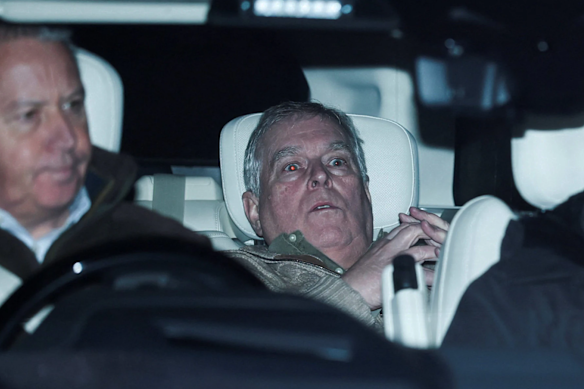
The former duke would then have been placed in the back of a police car and driven away for a formal interview.
Once at the police station, he would be checked in at the custody suite by a sergeant, who would confirm the grounds for arrest were lawful before authorising his detention.
Like any other person in custody, he would then have been searched for anything that could be used to harm himself or anyone else, and required to hand over his phone, any jewellery, watch, belt, or tie.
He would also probably have been subjected to a risk assessment to establish whether there were any medical conditions or drink or drug use to ensure he was afforded appropriate care in custody.
At this point, officers would have explained his rights, including the right to free and independent legal advice, the right to notify someone of his arrest and the codes of practice under which he was being detained.
Detainees are then usually fingerprinted before being led to a cell pending an interview.
A typical cell will be “austere”, according to former police officers, with a toilet possibly screened off inside, and a mattress raised 6 – 12 inches (30 centimetres) off the floor.
At this point, he may have been offered a cup of tea or food if required.
Mountbatten-Windsor would have been allowed some time to talk to his lawyer before the police interview.
The interviews by the investigating officers may be staggered depending on what he says and any other tandem operations that the police team has carried out.
It is thought unlikely that Mountbatten-Windsor would have been handcuffed at any stage, as there would be no history of violence or concerns that he could seek to escape.
The Telegraph, London
From our partners
Disclaimer : This story is auto aggregated by a computer programme and has not been created or edited by DOWNTHENEWS. Publisher: www.smh.com.au