
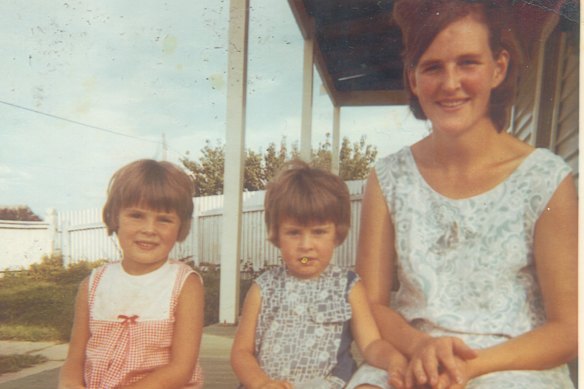

They were more like sisters than mother and daughter, because there was only a 17-year age difference.
Tracey Moss adored her mum, Lorraine. “To me she was very beautiful, with straight, shoulder-length, mousy brown-coloured hair, much like mine,” she recalls.
She also loved her dad, John, who with his swept-back rocker-style black hair resembled an Australian larrikin version of Elvis. Tracey remembers family camping trips, teasing John about his concealed bald patch, and growing up in what she believed was a loving family.
Until it wasn’t.
Long before Erin Patterson used poisoned mushrooms to kill three family members and nearly a fourth with deadly homemade beef Wellingtons, Lorraine was lacing her husband’s food with arsenic.
In the Patterson case, it would take just days for her three victims to die. In the Moss case, it would take more than five agonising years in what a homicide detective would later describe as “cold-blooded torture”. When he died, John Moss was found to have 80 times the normal level of arsenic in his system.
As his health collapsed, he developed a tolerance to arsenic, until he ingested four massive doses in the eight weeks before he died.
Now, 42 years later, Tracey is ready to tell her story. How she became estranged from her mother, how she had to live with rumours that she was responsible for the death, the years not knowing what had happened to her father, and the battle to win back custody of his grave from the woman who killed him.
It wasn’t a shotgun wedding, but close to it. Lorraine was 17 and already pregnant; Johnny was 21 and working at a local meat-processing plant.
They had met only months earlier in 1965 at the Golden Square Fire Brigade country dance.
They had two girls and a boy in four years and bought a weatherboard home in Upper Road, California Gully, Bendigo. He worked at Mayfair Hams & Bacon in the gut line, where his job was to open up slaughtered pigs.
He was tough, having survived a near-fatal road collision, and was rarely sick.
In November 1978, he became ill, and began to suffer from unexplained night sweats, stomach cramps and diarrhoea. After he died in January 1984, homicide detectives asked Lorraine if there had been arsenic in the house.
The widow responded: “There’s never been any of that around here.” But her 17-year-old daughter, Tracey, remembered differently: “Yes we did, remember – we bought it for Dad once, years ago.”
Police later found a tin of Lanes brand arsenate bought from a local nursery in 1978 – around the time Johnny Moss first reported feeling ill.
After tests ruled out gastroenteritis, doctors looked to his workplace, suspecting leptospirosis – a disease found in vets, slaughter men and those who deal with domestic animals. Johnny Moss was an obvious candidate, and it was suggested he had been infected from the slaughtered pigs.
He recovered, but entered a cycle of ill health, suffering bouts of fatigue, dizziness and numbness in his fingers and toes. In September 1982, he went to his doctor after a vomiting attack. Tests were inconclusive and within weeks Moss recovered – temporarily.
The pattern continued for two years. He would appear to improve, then each relapse left him weaker than before.
Tracey writes in the diary she is publishing: “By mid-April/May [1983], my dad started becoming more noticeably ill with bouts of ‘flu-like’ and ‘gastro-like’ symptoms. A mystery illness, initially thought to be an animal disease from his workplace handling pigs and cattle, but was evading detection from diagnosis and the theories of doctors.”
Her father was moved to Melbourne for specialist care. “My mum would stay at the hospital accommodation, about 100 metres from the Austin Hospital,” Tracey writes.
“Mum was there to help him with almost every task. Showering, going to the toilet, and helping to lift him every time he needed to transfer from where he was lying or seated. He had become very picky with food as he often had mouth ulcers, stomach pains and nausea.
“Mum set up a mattress in our lounge room, so Dad could lie and watch the television and be with us all as a family. He was no longer comfortable sitting in our lounge chairs.
“He went from a walking frame to a wheelchair and back to a walking frame, each time needing to relearn how to move his legs and walk again. He was so determined and motivated to beat this horrible, unexplained illness he was suffering so dreadfully from.”
Playing the dutiful wife, Lorraine would take him in a wheelchair to the local pub to see his mates.
In August 1983, doctors took nail and hair samples to test for lead arsenic poisoning. In an act described by a Supreme Court judge nine years later as “gross carelessness”, the results were mislaid and didn’t get to the doctors at the Austin Hospital until January 12, 1984. It was too late – Johnny Moss died the next day. He was 40.
If the tests had been checked earlier, it is likely he would have survived, as the fatal doses were delivered months later.
“Dad was released from the hospital just before Christmas 1983, and we spent the next few weeks together as a family,” Tracey writes. “Dad’s condition had stabilised, but there were still some worrying factors about his condition. He had lost weight but looked bloated from medications.
“Although I didn’t know it, I said goodbye to my dad for the final time on the morning of Wednesday, January 11, 1984. I shared a kiss with both my parents and told them I would see them soon.”
She stayed with her grandparents that night and on January 13, John died. The case was referred to the homicide squad.
“Detective Jack [Jacobs] from the homicide squad in Melbourne introduced himself and his colleague, then sat beside me on the couch and said: ‘Your dad had high levels of arsenic in his system, and we are here to find out how it got there.’
“I will never forget those words. My first reaction was total disbelief and thinking that was a crazy statement to make,” Tracey recalls.
From the beginning, police suspected the killer was a family member, and Tracey would later find out some relatives considered her a suspect, nominating her as “just as nutty as Lorraine”.
For the homicide squad, it soon became clear that Lorraine was the killer. They concluded she hated her husband and was having an affair. They also established that his condition improved when he was in hospital and deteriorated in his wife’s care.
Tracey remembers how her mother had changed after John’s death, dyeing her hair blonde and wearing heavy make-up. “She lost a lot of weight and began wearing revealing clothing, such as short skirts and singlet tops. And Dad’s friend, Bobby, soon became ‘Mum’s friend’.”
Soon, he moved in and Tracey moved out. The mother and daughter who had been so close were estranged.
When they tried to re-engage years later, Tracey suspected her mother was trying to reinvent history. “Mum started asking about the past,” she writes. “About the police statements. About the decisions I had made as a terrified young girl caught in the middle of something far bigger than herself.
“These weren’t questions rooted in curiosity or healing, though – they were interrogations.”
In July 1986, Lorraine was charged with murder, but the case was dropped before trial. An inquest returned an open finding, leaving Tracey with no answers.
With no victim support group, Jacobs kept in touch with Tracey, an act of kindness she hasn’t forgotten. “Detective Jack contacted me occasionally. His calls were always kind, gentle and unexpected. There was something comforting in hearing from someone who understood the case.”
Lorraine carried her secret, but it was eating her soul. Believing there was a 15-year statute of limitations, she waited 16 years to let the demon out.
In April 2000, Lorraine told daughter Colleen: “I think I killed your dad, Col.”
When Tracey heard of her mother’s confession, she rang the man she knew had not forgotten the case: Jack Jacobs.
The retired detective contacted the homicide squad, and on January 17, 2001 – 17 years to the day after her house was first searched for poisons, and 15 years after she was first charged with murder – Lorraine was arrested again.
After her family confession, she overdosed on pills, confessing again to nurses. This time when police approached, she was broken. “Just lock me up,” she said.
Convicted, she was sentenced to a minimum of 18 years’ jail.
“She is a convicted killer,” Tracey writes. “She took my dad’s life. She caused lifelong trauma to her own children. She shattered our sense of safety, direction and belonging. She altered the entire course of our lives more than once.”
Finally, Tracey had some answers, but her battle was not over. She was to discover her father’s killer had custody of his grave.
It was not a one-off case. Several high-profile murder cases in which the killers had custody of the graves led to the government changing the law for cases from 2005 – too late for Tracey.
She battled bureaucracy and was forced to write a sugary-sweet letter to her mother asking her to relinquish control of the grave. She agreed.
John Silvester lifts the lid on Australia’s criminal underworld. Subscribers can sign up to receive his Naked City newsletter every Thursday.
From our partners
Disclaimer : This story is auto aggregated by a computer programme and has not been created or edited by DOWNTHENEWS. Publisher: www.smh.com.au


